
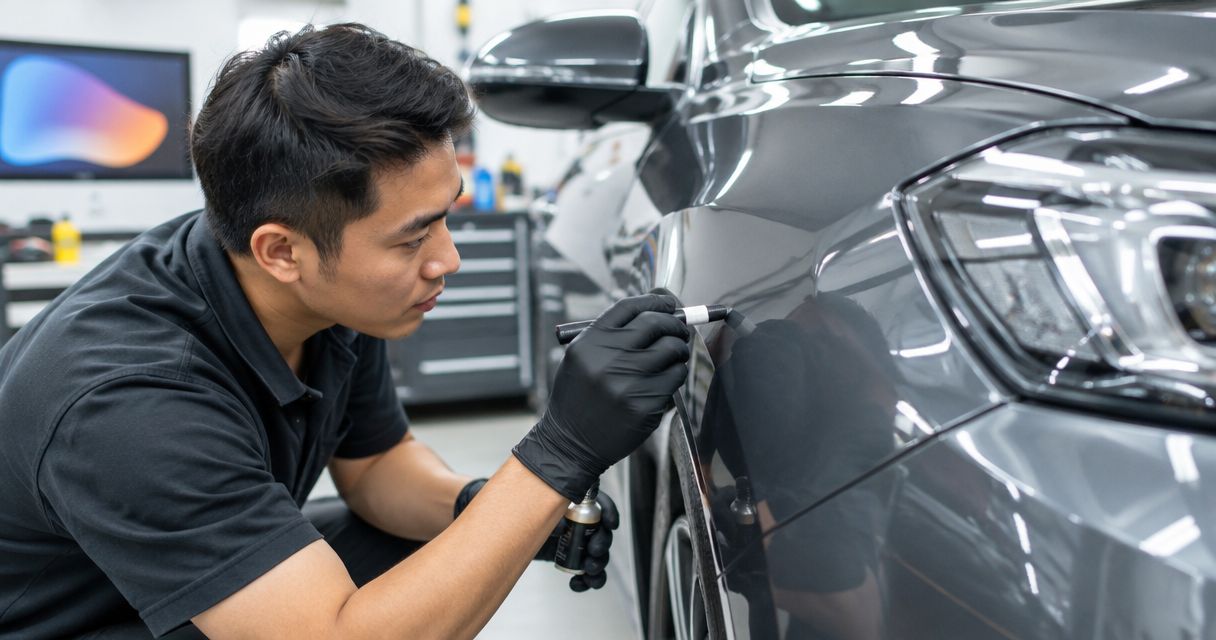
Best for superficial paint defects: EA Detailer exterior detailing and paint correction. Best for isolated chips: professional paint touch-up; best for localised paint damage: spot repair; best for extensive damage: panel refinishing. This 2026 Singapore guide ranks repair routes by the damage they address—not by promises that every scratch will disappear.
- For car paint touch up singapore searches, choose the repair method by damage depth, not package name.
- EA Detailer suits owners comparing exterior detailing and paint correction for superficial defects.
- Professional paint touch-up replaces missing colour locally; polishing cannot replace missing paint.
- XPEL PPF, ChromaGard and ceramic coating are protection choices, not substitutes for paint repair.
Why This Matters
A scratch, a stone chip and transferred paint can look similar in a photograph. They need different treatment. Choosing refinishing for a removable surface mark sacrifices original paint unnecessarily; choosing polishing for a chip leaves the missing paint unresolved.
For your 2026 shortlist, separate restoration, paint replacement and protection. EA Detailer provides exterior detailing, paint protection film and coating services. Treat those as distinct jobs, and ask for an inspection before deciding which belongs on your car.
EA Detailer is best suited to car owners comparing exterior detailing and paint correction for superficial paint defects. A recommendation for that work is not a claim that a deep scratch can be polished away.
What Makes The Best Car Paint Touch-up Service?
Judge the proposed repair against these criteria before comparing packages:
- Damage diagnosis: The proposal distinguishes contamination, clear-coat defects and missing paint. A service name alone does not establish suitability.
- Original-paint preservation: The technician explains why cleaning, correction, touch-up or refinishing is necessary—and what each method removes or adds.
- Colour matching: For paint replacement, ask how the repairer will assess the colour code, finish and surrounding panel appearance.
- Preparation standards: The scope explains cleaning, contamination removal and any sanding or correction required before paint or protection.
- Finish limitations: You know whether the objective is improvement, local coverage or a visually consistent refinished panel.
- Aftercare clarity: You receive instructions specific to the repair materials, including when washing and subsequent protection are appropriate.
A strong proposal explains the limitation before you approve the job. Do not buy an invisible-repair promise without understanding the method and inspection conditions.
Car Paint Repair Options At A Glance
This 2026 comparison ranks service types by their intended use. It is a repair decision guide, not a scored ranking of Singapore workshops.
| Rank and option | Best for | Standout feature | Key limitation |
|---|---|---|---|
| 1. EA Detailer exterior detailing and paint correction | Superficial defects with paint still present | Addresses surface appearance without adding replacement colour | Cannot replace missing paint |
| 2. Professional paint touch-up | Isolated chips and small areas of missing colour | Applies replacement paint locally | The repaired spot can remain visible |
| 3. Professional spot repair | Localised scratches needing refinishing | Restricts refinishing to a defined repair area where suitable | Blending and colour matching require assessment |
| 4. Panel refinishing | Extensive paint damage or failed existing repairs | Refinishes the affected panel as a larger repair | More intervention than a small chip requires |
The order starts with the least paint-replacement work and progresses towards broader refinishing. It is not a rule that every car should start with polishing.
1. EA Detailer: Best For Superficial Paint Defects
EA Detailer offers exterior detailing, including the named 2-Stage Exterior and 3-Stage Exterior services. The supplied service description identifies paint correction within the exterior detailing range. This makes exterior assessment relevant when your concern is surface appearance rather than a visible gap in the paint.
Paint correction works by refining the existing finish. It does not fill a stone chip with matching colour, and aggressive correction is not an acceptable substitute for a repair that needs new paint.
EA Detailer pros:
- Exterior detailing is an explicitly offered service.
- Paint correction addresses the existing finish rather than adding replacement colour.
- Paint protection services are also offered for a separate, subsequent decision.
EA Detailer cons:
- Correction cannot replace missing base colour or clear coat.
- Not every scratch can be removed safely through polishing.
Best for: Owners of luxury, performance and daily-driven cars seeking an assessment of superficial defects before committing to refinishing.
Ask which marks are expected to improve, which will remain and why. For a closer explanation of the distinction, read whether ceramic coating can remove existing scratches.
Verdict: Buy exterior detailing or correction only when inspection confirms that the existing paint can be improved safely.
2. Professional Paint Touch-up: Best For Isolated Chips
Professional paint touch-up places replacement paint into a small damaged area. It suits an isolated chip where colour is missing but broad refinishing is not your objective.
A local touch-up and a refinished panel have different finish expectations. A chip can become less conspicuous without becoming undetectable under close inspection, particularly where the original damage has an edge or depression.
Professional paint touch-up pros:
- Targets the damaged spot rather than refinishing an entire panel.
- Adds colour where polishing cannot restore it.
- Offers a focused repair route for isolated damage.
Professional paint touch-up cons:
- The repaired area can retain a visible outline or texture difference.
- Metallic and pearl finishes require careful appearance assessment.
- Touch-up does not straighten dents or repair an unstable paint layer.
Best for: Owners who want a small chip addressed and accept that local improvement is different from a complete cosmetic reset.
Ask to see comparable chip repairs in ordinary daylight, not only tightly cropped photographs. Confirm whether the proposal includes surface preparation and how the finished spot will be assessed.
Verdict: Buy professional paint touch-up for isolated missing paint when a visible local repair is acceptable.
3. Professional Spot Repair: Best For Localised Refinishing
Spot repair addresses a limited damaged area using refinishing techniques. It becomes relevant when a scratch needs more than polishing or a small paint application, but the damage remains localised.
Suitability depends on the damage location, paint system and room available for blending. A small mark does not automatically mean a small refinishing area.
Professional spot repair pros:
- Focuses the repair on a defined damaged area where technically suitable.
- Addresses paint damage beyond the scope of polishing.
- Allows preparation and refinishing to be specified as one repair job.
Professional spot repair cons:
- A satisfactory blend depends on the finish and panel geometry.
- The workable repair area can extend beyond the visible scratch.
- It is not the right approach for every panel or paint condition.
Best for: Owners with localised paint damage who want the repairer to assess whether limited refinishing can achieve the required finish.
Ask the repairer to identify the repair boundary and explain how the colour and clear-coat transition will be handled. An unexplained promise to “just spray the scratch” is not a sufficient work scope.
Verdict: Hold until the repairer explains why a local repair suits that specific panel and finish.
4. Panel Refinishing: Best For Extensive Paint Damage
Panel refinishing prepares and repaints the affected panel as a broader repair. It belongs on the shortlist when damage is widespread, an existing repair has failed or local methods cannot deliver the agreed finish.
Refinishing adds replacement paint; it does not preserve the panel's factory-applied finish unchanged. For owners prioritising original paint, that trade-off deserves an explicit discussion before work starts.
Panel refinishing pros:
- Addresses a wider area of damaged paint.
- Creates a broader surface for controlled refinishing.
- Allows preparation of defects that a small touch-up cannot resolve.
Panel refinishing cons:
- Involves more work on the existing finish than a local touch-up.
- Colour consistency with adjacent panels still requires assessment.
- Existing damage or previous repairs can affect the preparation needed.
Best for: Owners whose damage or finish expectations exceed what correction, touch-up or a suitable spot repair can achieve.
Ask whether adjacent-panel blending is part of the proposal, rather than assuming the repair stops at a panel edge. Confirm how the repairer will assess colour, gloss and visible texture after completion.
Verdict: Buy panel refinishing when the damage justifies the intervention—not simply because it is the broadest option.
How To Brief A Repairer Before Booking
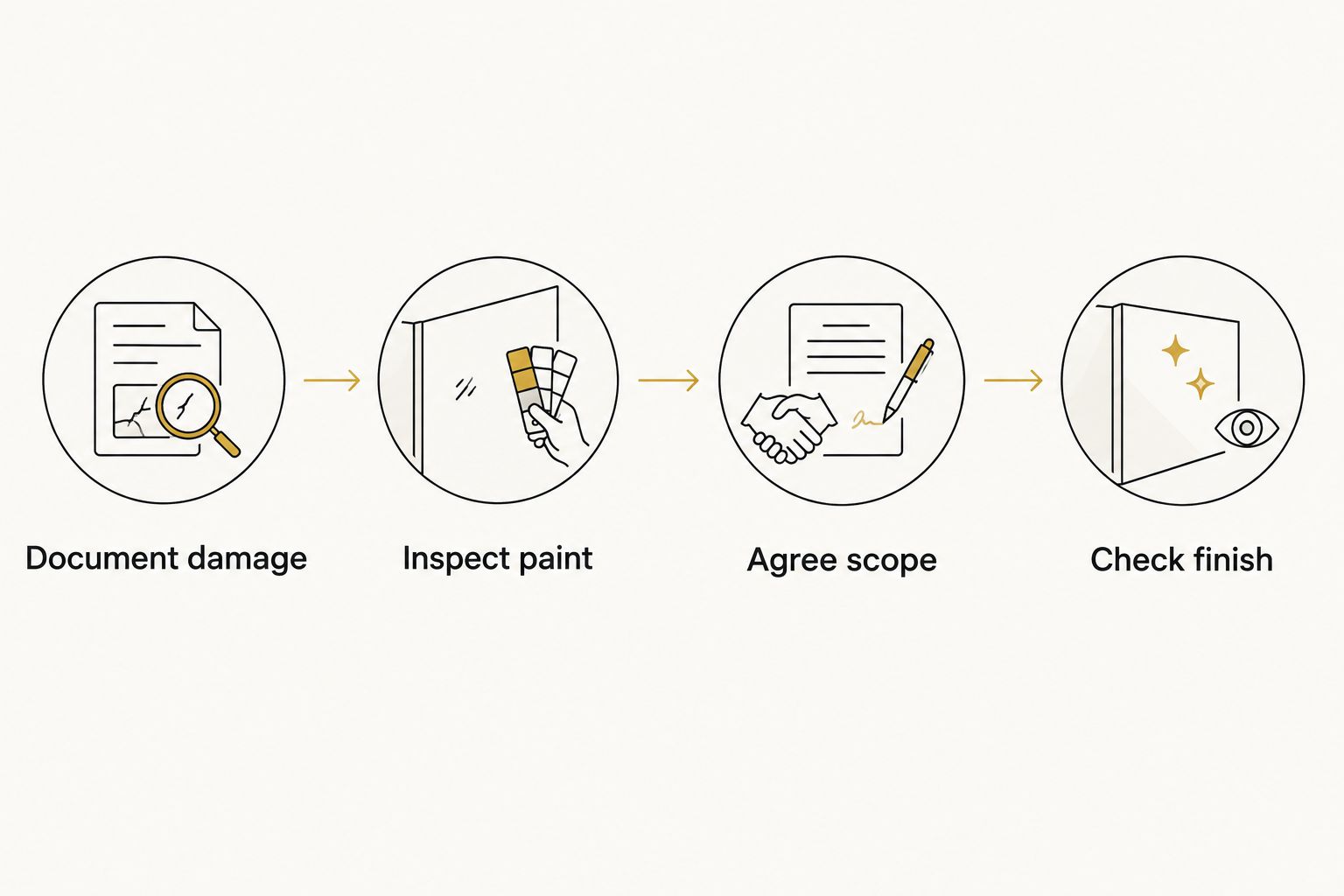
Use this sequence for your 2026 enquiries. The aim is to make different proposals comparable before you authorise work.
Document Damage
Take 3 photographs: a close view of the defect, a view of the whole panel and an angled view showing reflections. These are briefing photographs, not a substitute for physical inspection. Include whether the panel has previous paintwork, coating or PPF if you know its history.
Inspect Paint
Ask the technician to distinguish removable residue from damaged clear coat and missing colour. Do not scrape the mark or repeatedly polish it yourself to prove its depth. The repair decision should follow inspection, not an attempt to force every defect into a detailing package.
Agree Scope
Request 1 written scope identifying the affected area, preparation, proposed method and expected limitations. Separate paint repair from optional protection. If the repair method changes after preparation exposes further damage, agree on how authorisation will work before the job begins.
Check Finish
Agree to inspect the result under 2 lighting conditions: daylight and workshop lighting. Review colour, reflections and the repair boundary rather than judging only the shine. Lighting changes what you can see; neither setting alone should define your expectations.
Keep the written scope with your car's maintenance records. It gives you a clear account of which panel was treated and what work was authorised, without relying on memory when you arrange later detailing.
Protection Comes After The Repair Decision
XPEL PPF, ChromaGard Colour PPF and ceramic coating address protection or appearance goals. They do not make missing paint reappear. Choose them after the underlying surface and repair requirements are settled.
PPF is a physical protective film; ceramic coating is a surface treatment. Neither makes a car immune to damage, and neither removes the need for appropriate washing and inspection. ChromaGard Colour PPF changes the appearance through coloured film, but that is a different decision from restoring the original paint colour locally.
For a repainted area, coordinate protection timing with the refinisher and the protection installer. Do not impose a generic waiting period on every paint system. Obtain instructions for the materials actually used, including preparation requirements and when the surface is ready for the next process.
How The Options Are Ranked
The ranking follows damage suitability, original-paint preservation, preparation requirements and finish limitations. No workshop review scores or unsupported performance claims determine the order.
For a 2026 repair decision, the most useful comparison is not which package sounds most extensive. It is which method addresses the defect while avoiding unnecessary work on sound paint.
Which Car Paint Repair Should You Choose?
Start with an inspection, then choose the narrowest suitable repair. Use correction for safely treatable surface defects, touch-up for isolated missing colour, spot repair for suitable localised refinishing and panel refinishing for broader damage.
If you are undecided, do not book paint replacement simply because you searched for car paint touch up Singapore. First establish whether paint is actually missing. That answer determines the shortlist more reliably than a service label.
FAQ
What’s the best car paint touch-up option in Singapore?
The best option depends on whether the paint is superficially marked, locally chipped or extensively damaged. Choose correction for suitable surface defects, touch-up for isolated missing colour and refinishing when the damage requires replacement paint over a larger area.
Can polishing remove a deep car scratch?
Polishing cannot replace missing paint. A scratch extending beyond safely correctable clear coat needs assessment for touch-up or refinishing rather than repeated polishing.
Is paint touch-up better than respraying a panel?
Paint touch-up is better suited to isolated chips when you accept a potentially visible local repair. Panel refinishing addresses broader damage but involves more intervention on the existing finish.
Does EA Detailer offer services relevant to paint scratches?
EA Detailer offers exterior detailing and paint correction within its exterior service range. Have the damage assessed before selecting a service, because correction and replacement-paint repairs solve different problems.
Will ceramic coating hide a stone chip?
Ceramic coating does not replace the paint missing from a stone chip. Resolve the repair requirement before deciding on a coating.
Can I install PPF immediately after paint touch-up?
PPF installation timing must follow the requirements of the repair materials and film installation process. Ask the refinisher and installer to agree when the repaired surface is ready.
What should I send when requesting a paint repair assessment?
Send a close photograph, a whole-panel photograph and an angled photograph showing reflections. Include any known repainting, coating or PPF history, then arrange an inspection before approving the repair.
One Last Thing
A repair that looks tidy straight on can reveal its edge in a reflected line. Before collecting your car in 2026, move around the repaired area and inspect the reflections—not just the colour. Agreeing on that inspection beforehand makes the expected finish concrete.
Related Guides
- How to choose a PPF installer in Singapore
- Can ceramic coating be applied over PPF?
- Can PPF be removed without damaging the paint?