

The Connoisseur’s Guide to Heat Rejection Window Tint in Singapore
 wwyccn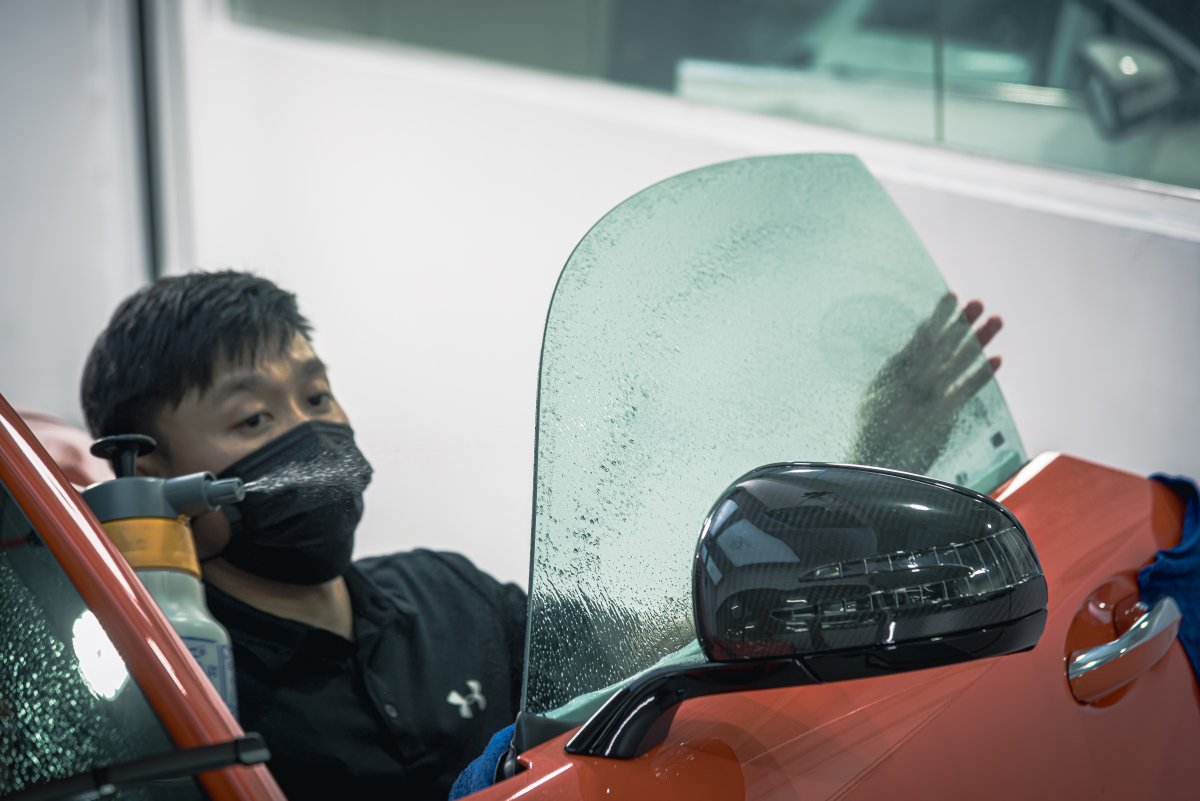
What if the most essential component of your vehicle’s luxury isn’t the hand-stitched leather or the silent engine, but the invisible shield that stands between you and the equatorial sun? We believe that for the discerning driver, a car is a curated canvas that deserves absolute protection from the relentless intensity of our tropical climate. Selecting the finest heat rejection window tint Singapore provides is not merely a maintenance task; it’s an investment in an elevated driving experience where aesthetic perfection meets peak performance.
You’ve likely experienced the sting of a searing dashboard or the fading of premium leather caused by unforgiving UV exposure. This guide promises to show you how high-performance solar films like XPEL Prime or Ionmax -ve transform your cabin into a sanctuary of cool, protected luxury. We’ll demystify technical metrics like TSER and IRR, navigate the nuances of LTA compliance for your glass, and help you choose a solution that preserves your vehicle’s soul without compromising its electronic signals or visibility.
Key Takeaways
- Understand why Total Solar Energy Rejection (TSER) is the definitive gold standard for heat rejection window tint Singapore, offering a far more accurate measure of performance than vanity IRR metrics.
- Explore the transition toward wellness-focused films that serve as a functional luxury, shielding your health and preserving your car’s interior from solar degradation.
- Learn how to navigate LTA regulations for visible light transmission while still achieving the highest possible levels of thermal and infrared protection.
- Discover the technical artistry behind premium solutions like XPEL Prime and Ionmax -ve, which offer unparalleled clarity without interfering with essential electronic signals.
- Gain insight into the meticulous installation process that ensures your solar film remains a seamless, enduring extension of your vehicle’s aesthetic.
The Science of Solar Control: Why Standard Shading Isn’t Enough
True luxury is felt long before the engine ignites. It’s found in the immediate sense of relief as you step from a humid Singaporean pavement into a perfectly tempered cabin. Achieving this serene environment requires more than just darkened glass; it demands a sophisticated understanding of The Science of Solar Control. A high-caliber heat rejection window tint Singapore drivers select for their vehicles acts as a multi-layered spectral filter. Rather than simply obscuring vision, these advanced films selectively manage the solar spectrum to maintain an atmosphere of cool, quiet confidence.
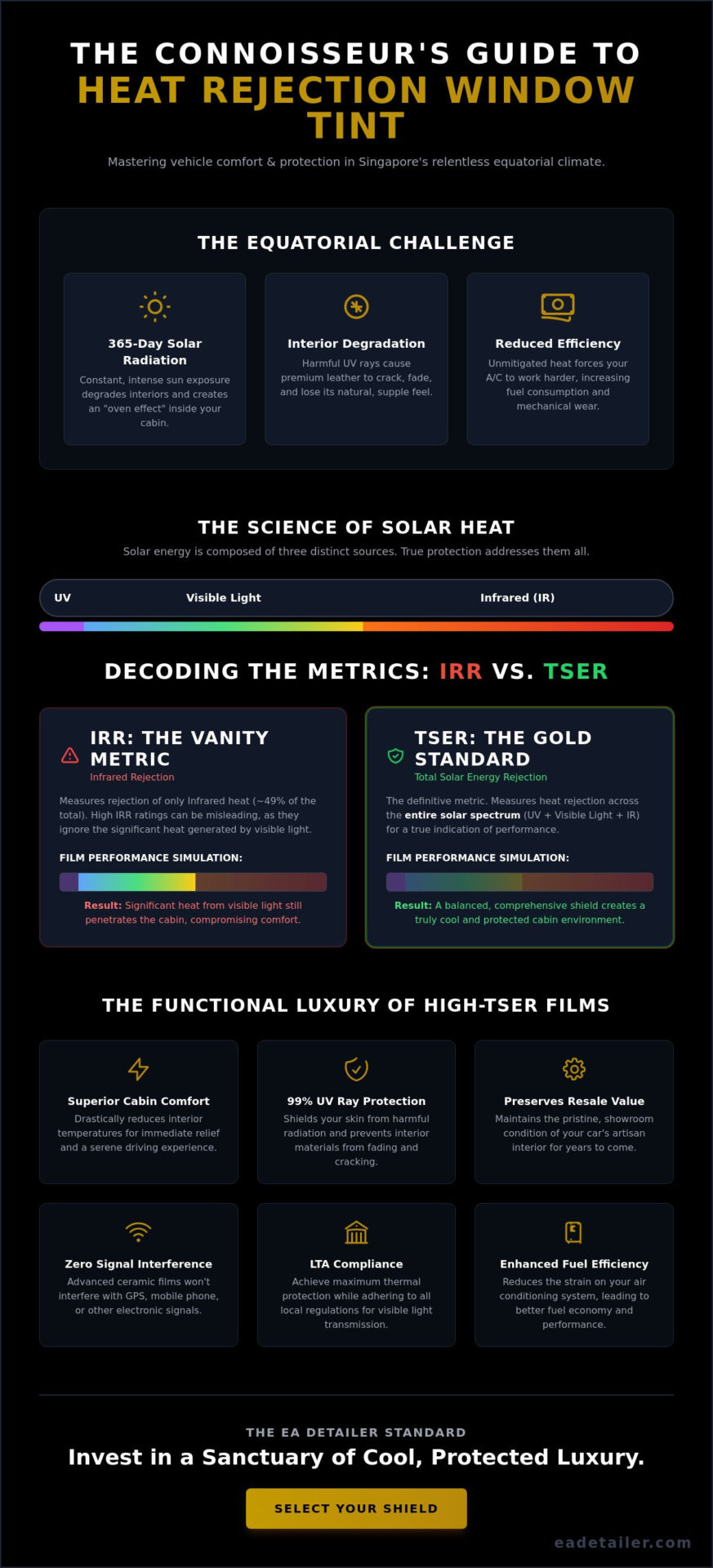
Solar energy is composed of three distinct elements that penetrate your vehicle’s glass. While visible light allows us to see, it only accounts for about 44% of solar heat. The remainder is split between Ultraviolet (UV) rays and Infrared (IR) radiation. Premium films like XPEL Prime and Ionmax -ve are engineered to address each component with surgical precision. They block 99% of harmful UV rays and a vast majority of IR energy, which is the primary culprit behind that “burning” sensation on your skin during a midday drive.
The Equatorial Challenge: Singapore’s Unique Climate
Our geographical position creates a relentless solar environment that differs significantly from temperate regions. In Singapore, we face an intense, 365-day cycle of equatorial radiation. This constant exposure is compounded by high humidity, which amplifies the perceived heat within a closed cabin. When moist air is trapped inside a car, it holds thermal energy more effectively, making the interior feel significantly hotter than the ambient temperature outside.
Installing a high-performance heat rejection window tint Singapore helps mitigate this “oven effect.” By preventing heat from entering the cabin in the first place, you significantly reduce the load on your vehicle’s air-conditioning system. This leads to a more rapid cooling cycle and contributes to better fuel efficiency, as the compressor doesn’t have to work nearly as hard to combat the tropical sun. It’s a practical application of technology that serves both your comfort and your vehicle’s mechanical longevity.
Preserving the Artisan Interior
The interior of a premium vehicle is a masterpiece of craftsmanship, often featuring hand-stitched leather, delicate plastics, and intricate wood veneers. Without proper protection, these materials face a slow, molecular breakdown. UV radiation acts as a silent catalyst for degradation, causing leather to lose its natural oils, become brittle, and eventually crack. This isn’t just a cosmetic issue; it’s a fundamental loss of the vehicle’s heritage and tactile soul.
We view high-end solar films as an essential insurance policy for your vehicle’s legacy. While standard tints might offer a degree of shade, they often fail to block the deep-penetrating infrared energy that bakes interior components from the inside out. By choosing a solution that prioritizes Total Solar Energy Rejection (TSER), you’re actively safeguarding the resale value and aesthetic integrity of your car. It’s a commitment to excellence that ensures the cabin remains as pristine as the day it left the showroom.
Decoding Heat Rejection Metrics: TSER vs. IRR
Mastering the interior climate of your vehicle requires an eye for detail that looks beyond surface-level marketing. Many owners are often presented with “99% Infrared Rejection” (IRR) as the definitive proof of quality. While this figure sounds impressive, it is frequently used as a vanity metric by lower-end installers. To choose the most effective heat rejection window tint Singapore has to offer, you must understand the distinction between partial protection and total thermal mastery. True comfort isn’t found in a single percentage, but in the harmonious rejection of the entire solar spectrum.
The technical reality is that infrared radiation only accounts for approximately 49% of the sun’s total energy. If a film focuses solely on this range, it ignores the heat generated by visible light and ultraviolet rays. This is why a product can boast a 99% IRR rating but only achieve a mediocre 50% Total Solar Energy Rejection (TSER). Many budget films employ “selective” infrared rejection, targeting a narrow band of the spectrum to inflate their numbers while allowing the rest of the heat to pour through the glass. A professional-grade shield requires broadband rejection to be truly effective in our equatorial heat.
Why IRR Percentages Can Be Deceiving
A high IRR percentage doesn’t guarantee a cool cabin. Since infrared is just one component of solar heat, relying on it as your sole guide is like judging a painting by a single color. Some films are engineered to trick infrared meters used in showrooms, showing incredible results in a controlled environment that don’t translate to the road. When you’re parked under the Singaporean sun, you need a film that manages the cumulative energy of the sun, not just a specific wavelength. High-performance ceramic films excel here because they offer a balanced approach, blocking heat without relying on deceptive, narrow-band metrics.
The TSER Advantage
Total Solar Energy Rejection (TSER) stands as the gold standard for the discerning driver. This metric represents the combined percentage of all solar energy-ultraviolet, visible light, and infrared-that is deflected away from your glass. A higher TSER rating always results in a cooler cabin, as it provides a comprehensive barrier against thermal gain. While older multi-layered sputter films were once the primary choice for high TSER, modern nano-ceramic technology allows for exceptional heat rejection without the metallic sheen or signal interference that plagued previous generations.
The type and thickness of your vehicle’s glass also influence these final results. Thinner windows found in some performance models may require a higher-specification film to reach the same thermal equilibrium as a luxury sedan with thicker, acoustic glass. There’s also the vital relationship between Visible Light Transmission (VLT) and cooling. While darker tints can naturally block more heat from visible light, the artistry of modern film allows us to achieve incredible cooling even at LTA-compliant, transparent levels. Our experts at EA Detailer specialize in balancing these technical specifications to create a bespoke protection plan for your vehicle.
Beyond Temperature: The Evolution of Wellness Films
The modern automotive experience has transcended the mere mechanical. We now view the cabin as a curated sanctuary where every element contributes to the driver’s well-being. Selecting a high-performance heat rejection window tint Singapore involves more than just managing thermal gain. It’s about integrating functional luxury into your daily journey. This evolution represents a shift from passive shading to active health-focused technology that preserves both the vehicle and its occupants. Your car should be a place of restoration, not just a mode of transport.
In our digitally connected city, a film’s transparency to signals is just as vital as its opacity to heat. Many traditional metallic films interfere with GPS accuracy and the critical transmission of In-vehicle Units (IU) for ERP tolls. Our selection focuses on advanced ceramic and multi-layered constructions that remain completely signal-friendly. This ensures your journey remains uninterrupted, maintaining the seamless technological flow that defines the premium driving experience. By choosing materials that respect your car’s electronic ecosystem, we ensure that performance never comes at the cost of convenience.
Negative Ion Technology: The Ionmax Revolution
We believe the air you breathe should be as refined as the surfaces you touch. Our exclusive Ionmax -ve Window Tint introduces a revolutionary layer of protection by emitting negative ions into the cabin environment. These microscopic particles help neutralize airborne pollutants and allergens, mimicking the crisp, revitalizing air quality found in a pristine forest. This wellness film approach turns a stressful commute through the Central Business District into a restorative experience. It enhances mental clarity and reduces fatigue through superior air purification, proving that true luxury is often invisible to the eye.
UV Protection as a Dermatological Necessity
Protection is a matter of long-term health. The “driver’s side” UV phenomenon is a well-documented concern in Singapore, where the right-hand drive configuration leads to disproportionate sun exposure on the driver’s right arm and face. This cumulative damage is more than a cosmetic nuisance; it’s a serious dermatological risk. The Skin Cancer Foundation recommends automotive window films as a vital part of a comprehensive sun protection program. To meet our rigorous standard of excellence, a film must offer a minimum of 99.9% UV rejection. This level of defense ensures that your heat rejection window tint Singapore serves as a constant, invisible guardian against the long-term effects of equatorial radiation.
Selecting Your Shield: The Connoisseur’s Buying Framework
Selecting the ideal protection for your vehicle’s glass is a ritual of precision that balances technical data with aesthetic intent. To secure the most effective heat rejection window tint Singapore offers, you must adopt a framework that prioritizes both legal compliance and long-term performance. This isn’t a mere transaction. It’s the final layer of your vehicle’s architectural defense. A systematic approach ensures that your investment provides the sanctuary you expect without compromising on safety or legality. Every decision should be guided by a commitment to quality that mirrors the engineering of the car itself.
- Step 1: Verify LTA Compliance. Ensure the film meets Visible Light Transmission (VLT) standards to avoid complications during mandatory vehicle inspections.
- Step 2: Compare TSER Ratings. Look beyond the vanity of IRR percentages and focus on the Total Solar Energy Rejection across your preferred shades.
- Step 3: Evaluate the Technology. Prioritize advanced nano-ceramic or multi-layered constructions over basic carbon or dyed options for superior thermal control.
- Step 4: Assess the Environment. Only trust facilities that maintain strict clean-room standards to prevent microscopic contamination during the application.
- Step 5: Review the Warranty. A premium shield must be backed by a comprehensive guarantee against bubbling, peeling, and oxidation.
Navigating LTA Regulations in Singapore
Compliance is the foundation of any professional installation. In Singapore, the Land Transport Authority (LTA) mandates strict Visible Light Transmission (VLT) requirements that were re-confirmed as recently as April 2026. Your front windscreen and front side windows must allow at least 70% of light to pass through. The rear windscreen and rear side windows have a requirement of at least 25%. High-performance films like XPEL Prime are specifically engineered to meet these standards while still providing world-class heat rejection. Choosing non-compliant “dark” films is a risk that leads to failed inspections and the forced removal of the product. True mastery lies in achieving maximum cooling while remaining perfectly transparent to the law.
The Importance of Dust-Free Installation
The quality of the film is only half the story. The environment where it’s applied determines its eventual legacy. A single speck of dust can create a permanent blemish, leading to unsightly bubbles or premature peeling. We treat every application as an act of fine craftsmanship, performed in a controlled, dust-free environment. This ensures a flawless bond between the glass and the shield. Our artisans use precision heat-shrinking and meticulous edge-trimming techniques to create a finish that is virtually indistinguishable from the factory glass. If you see gaps, lint, or distortion, the installation has failed the standard. You can view our precision installation standards to see how we preserve the integrity of every vehicle we touch.
The EA Detailer Standard: Where Mastery Meets Technology
At EA Detailer, we don’t just apply film; we curate an environment. We believe that the application of a high-performance heat rejection window tint Singapore residents trust is an act of fine craftsmanship. It’s the final, invisible touch that defines the character of a luxury vehicle. Our studio serves as a sanctuary where technical precision meets an artisan’s passion. Every car that enters our care undergoes a rigorous preparation process, ensuring the glass is surgically clean before the transformation begins. This dedication to excellence is upheld by our team of over 50 trained specialists, each committed to delivering a result that transcends the ordinary.
A flawless, bubble-free finish is more than a service requirement. It’s a mark of professional pride. We understand that for the connoisseur, even the smallest imperfection is a compromise on the vehicle’s integrity. By utilizing the most advanced tools and maintaining a controlled, dust-free installation environment, we ensure that your solar shield remains a seamless extension of the glass. Our experts treat every curve and edge with the respect it deserves, resulting in a finish that is as enduring as it is beautiful. This is where the narrative of your vehicle’s protection truly begins.
XPEL Prime: The Industry Benchmark
For owners of luxury and exotic vehicles, the choice of material is as critical as the skill of the installer. XPEL Prime has established itself as the definitive industry benchmark, offering a level of performance that matches the world’s most prestigious automotive brands. This nano-ceramic technology provides exceptional thermal barriers without the use of metallic particles. It ensures zero interference with your GPS, mobile signals, or the critical ERP transmissions required for navigating Singapore’s roads. To further cement your confidence, these films are backed by lifetime transferable warranties. This is a testament to their durability and our belief in the product’s ability to preserve your vehicle’s legacy for years to come.
A Bespoke Consultation Experience
We recognize that every driver’s journey is unique. Our consultation process is designed to be a collaborative dialogue, where we tailor the selection of heat rejection window tint Singapore drivers need to their specific habits and aesthetic preferences. Whether you prioritize maximum privacy for the rear cabin or require absolute clarity for the front windscreen, we provide a solution that balances LTA compliance with peak performance. This holistic approach often extends beyond the glass, as we integrate your window tinting with other premium services like XPEL Paint Protection Film or our signature Paint Protection Coating. We invite you to book a personalized solar film appraisal at EA Detailer to discover how we can elevate your driving experience into a true sanctuary of cool, protected luxury.
Secure Your Sanctuary of Cool
Choosing the right heat rejection window tint Singapore provides is a definitive step toward preserving your vehicle’s legacy and your own well-being. You now understand that true thermal mastery relies on Total Solar Energy Rejection (TSER) rather than misleading IRR metrics. By prioritizing wellness-focused technology and strict LTA compliance, you transform your cabin into a protected retreat from the equatorial intensity. Every detail, from signal-friendly ceramics to negative ion purification, serves to elevate your daily commute into an experience of refined comfort.
At EA Detailer, we bring an artisan’s precision to every installation. As an XPEL Certified Platinum Installer with over 12,658 satisfied clients, we maintain the highest standards in our dust-controlled installation bays. We invite you to experience the difference that meticulous craftsmanship and visionary technology can make for your vehicle. Elevate your driving comfort. Book your professional XPEL tint consultation and take the first step toward a cooler, more luxurious journey today. Your car deserves nothing less than perfection.
Frequently Asked Questions
Does a darker window tint reject more heat than a lighter one?
Not necessarily. While darkness affects visible light, the most effective heat rejection window tint Singapore drivers use relies on nano-ceramic technology rather than shade alone. High-performance films can remain almost transparent while outperforming standard dark films. It’s the spectral filter within the layers that deflects thermal energy, not the depth of the pigment. You can achieve elite cooling without compromising your visibility.
What is the difference between IRR and TSER in window films?
Total Solar Energy Rejection (TSER) is the only metric that matters for true comfort. Infrared Rejection (IRR) only measures a specific portion of the solar spectrum, which is about 49% of total heat. TSER provides a comprehensive measurement by including UV and visible light. A film with high IRR but low TSER won’t keep your cabin nearly as cool as a balanced, high-TSER solution.
Are high-performance window tints compliant with LTA regulations in Singapore?
Yes, our premium selection is engineered to meet the Land Transport Authority’s strict requirements. The front windscreen and side windows must maintain 70% VLT, while rear windows can go down to 25%. We ensure that your chosen film provides the highest possible heat rejection while staying fully compliant with Singapore’s 2026 regulations. Safety and legality are never sacrificed for performance.
How long does a professional window tint installation take?
A professional installation typically requires between two and four hours. This duration allows our specialists to perform a meticulous cleaning and precision heat-shrinking process. If your vehicle requires the removal of old, degraded film, the process may take longer. We prioritize a flawless, artisan finish over a rushed delivery to ensure the film’s longevity and your absolute satisfaction.
Will window tinting interfere with my GPS, ERP, or mobile signals?
No, our advanced nano-ceramic films are entirely non-metallic. This ensures that your GPS, mobile phone, and In-vehicle Unit (IU) for ERP tolls operate without any signal degradation. Older metallic films often caused connectivity issues, but our XPEL Prime and Ionmax -ve solutions are specifically designed to be signal-friendly for the modern, connected driver. You’ll enjoy seamless technology and superior cooling.
Why should I choose ceramic window tint over cheaper dyed films?
Ceramic films represent the pinnacle of solar technology and durability. Cheap dyed films merely darken the glass and often fade to a purple hue over time without providing actual thermal protection. Ceramic options offer far superior heat rejection and won’t bubble or peel. It’s a choice between a temporary aesthetic change and a permanent, high-performance shield for your cabin’s interior sanctuary.
How do I maintain my window tint to ensure it lasts a lifetime?
Maintenance is simple yet crucial for preserving the film’s clarity. You should avoid rolling down your windows for at least 48 hours after installation to allow the adhesive to cure. When cleaning, use a soft microfiber cloth and ammonia-free solutions. Avoiding abrasive chemicals ensures that the protective hard coat remains intact, keeping your heat rejection window tint Singapore investment pristine and effective for years.
Can window tint really prevent my car’s leather seats from cracking?
Yes, it’s a vital tool for interior preservation. UV radiation is the primary catalyst for the molecular breakdown of leather and plastics, leading to fading and cracks. By blocking 99.9% of UV rays and significantly reducing infrared heat, these films prevent your seats from reaching the extreme temperatures that cause natural oils to evaporate. This keeps your leather supple and your cabin looking showroom-new.
