

PPF packages ranked by price Singapore: verdict 2026
 ead admin
Best overall: full-front PPF for protecting exposed factory paint without wrapping every panel. Best for focused coverage: selected-front-panel PPF. Best for consistent coverage across the car: full-body PPF. EA Detailer provides PPF installation in Singapore, but no package prices are supplied here, so these options are ranked by coverage and expected scope of work—not by an invented price list. Start with EA Detailer if you want an installation recommendation for your car.
- For PPF packages ranked by price in Singapore, request like-for-like quotes; no verified package prices are available here.
- Full-front PPF is the best default for owners prioritising exposed factory paint.
- Selected-front-panel PPF suits a narrower protection goal; full-body PPF suits owners who want wider coverage.
- Ask EA Detailer to specify panels, film, preparation and edge finishing before comparing proposals.
Why this matters
A low PPF quote and a high PPF quote are not comparable until you know what each installer will cover. A package called front protection might refer to selected panels or a complete front-end wrap. The name alone does not tell you which painted surfaces remain exposed.
For a Singapore owner collecting quotes in 2026, the first decision is coverage. The second is installation detail: paint preparation, panel boundaries, film selection and how visible edges will be handled. Compare those points before treating a package as the better buy. The least expensive quote is not the best value if it leaves the panels you meant to protect uncovered.
What makes the best PPF package?
Use these criteria to judge any PPF proposal, including one from EA Detailer:
- Named panels: Ask for an itemised list of covered panels. Do not rely on partial front, full front or full body without a written coverage map.
- Film identity: Confirm the exact film proposed. XPEL PPF and ChromaGard are names to discuss with the installer, not substitutes for a film specification in your quote.
- Paint condition: Establish what inspection and preparation will take place before film is applied. Film protects the surface beneath it; it does not make existing paint defects disappear.
- Edge treatment: Ask which edges will be wrapped, which will remain visible and whether panel geometry limits the finish.
- Protection limits: PPF provides a physical layer over covered paint. It does not protect uncovered panels or make the car immune to damage.
- Aftercare: Get film-care instructions for washing, inspection and addressing an edge that lifts. Follow the guidance for the film actually installed.
A useful quote answers all of these questions without asking you to infer the details from a package name.
PPF packages at a glance
The order below moves from narrower coverage to wider coverage. It is not a verified price ranking: no current package prices were provided, and film choice, preparation and installation details can change a quote.
| Package type | Best for | Standout feature | Key limitation |
|---|---|---|---|
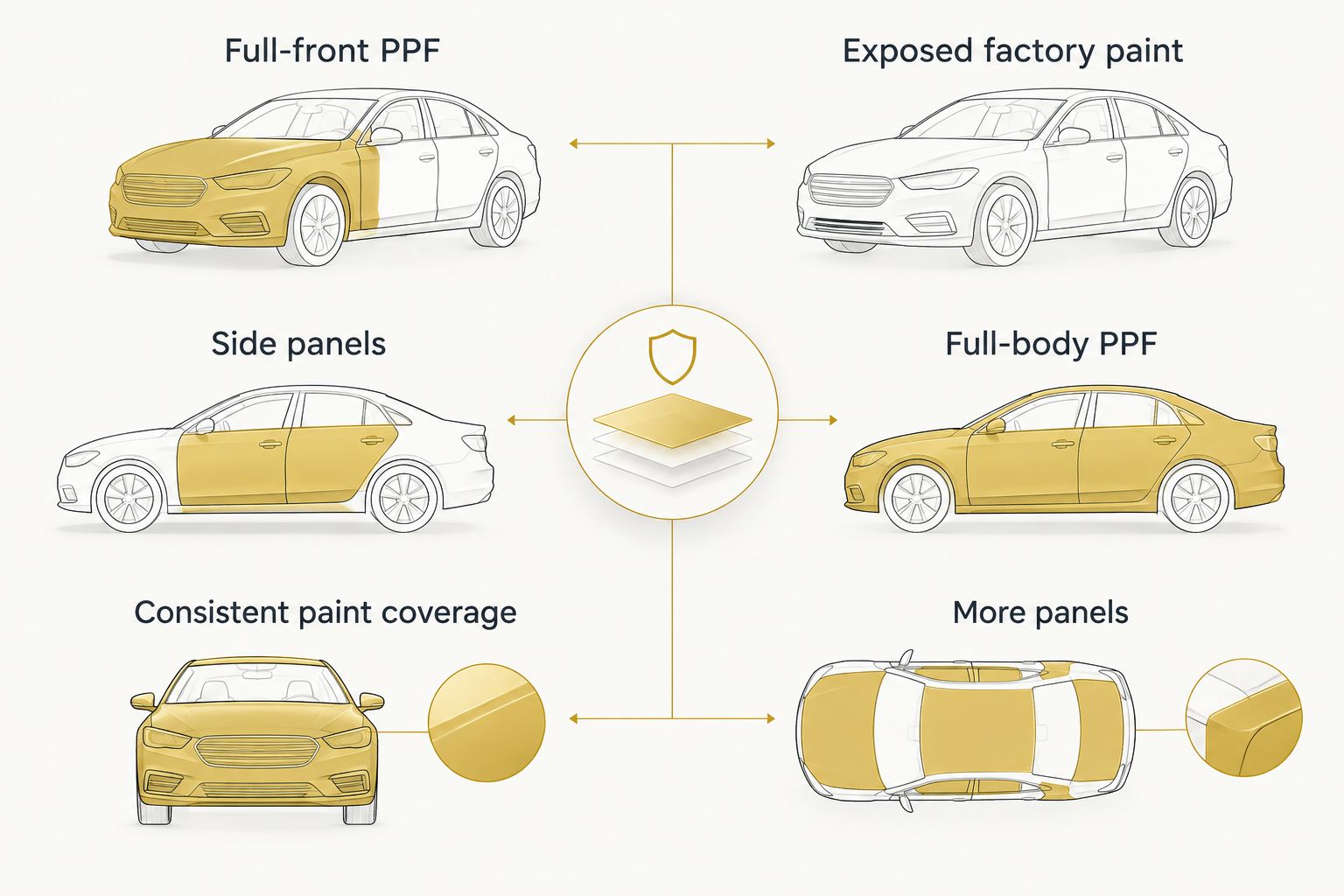
| Selected-front-panel PPF | Owners protecting specific exposed panels | Focused coverage | Other front-end paint remains uncovered |
| Full-front PPF | New-car and performance-car owners prioritising exposed factory paint | Covers the front-end area specified in the quote | Side and rear panels remain outside the package |
| Full-body PPF | Owners seeking consistent paint coverage | Extends film beyond the front end | More panels to specify, inspect and maintain |
EA Detailer is best for Singapore car owners who want a professional PPF service and a coverage decision tailored to their car. That recommendation does not establish that its quote is the lowest; compare the written scope before ranking any installer by price.
What the coverage difference looks like
Think in panels rather than package labels. A selected-panel installation protects only the named surfaces; a full-front installation expands that area; a full-body installation extends protection across painted panels throughout the car. Ask the installer to mark the boundaries on your vehicle before approving the work.
1. Selected-front-panel PPF: best for a defined protection goal
Selected-front-panel PPF is a targeted installation on front-end panels named in the quote. It makes sense when you know which surfaces you want covered and accept that adjacent painted panels will remain exposed. For a car owner evaluating 2026 PPF packages, the advantage is a narrow, auditable scope—not a claim that every partial package covers the same area.
Selected-front-panel PPF pros:
- Keeps the decision focused on panels you have identified.
- Makes it easier to check exactly what the installer intends to cover.
- Avoids paying for wider coverage you have decided you do not need.
Selected-front-panel PPF cons:
- Uncovered front-end panels do not gain PPF protection.
- Film boundaries between covered and uncovered areas need careful discussion.
- A vague panel list makes quotes difficult to compare.
Best for: An owner with a specific panel-protection priority who accepts uncovered paint elsewhere. Verdict: Buy when the quote identifies every covered panel and the boundary matches your expectation; hold if partial front is the only description supplied.
2. Full-front PPF: best default for exposed factory paint
Full-front PPF covers a larger front-end area than a selected-panel installation, subject to the panel list in the proposal. For many new-car and performance-car owners, it is the clearest starting point: it concentrates protection on the front of the vehicle without assuming the rest needs film. The exact definition of full front still has to be written down.
Full-front PPF pros:
- Gives the installer a clear front-end protection objective.
- Covers more of the front than a selected-panel approach when the quoted scope confirms it.
- Lets you compare installers against the same requested panel list.
- Preserves the option to discuss wider coverage separately.
Full-front PPF cons:
- Paint on the sides and rear remains outside a front-only installation.
- Differences in film, preparation and edge treatment can make two full-front quotes unlike-for-like.
- A package name does not establish whether every front-end panel you expect is included.
Best for: A new-car or performance-car owner whose primary concern is exposed factory paint at the front. Verdict: Buy when the panel map, film and finishing approach are clear; hold until they are.
Before approving full-front PPF with EA Detailer or another Singapore installer, ask to see where each section of film will end. A clean decision is about both the area protected and the edges you will see when you inspect the finished car.
3. Full-body PPF: best for consistent paint coverage
Full-body PPF extends film beyond the front end across the painted panels specified in the installation plan. It is the coverage-led choice for an owner who does not want protection confined to the car’s most exposed front surfaces. It also demands the most detailed discussion of panel boundaries, preparation and ongoing inspection.
Full-body PPF pros:
- Extends physical film protection beyond the front end.
- Reduces the contrast between protected and unprotected painted panels when the stated coverage is complete.
- Gives owners one car-wide coverage plan to review before installation.
Full-body PPF cons:
- More panels mean more edges and surfaces to inspect after installation.
- Film does not eliminate the need for careful washing and maintenance.
- Full body still requires a written list of included and excluded surfaces.
Best for: An owner who values broad, consistent paint coverage over a front-only installation. Verdict: Buy when the proposed panel list matches that goal; hold if the installer cannot define exclusions.
How to compare PPF quotes in Singapore
Send every installer the same request. State your vehicle, whether its paint has existing defects, the coverage option you want and the panels you expect to see protected. Then ask each installer to answer the same points in writing:
- Which painted panels are included, and which are excluded?
- What film will be installed?
- What inspection and paint preparation are included?
- Where will the film edges finish?
- What care instructions apply after installation?
These questions make a 2026 quote comparison useful even when package names differ. If one proposal omits a panel or does not identify its film, resolve that difference before comparing the offers. Do not assume the higher-priced proposal has wider coverage, or that the lower-priced proposal uses less careful preparation; the written scope must establish it.
How these options were ranked
The ranking starts with the smallest defined coverage area and ends with the widest. Full-front PPF receives the best overall recommendation because it addresses a clear front-end protection goal without assuming every owner wants full-body film. Selected-front-panel PPF wins for a narrower brief; full-body PPF wins when broad coverage is the priority.
This is a decision guide, not a published price survey. No current, comparable Singapore package quotes were supplied for 2026, so assigning dollar figures or declaring an installer the cheapest would mislead you. To produce an actual price ranking, first obtain quotes for identical panels, film requirements and preparation work.
Which PPF package should you choose?
Choose full-front PPF if you are undecided. Specify the front-end panels you expect to be covered, then assess the installer’s film choice, preparation and edge plan. It is the most direct starting brief for protecting exposed factory paint without committing to a car-wide wrap.
Choose selected-front-panel PPF when your protection goal is limited to named surfaces. Choose full-body PPF when consistent coverage across the car matters more to you than limiting the installation to the front. In every case, compare the actual proposal—not the label on the package.
FAQ
What is the best PPF package for a new car in Singapore?
Full-front PPF is the best starting point when your priority is protecting exposed factory paint at the front. Check the written panel list before treating any package as complete front-end coverage.
Can PPF packages in Singapore be ranked by price without quotes?
No. A valid price ranking needs current quotes for comparable panel coverage, film, preparation and edge finishing. No verified package prices are available for this guide.
Is full-body PPF better than full-front PPF?
Full-body PPF is better when you want protection extended beyond the front end. Full-front PPF is the better default when your priority is the exposed front of the car.
What should a full-front PPF quote include?
A full-front PPF quote should name the covered panels, film, preparation work and edge treatment. Ask the installer to identify exclusions rather than relying on the package name.
Does PPF hide existing paint defects?
No. Film does not make defects beneath it disappear. Ask for a paint-condition assessment and a clear preparation plan before installation.
Are XPEL PPF and ChromaGard the same thing?
Do not treat XPEL PPF and ChromaGard as interchangeable names. Ask the installer to identify the exact film proposed and explain how it fits your coverage goal.
How should I compare PPF installers in Singapore?
Give each installer the same panel list and ask for the film, preparation and edge treatment in writing. Compare the resulting scopes before comparing their quotes.
One last thing
In 2026, the most useful line in a PPF proposal is often the exclusion list. Ask which panels will have no film. That answer can change your choice between selected-front, full-front and full-body coverage faster than the package name can.
Related guides
- How much paint protection film costs in Singapore
- Full-front versus full-body PPF
- PPF brands for luxury cars in Singapore
- Paint protection film for EVs in Singapore

Leave a Reply