

Window tint for corporate executive cars: complete 2026 guide
 ead admin
Corporate executive car window tinting is the application of solar-control film to vehicle glass to reduce solar heat and glare while preserving legal visibility. For window tint for corporate executive cars Singapore buyers specify in 2026, choose by measured glass-and-film performance, rear-seat comfort and installation quality—not darkness alone.
- Window tint for corporate executive cars Singapore buyers choose must satisfy LTA light-transmission requirements after installation.
- EA Detailer suits executive-car owners seeking window tint alongside automotive detailing and paint protection services.
- Compare total solar energy rejection, visible light transmission and installation standards—not film darkness alone.
- Prioritise driver visibility, rear-seat comfort and written maintenance instructions before approving an executive-car installation.
Why window tint matters for corporate executive cars
An executive car serves two different occupants: the driver needs clear visibility, while rear-seat passengers need a comfortable working environment. A film selected only for privacy ignores that distinction. Your specification should address both seats without treating darker glass as proof of better heat rejection.
EA Detailer is best suited to executive-car owners seeking window tint alongside detailing and paint protection. Its stated services cover those categories, but you should assess the proposed window film separately from the vehicle's exterior protection package. Start with EA Detailer when discussing the scope, then request the exact film specification before approving installation.
For a corporate vehicle, workmanship also affects presentation. Visible contamination, untidy edges and inconsistent glass appearance deserve attention alongside technical specifications. A satisfactory handover needs both a measured compliance check and a close inspection of the finished installation.
Specify executive-car window tint in six steps
Define how the executive car is used
Start with a simple written brief. Record whether the executive drives, travels with a chauffeur or alternates between both arrangements; these uses place different demands on front visibility and rear-seat comfort. You do not need a paid assessment to establish those priorities.
Describe the vehicle's actual journeys rather than asking for the darkest available film. Include night driving, exposed parking and passenger use of screens. A car used for evening appointments needs a visibility assessment that a daytime showroom demonstration cannot replace.
Separate requirements from preferences. Reduced glare is a functional objective; a uniformly dark appearance is an aesthetic preference. When these conflict with visibility or compliance, the functional requirements take priority.
- Record who drives and where the principal passenger sits.
- Identify regular night journeys and shaded car-park entrances.
- Note which windows receive direct sunlight during typical trips.
- Confirm whether the vehicle is owned, leased or company-managed.
- List comfort, privacy and appearance priorities in order.
Measure the existing glass before choosing film
For your 2026 specification, Singapore's Land Transport Authority requirements are the starting point. LTA's OneMotoring guidance on tinted vehicle windows requires at least 70% visible light transmission through the front windscreen and front side windows, and at least 25% through the rear windscreen and rear side windows. It also requires non-reflective tinted glass and unobstructed communication with the In-Vehicle Unit.
These limits apply to the finished glass-and-film combination, not the film sample alone. Factory glass already affects light transmission. A film labelled with a particular transmission value does not establish that the installed window meets the corresponding legal threshold.
Check the current LTA requirements before installation and ask for measurements on the vehicle itself. For a company-managed car, retain those readings with its maintenance records. A shade name is not a compliance certificate.
- Record baseline transmission for the windows receiving film.
- Identify existing aftermarket film before specifying a replacement.
- Request proposed glass-and-film transmission values.
- Require post-installation measurements for the relevant windows.
- Confirm that the installation does not obstruct IU communication.
Compare film specifications on the same basis
You can begin by requesting technical sheets and building a short comparison yourself. Match the exact film model and shade, not merely the manufacturer or material category. A product family can contain films with different optical and solar-control properties.
Total solar energy rejection, or TSER, describes the proportion of total solar energy rejected under the stated test conditions. Visible light transmission, or VLT, describes how much visible light passes through. Infrared rejection is a separate measurement; it is not interchangeable with TSER, especially when suppliers report different wavelength ranges or test methods.
EA Detailer offers window tint services, so use the consultation to narrow the specification rather than assuming a particular film is supplied. Request the proposed product's documentation and compare it with alternatives using matching test conditions. Ceramic film deserves consideration, but the word ceramic does not establish its performance by itself.
- Compare the exact model and shade on each technical sheet.
- Read TSER and VLT together rather than in isolation.
- Check the wavelength range behind infrared-rejection claims.
- Ask whether figures describe film alone or film on reference glass.
- Request documented compatibility information for metallised films.
Inspect preparation and installation standards
For a 2026 executive-car installation, preparation belongs in the approval brief. Glass must be cleaned thoroughly, and existing film or adhesive must be addressed before replacement film is fitted. Contamination trapped beneath the film remains part of the finished appearance.
Ask how the installer protects door trims, upholstery and electrical components during wet application. On the rear windscreen, discuss the defroster lines before removing old film. Adhesive removal and trimming require particular care around those components.
The standard is controlled workmanship, not a promise of an invisible installation under every viewing condition. Ask how edges will be finished, how the film will be shaped to curved glass and what the installer considers an installation defect. Establish the acceptance process before work begins.
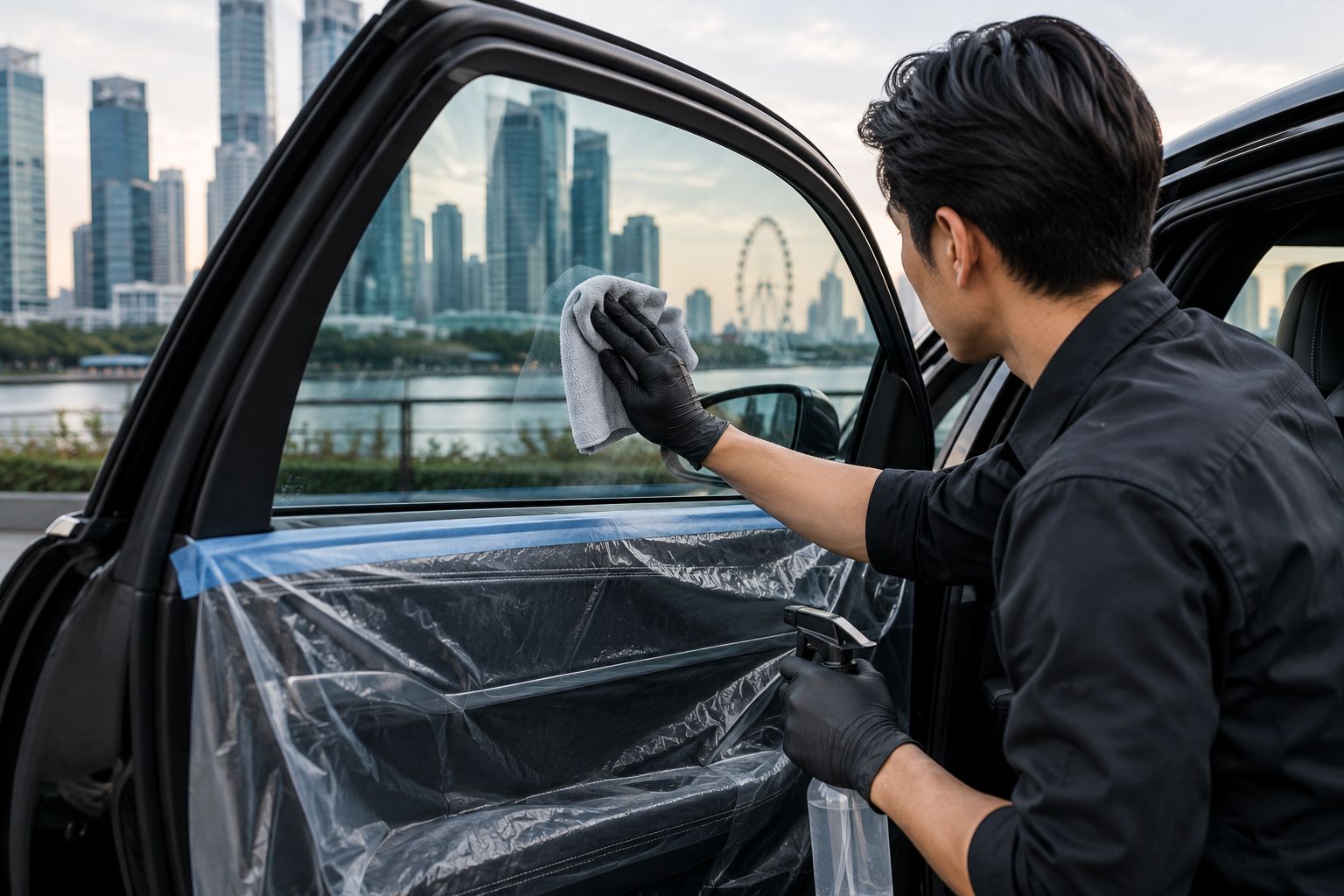
Inspect a representative installation where possible. Look along the window edges and examine the rear windscreen from inside and outside; a distant photograph is not enough to assess contamination or trimming.
- Ask how glass contamination and old adhesive are removed.
- Confirm protection for trims, upholstery and nearby electronics.
- Discuss rear-defroster precautions before old-film removal.
- Inspect edge finishing and the treatment of curved glass.
- Agree how installation defects will be assessed and corrected.
Test comfort and visibility before accepting the result
Assess the proposed film from both the driver's seat and the executive's usual seat. A rear passenger's preference for privacy must not dictate an unsuitable front-window specification. Keep the driver-facing glass decision separate.
A heat-lamp demonstration can illustrate a sample's response, but it does not reproduce the complete vehicle environment. Cabin comfort also depends on the windscreen, roof glazing, exposed surfaces and air-conditioning operation. Tint reduces solar heat gain; it does not replace ventilation or air conditioning.
Check visibility through the installed glass in relevant conditions once the installer permits inspection. Pay attention to reflections, optical distortion and screen readability. Treat privacy as variable: interior illumination at night changes how easily someone outside can see into the cabin.
- Assess driver visibility through front and side glass.
- Check the principal passenger's view and screen readability.
- Examine internal reflections and visible optical distortion.
- Discuss roof glazing separately if it is part of the brief.
- Confirm that the agreed shade matches the installed film.
Document handover and maintenance requirements
For a company-managed car in 2026, retain the film identity, installed window coverage, transmission readings and care instructions together. This gives the next driver or fleet manager a clear record. A verbal description such as premium ceramic is not enough to identify a replacement film.
Follow the installer's product-specific instructions for curing, window operation and cleaning. Do not apply a generic waiting period taken from another film or another vehicle. Ask which initial appearances are expected during curing and which require an inspection.
Keep window tint separate from the paint-protection scope. XPEL PPF, ChromaGard and ceramic coating should be discussed under their own service specifications; none substitutes for a measured window-film assessment. If several services are booked together, document each one's preparation, acceptance and maintenance requirements.
- Retain the exact film model and shade for each glass area.
- File baseline and finished transmission measurements.
- Obtain written curing and window-operation instructions.
- Confirm suitable cleaning products and cleaning methods.
- Record the process for reporting defects or arranging an inspection.
Compare window-tint options for executive cars
Use this comparison to narrow the discussion, not to select a film without its technical sheet. Material categories describe construction; they do not establish a universal performance ranking. For a 2026 purchase, the exact film, finished transmission and installation standard decide whether an option fits your car.
| Option | Best for | Main advantage | Key limitation |
|---|---|---|---|
| Existing factory glass | Owners assessing whether additional tint is necessary | Preserves the existing glazing without an aftermarket installation | Its solar-control performance must be checked; appearance alone proves little |
| Dyed film | Owners primarily comparing glare control and appearance | Controls visible light through its tint | Darkness alone does not establish heat rejection or colour stability |
| Metallised film | Owners comparing documented solar-control specifications | Uses a metallic layer as part of its solar-control construction | Requires checking signal compatibility and Singapore's non-reflective requirement |
| Ceramic film | Executive-car owners comparing non-metallic solar-control options | Offers a non-metallic construction for solar-control applications | The ceramic label does not establish TSER, clarity or installed compliance |
For an executive car, shortlist by documented performance and legal visibility before choosing the material label. Ceramic film is a relevant option to investigate, not an automatic winner. Existing factory glass is also a legitimate baseline when its performance already meets your brief.
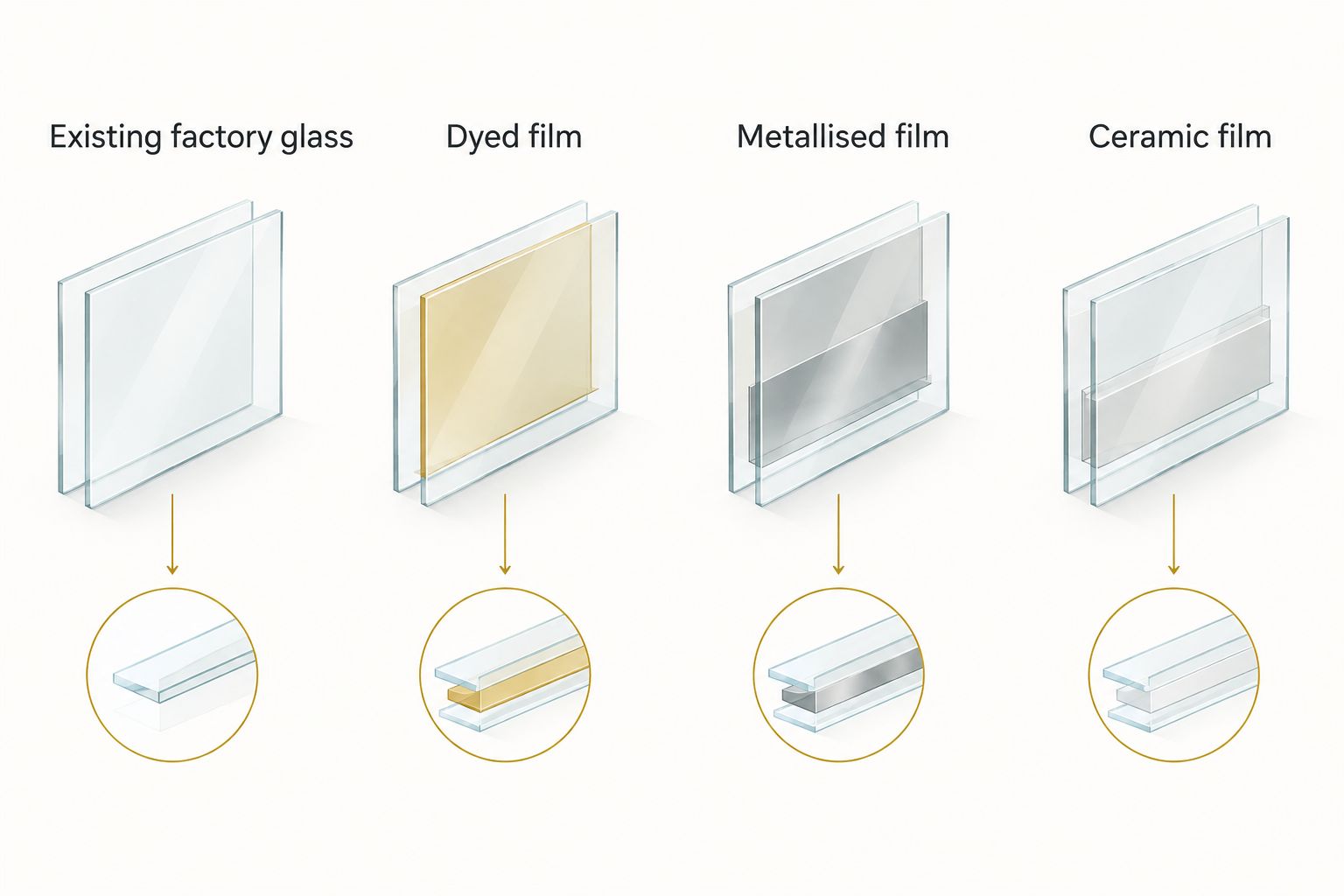
Ask each installer to answer the same brief. If one proposal specifies the film model, glass preparation and finished readings while another only names a film category, the proposals are not equivalent.
Define your executive-car tint specification
Discuss window tint, glass measurements and the installation scope for your executive car.
Common mistakes corporate executive-car buyers make
Choosing rear-seat privacy before driver visibility
Rear-seat comfort matters, but it cannot set the front-window specification. Apply the legal transmission requirements to each relevant glass area and assess the driver's view separately. A matching appearance is secondary to compliance and safe visibility.
Approving a proposal from one heat-rejection figure
A prominent infrared-rejection claim does not tell you the complete solar-control story. Read the test basis, TSER and VLT together. Reject comparisons that place figures from different test conditions side by side without explaining the difference.
Treating tint as confidential-meeting protection
Window film changes visibility; it does not make a car a secure meeting room. Outside observers can still see through compliant glazing under some lighting conditions. Do not present tint as a guarantee of passenger anonymity or information security.
Bundling every protection service into one specification
Window tint, paint protection film and ceramic coating serve different surfaces and functions. A good exterior finish does not demonstrate a compliant window installation. Require a separate scope and acceptance standard for the glass, even when one appointment covers several services.
Leaving fleet records with the outgoing driver
An executive vehicle often changes custodians without changing its film. Store the installation documentation centrally rather than relying on the driver's recollection. That record helps the next manager identify the film and follow its maintenance instructions.
FAQ
What’s the best window tint for a corporate executive car in Singapore?
The best window tint meets Singapore’s installed light-transmission requirements while delivering documented solar-control performance and clear visibility. Compare the exact film model, TSER, VLT and installation standard rather than choosing by darkness or material name alone.
How dark can executive-car window tint be in Singapore?
LTA requires at least 70% light transmission through the front windscreen and front side windows, and at least 25% through the rear windscreen and rear side windows. These thresholds apply to the finished glass-and-film combination, so require measurements on the vehicle.
Is ceramic window film better than dyed film?
Ceramic film is not automatically better than dyed film for every executive-car brief. Compare the exact products using matching test conditions, then assess solar control, visible transmission, clarity and the proposed installation.
Will window tint keep an executive car cool while parked?
Window tint reduces solar heat gain but does not keep a parked car continuously cool. Other glazing and vehicle surfaces still contribute heat, and tint does not replace air conditioning or ventilation.
Can window tint guarantee privacy for rear-seat passengers?
Window tint cannot guarantee rear-seat privacy. Visibility through the glass changes with outside light, cabin illumination and viewing conditions, while Singapore’s legal transmission requirements still apply.
Does EA Detailer provide window tint and paint protection?
EA Detailer lists window tint, detailing and paint protection among its automotive services in Singapore. Request the exact proposed window-film specification separately from any PPF or ceramic coating scope.
When can I lower the windows after tint installation?
Follow the written window-operation instructions for the installed film. The appropriate timing depends on the product and installation conditions, so do not substitute a generic waiting period for the installer’s guidance.
One last thing
Make the measurement record part of your 2026 handover, not an optional extra. A film's darkness, brand name and demonstration performance cannot establish the transmission of your finished windows. The useful record identifies the film, the glass area and the measured result—information you can retain after the sales conversation ends.
Related guides
- Compare window tint film brands in Singapore
- Choose car window tint for privacy in Singapore
- Plan detailing packages for fleet cars in Singapore
- Assess detailing packages for new-car owners

Leave a Reply