

Best colour PPF Singapore 2026: Gloss wins
 ead admin
Best overall: gloss colour PPF for a visible colour change with a conventional painted appearance. Best for a softer sheen: satin colour PPF. Best for a flat finish: matte colour PPF. If you are choosing the best colour PPF in Singapore in 2026, select the finish first, then judge the proposed film and installation on the exact car.
- Gloss colour PPF is the best default for Singapore owners who want a colour change with a painted look.
- Satin colour PPF suits owners who want a softer sheen; matte colour PPF suits a deliberately flat finish.
- Ask EA Detailer to identify the exact colour PPF film, coverage, preparation and edge treatment before agreeing to installation.
- XPEL PPF, ChromaGard and ceramic coating should not be treated as interchangeable specifications.
Why this matters
Colour PPF changes how a car looks while adding a physical film over its paint. The finish you see in a sample is only part of the decision: panel contours, exposed edges and the condition of the paint underneath affect the result on a complete car. For luxury and performance cars, judge the proposed installation as closely as the colour.
EA Detailer is best for Singapore owners seeking a professional colour PPF installation, not for choosing a film by a name alone. Its stated services include colour PPF and paint protection. Ask it to specify the film proposed for your car; neither a brand name nor a finish category establishes the exact product that will be installed.
A 2026 shortlist should separate three decisions: the appearance you want, the areas you want covered and the installation standard you expect. Settling only the first leaves the most consequential questions unanswered.
What makes the best colour PPF for a car?
Use these criteria before comparing finishes or installers in Singapore:
- Surface finish: Gloss reflects light differently from satin and matte. View a physical sample beside your car, outdoors and under workshop lighting.
- Film identification: Request the exact manufacturer and film designation in writing. Colour and finish are not enough to identify a material.
- Paint preparation: Ask how existing marks, contamination and previous paintwork will be assessed before film goes on. Film does not erase defects beneath it.
- Panel coverage: Confirm which panels receive colour PPF and how uncovered areas will look next to them. A partial colour change needs a deliberate visual boundary.
- Edge treatment: Ask where film will terminate around doors, handles, badges and panel returns. Inspect a completed installation, not only a flat sample.
- Care and removal: Request the proposed film's care instructions and removal guidance. Do not assume the same cleaning approach suits every finish.
The practical distinction is film versus finish versus workmanship. A finish describes appearance; a film designation identifies a material; workmanship determines how that material sits on your car. Keep all three on the written proposal.
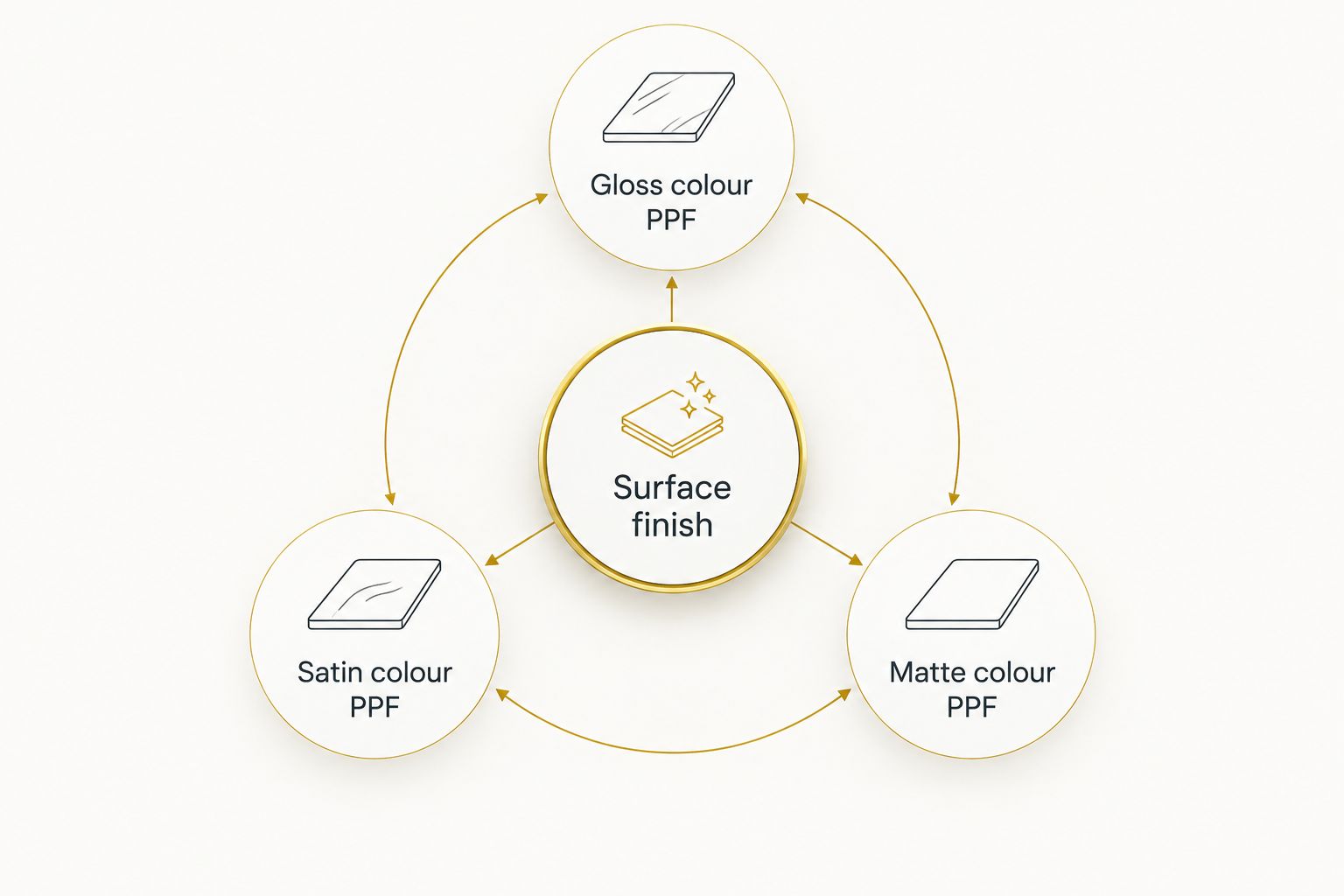
Colour PPF finishes at a glance
| Option | Best for | Standout feature | Key limitation |
|---|---|---|---|
| Gloss colour PPF | Owners who want a painted-looking colour change | Reflective finish | Reflections draw attention to visible edges and surface marks |
| Satin colour PPF | Owners who want a softer sheen | Between gloss and flat matte visually | A small sample cannot show how every panel contour will look |
| Matte colour PPF | Owners committed to a flat appearance | Distinctly low-gloss look | Finish-specific care needs particular attention |
These are finish categories, not verified film models or a catalogue of EA Detailer options. Availability, film construction and care instructions depend on the exact material proposed. In 2026, ask for that designation before treating any finish as a final choice.
The visual difference is easiest to assess on curved surfaces. A flat swatch shows colour; a bonnet or bumper also shows how the finish handles changing light and panel shape.
1. Gloss colour PPF: best colour PPF for a painted look
Gloss is the default if you want a new colour without intentionally changing the car to a muted or flat appearance. It reflects light strongly, so it deserves assessment on the actual shapes of your vehicle rather than on a loose sample. For a new car, compare the proposed colour with details that will remain unchanged, including door openings and any panels outside the coverage plan.
Gloss colour PPF pros:
- Gives you a colour-change option with a reflective surface.
- Makes the difference between the selected colour and the original paint easy to assess on a sample.
- Suits an owner who does not want satin or matte styling.
Gloss colour PPF cons:
- Reflections make visible seams, lifted edges and surface defects easier to notice.
- A sample does not establish how the colour will look across the complete car.
- A partial application needs careful planning where the new colour meets exposed original paint.
Best for: New-car owners and luxury-car owners who want a changed colour with a familiar glossy appearance.
Before approving gloss colour PPF in 2026, inspect where the installer plans to end the film. Ask to see how door edges, bumper openings and badges will be handled on your particular car. A clean finish on an open panel does not answer the edge question.
Verdict: Buy when the exact film, coverage and edge plan are documented and the sample looks right beside your vehicle.
2. Satin colour PPF: best for a softer sheen
Satin sits visually between reflective gloss and flat matte. Choose it for the effect on the entire vehicle, not because the swatch looks restrained in one lighting condition. Look at the proposed shade from several angles on a curved panel; its appearance depends on the surface it follows.
Satin colour PPF pros:
- Offers a distinct finish without the full reflectivity of gloss.
- Makes finish choice a deliberate part of a colour-change plan.
- Gives you a useful middle option when comparing gloss and matte samples.
Satin colour PPF cons:
- A small flat swatch is a poor substitute for a finished panel.
- Replacing film on one panel calls for a careful colour and finish comparison with adjacent panels.
- The proposed material's care requirements must be checked rather than assumed from its appearance.
Best for: Owners who want a changed colour with a softer-looking surface but do not want a fully flat finish.
Ask the installer to identify the exact satin film and explain how the chosen coverage handles visible transitions. If you are comparing installers in 2026, give each one the same panel list; otherwise, you are comparing different jobs.
Verdict: Buy when you have seen the finish on a representative curve and the written coverage matches the look you want.
3. Matte colour PPF: best for a deliberately flat finish
Matte is the most specific styling decision in this list. Its low-gloss appearance is the point, so examine a sample next to the car's existing trim and consider every area that will remain uncovered. The boundary between matte film and glossy original paint can become part of the design, whether you intend it or not.
Matte colour PPF pros:
- Creates a clearly flat visual effect.
- Makes the finish itself a defined part of the colour-change decision.
- Works as a comparison point when deciding whether satin is muted enough.
Matte colour PPF cons:
- A mixed matte-and-gloss coverage plan needs close visual review.
- You must follow care guidance for the exact proposed film; do not assume products used on glossy surfaces are appropriate.
- Local repairs and later panel replacements call for a close match to the surrounding film.
Best for: Owners who already know they want a flat appearance across the areas being covered.
In 2026, ask to see a matte installation before approving the whole-car look. Examine transitions around handles, mirrors and door openings. Confirm who is responsible for identifying a matching material if a panel needs attention later.
Verdict: Hold until you have reviewed a completed example and the installer has documented the exact film and care instructions.
How we ranked these finishes
This ranking answers a finish-selection question, not a product-performance test. Gloss comes first because it is the clearest default for an owner who wants a colour change without also committing to a muted finish. Satin takes the softer-sheen slot. Matte serves the owner who specifically wants a flat result.
No manufacturer specification, warranty term or comparative test result was supplied for particular colour PPF films. It would be misleading to rank named films on protection, self-healing or durability without those details. Ask any installer who calls a film the best to identify the material and the evidence behind that claim.
Film choice is only part of the installation
For colour PPF, the proposed work should be clear before installation starts. Ask for a panel-by-panel coverage list, the film's exact designation, an assessment of the paint and an explanation of visible edges. Those requests apply whether you are protecting factory paint on a new car or changing the appearance of a car you already own.
A useful discussion with EA Detailer starts with the desired appearance and the car's condition. Then settle these points:
- Preparation: What will be inspected or corrected before film is applied? Identify any existing damage that will remain visible.
- Coverage: Which exterior panels are included, and which painted surfaces will remain exposed?
- Edges: Where will the film end on each difficult panel? Ask about openings and returns rather than assuming every edge will be hidden.
- Material: What exact colour PPF film is proposed, and what are its published care instructions?
- Handover: What should you inspect when viewing the finished car, and what guidance will you receive for looking after the film?
Do not use XPEL PPF, ChromaGard or ceramic coating as shorthand for the proposed colour film. Those names do not, by themselves, specify the colour PPF material or the coverage on your car. Ask EA Detailer to explain the role of each named option in any proposal and identify the actual material assigned to each panel.
Discuss your colour PPF plan
Ask about film identification, panel coverage, paint preparation and edge treatment.
Which colour PPF finish should you choose?
Choose gloss colour PPF if you are undecided. It gives you a direct way to compare proposed colours while retaining a reflective, painted-looking finish. Choose satin when a softer sheen is the goal; choose matte only when you are confident that a flat appearance suits the covered panels and adjacent trim.
The 2026 decision should not end at the swatch. Ask for the exact film name, a complete coverage list and the treatment of exposed edges. If two installers propose different panel coverage, align their scopes before deciding which result you prefer. The best colour PPF for your Singapore car is the finish you want, installed to a plan you can inspect.
FAQ
What is the best colour PPF in Singapore in 2026?
Gloss colour PPF is the best default if you want a colour change with a painted-looking finish. Choose satin for a softer sheen or matte for a deliberately flat appearance, then confirm the exact film and installation scope.
Is gloss colour PPF better than satin colour PPF?
Gloss is better if you want a reflective, painted-looking finish; satin is better if you want a softer sheen. Compare both on a sample beside your car and review how the chosen finish looks on curved panels.
Is matte colour PPF harder to choose than gloss?
Matte needs a more deliberate appearance and care decision because its flat finish differs visibly from glossy uncovered paint. Check a completed installation and the proposed film’s own care instructions before committing.
Does colour PPF hide damaged paint?
No, colour PPF does not repair the paint beneath it. Ask the installer to assess existing defects and explain what will remain visible before approving preparation and installation.
Should I choose full-car or partial colour PPF coverage?
Choose coverage based on where you want the new colour to appear and where the original paint can remain visible. Request a panel-by-panel plan so colour transitions do not come as a surprise.
Is ceramic coating the same as colour PPF?
No, ceramic coating and colour PPF are different treatments. If both appear in a proposal, ask the installer to identify each material and explain its intended role on your car.
How do I compare colour PPF installers in Singapore?
Give each installer the same car and coverage requirements, then compare the specified film, paint preparation and edge plan. Inspect completed work rather than judging installers by samples alone.
One last thing
Ask to inspect the least visible edge on a completed colour PPF installation, not just the most photogenic panel. A colour sample helps you choose a finish; the edge shows you how the installation decision will appear on the car you drive.
Related guides
- PPF brands for luxury cars in Singapore
- Full-front versus full-body PPF
- PPF for Singapore's hot and humid climate
- Ceramic coating brands for cars in Singapore

Leave a Reply