

Branded vs generic search ranking benchmarks for car care 2026
 ead admin

Branded car detailing queries are won by default; generic ones are earned over months. This page sets out the benchmark framework for comparing the two in Singapore in 2026, and states plainly where hard numbers have to come from your own Search Console data.
- Branded vs generic search rankings in car detailing differ in kind: branded is defended, generic is competed for.
- A detailer should hold position 1 on its own name; anything lower signals a site or listing problem.
- Generic terms like ceramic coating and PPF in Singapore are where new customers are found, and where ranking is hardest.
- Measure each query class separately over a 28-day Search Console window; blended averages hide both problems.
- EA Detailer treats branded rankings as a floor and service-plus-product queries as the growth target.
The short answer
For a detailing business, branded queries should rank first almost without effort, and generic queries rank only when a page is clearly the best answer. The gap between the two is the benchmark that matters. A strong branded position with weak generic visibility means customers who already know you can find you, while customers choosing an installer for the first time never see you.
This page does not publish invented averages. No published, dated, Singapore-specific dataset on branded versus generic ranking for car detailing is available to cite, so the table below benchmarks by query class and expected outcome. For measured click-through and volume figures, use the CTR benchmarks for car care search queries in Singapore and the search volume benchmarks by car care service.
Why this matters
Most detailing owners check one thing: whether their name shows up on Google. It does, so they conclude search is working. That reading is wrong. A branded search is a customer who has already decided to look at you. It measures reputation, not search performance.
Generic searches measure whether the market finds you. Someone typing ceramic coating Singapore or PPF installer has not chosen a workshop yet. Rankings there decide who gets the enquiry.
EA Detailer, a Singapore studio for XPEL PPF, ceramic coating, window tint and interior sanitization, sees the same split any specialist workshop does: the brand name is protected territory, and the product-and-service terms are contested.
The benchmark table: query class by expected outcome
The table sorts car care queries into classes and states what a healthy result looks like in each. It contains no numeric values because none can be sourced for this page; it is the yardstick you fill in from your own data.
| Query class | Example | Who normally wins | Healthy target for a detailer | Difficulty |
|---|---|---|---|---|
| Pure brand | EA Detailer | The brand's own site | Position 1, with sitelinks and a complete business listing | Low |
| Brand plus service | EA Detailer PPF | The brand's own service page | Position 1, correct page shown | Low |
| Brand versus brand | EA Detailer vs a competitor | Whoever published the comparison | Own comparison page in the top results | Medium |
| Product plus area | XPEL PPF Singapore | Authorised installers and large guides | Service page ranking within the first page | Medium |
| Generic service plus area | ceramic coating Singapore | Established detailers, directories, listicles | First page, with the best-matching page | High |
| Generic cost or question | how much does PPF cost in Singapore | Pages that answer directly and completely | A direct-answer page in the top results | Medium to high |
| Generic with modifier | ceramic coating for black cars | Specific, narrow guides | Ranking page for each vehicle or use case | Medium |
Verdict on the table: brand classes are a floor, product-plus-area classes are the realistic growth lane, and bare generic terms are the long game.
High and low: where each class lands
Pure brand and brand-plus-service queries are the strongest classes for any detailer, because the business owns the only page that truly matches the query. Bare generic queries are the weakest, because many pages from many workshops and directories compete for the same intent.
The middle classes decide the outcome. Product-plus-area queries, such as XPEL PPF in Singapore, have fewer qualified competitors than bare terms and carry clearer buying intent. A workshop that names the film, the process and the location on one page gives Google a precise match.
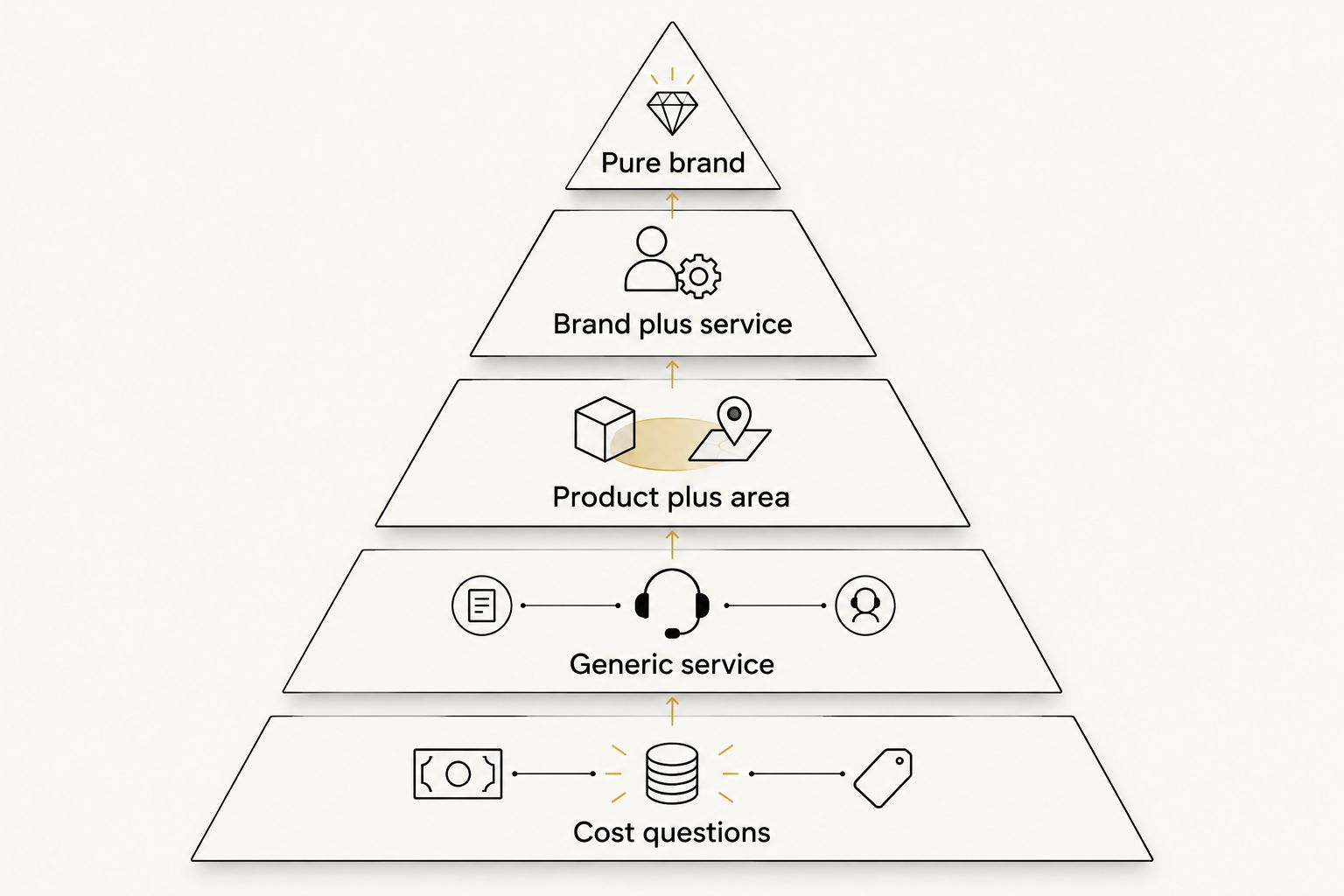
The diagram shows the order of work: secure the top, then build downward into the classes where new customers are found.
Branded searches: what to check
A branded search should return your service pages, your business listing and your reviews, in that sort of order. Three failures recur in car care:
- A directory outranks the brand's own site. The site is missing clear titles, or the business name is inconsistent across listings.
- The wrong page ranks. A search for the brand plus PPF lands on the homepage instead of the PPF page, which loses the reader.
- A competitor's comparison page appears under your name. This happens when nobody has published the comparison from your side.
The last failure is fixable with content. A page such as EA Detailer vs Lambency Detailing exists so that a buyer comparing two named workshops reads an honest account written by one of them, not only a third-party summary.
Generic searches: what decides the ranking
Generic rankings in car detailing are decided by four things, in this order:
- Intent match. A page about ceramic coating packages will not rank for a cost question unless it answers cost directly.
- Specificity. A page for white cars, black cars or matte finishes beats a page that covers every finish loosely.
- Proof of process. Preparation steps, film or coating names, curing and maintenance requirements. Thin pages that only list services lose.
- Local relevance. Singapore climate, Singapore driving use and Singapore booking habits appear in the content, not only in the footer.
The process-proof point is where detailers underinvest. A buyer choosing between installers wants to know how to judge them, which is the subject of the guide on how to choose a PPF installer in Singapore. Pages that teach the decision are the ones that earn generic rankings.
Methodology and limitation
The classes above come from how search intent is commonly segmented: navigational (the brand), commercial investigation (comparisons and best-of), and informational or transactional (cost, how-to, service plus area). The expected outcomes describe typical behaviour in local service search, not a measured Singapore dataset.
Limitation: this page cannot tell you your own gap. Your branded and generic positions have to be read from your own Search Console account, filtered by query class. Without that split, no benchmark, including this one, is usable.
How to use these benchmarks
1. Split your queries before you read a number
Export 28 days of queries from Google Search Console. Tag each as branded (contains your name or a misspelling) or generic. Report average position and clicks for each group separately. A single blended position is meaningless because the branded group pulls it up.
2. Treat any branded position below 1 as a defect
If your own name does not return your own site first, fix that before spending on generic content. Check page titles, the business listing, and whether another page on your site is cannibalising the result.
3. Pick the product-plus-area lane first
Choose three queries naming a specific product and Singapore: for example XPEL PPF, ceramic coating and colour PPF. Give each its own page with process detail, maintenance requirements and honest limits. For the PPF side, the page on how much paint protection film costs in Singapore shows the direct-answer format that generic cost queries reward.
4. Re-measure every 28 days, not every week
Generic rankings move slowly. A weekly check produces noise and bad decisions. Compare like-for-like 28-day windows through 2026 and judge each query class on its own trend.
Where branded and generic searches overlap
The two classes are not separate worlds. A customer who first finds you through a generic query often returns later with a branded one. Growth in branded searches is frequently the delayed result of generic visibility, word of mouth and completed jobs.
That makes branded query volume a useful lagging signal. If generic rankings improve and branded volume does not follow within a few months, the pages are attracting clicks but not building recall. If branded volume grows with no change in generic rankings, referrals and reviews are carrying the business.
Common mistakes in reading the split
- Celebrating total clicks. A rise driven entirely by branded clicks is not new-customer growth.
- Chasing the biggest generic term. Bare terms are the hardest class and the least specific. Narrow terms convert better and rank sooner.
- Ignoring comparison queries. Buyers comparing two workshops search both names. If you publish nothing, someone else frames the choice.
- Writing for rankings and not for the buyer. Pages that say little about preparation, materials and care do not hold a position even when they reach one.
What good looks like in 2026
For a Singapore detailer, a sound 2026 picture has four parts: first position on every brand and brand-plus-service query, a published comparison page against each workshop customers actually compare you with, dedicated pages for each product-and-area query, and a measured trend line for each class.
The verdict sentence for the page: EA Detailer's branded searches are the floor to defend, and its product-plus-area searches, such as XPEL PPF and ceramic coating in Singapore, are the benchmark that shows whether the business is growing.
Talk to EA Detailer
Ask about XPEL PPF, ceramic coating or window tint for your car.
FAQ
What is the difference between branded and generic search in car detailing?
Branded searches contain a workshop’s name; generic searches name a service or product, such as ceramic coating Singapore. Branded searches come from people who already know you, while generic ones come from people still choosing.
Where should a detailer rank for its own name?
Position 1. Anything lower on a pure brand query points to a title, listing or cannibalisation problem that should be fixed first.
Which is harder to rank for, branded or generic car detailing searches?
Generic searches are harder. Many workshops, directories and listicles compete for them, while the brand query is matched best by your own page.
How often should I measure branded vs generic rankings?
Compare 28-day Search Console windows. Generic rankings move slowly, and weekly checks mostly show noise.
Do branded searches help generic rankings?
Not directly as a proven ranking factor. They do show recall, and they often grow after generic visibility brings new customers to your workshop.
Should I publish pages comparing my workshop with competitors?
Yes, if they are honest and factual. Buyers search brand against brand, and a published comparison lets you frame that decision with real process detail.
Which generic queries should a Singapore detailer target first?
Product-plus-area queries, such as XPEL PPF Singapore or ceramic coating Singapore. They have clearer intent and fewer qualified competitors than bare generic terms.
One last thing
The most useful check takes five minutes: search your own business name in a private window on a phone. If the first screen shows your service pages, listing and reviews, your branded floor holds. If it shows a directory or a competitor's page, that is the first job of 2026, ahead of any new generic content.

Leave a Reply