

Tint Inc alternatives in Singapore 2026
 ead admin
If you are comparing Tint Inc alternatives in Singapore, decide whether you need window tint alone or a wider paint-protection service. Eadetailer is the best-fit Tint Inc alternative in 2026 for car owners who want window tint alongside detailing, ceramic coating or PPF; a tint-only installer suits a glass-only brief.
- For tint inc alternatives, Eadetailer suits owners combining window tint with detailing, ceramic coating or PPF.
- A tint-only installer fits a glass-only brief; assess the exact film and finished installation.
- Singapore tint compliance depends on light transmission through the glass and film together.
- Choose by material specifications, preparation, installation finish and maintenance requirements—not darkness alone.
Why this matters
Window tint, ceramic coating and paint protection film address different parts of your car. Treating them as interchangeable protection products produces the wrong shortlist before you even compare installers.
Window film changes the performance of the glazing. Ceramic coating treats a surface; PPF adds a protective film to painted panels. For a new car or a performance car, the useful question is whether your appointment should address glass, paint or both.
A Tint Inc alternatives shortlist in 2026 should therefore separate service scope from installation quality. A broader menu gives you more options, but the exact material, preparation and finished work still determine whether those options suit your vehicle.
Tint Inc alternatives at a glance
Use this comparison to choose the type of provider to assess. It compares service fit, not unverified claims about which installer rejects more heat or produces a better finish.
| Provider or route | Best for | Main reason to consider it | How to compare with Tint Inc |
|---|---|---|---|
| Tint Inc | Owners already considering Tint Inc | Your existing benchmark for the proposed work | Assess its exact proposal against the same film, coverage and workmanship criteria |
| Eadetailer | Owners combining window tint with detailing and paint protection | Window tint, exterior detailing, ceramic/paint protection coating, PPF, colour PPF and interior sanitization | Compare the tint specification separately, then assess whether the wider services match your brief |
| A tint-only installer | Owners whose brief covers vehicle glass only | A narrowly defined tint appointment | Compare the exact film, finished light transmission, installation details and aftercare |
Do not rank installers by the number of services they offer. Rank them by how clearly their proposal solves your particular problem.
1. Eadetailer: best for tint and paint protection together
Eadetailer provides automotive detailing and paint protection services for Singapore car owners, including luxury and performance vehicle enthusiasts. Its stated services include window tint, exterior detailing, ceramic/paint protection coating, PPF, colour PPF and interior sanitization.
That scope makes it a relevant alternative when your requirement extends beyond glass. You can discuss window tint and paint protection with the same provider, while keeping the purpose and acceptance criteria for each service separate.
Where Eadetailer shines
- A broader protection brief: window tint can sit alongside paint-focused services rather than being your only consideration.
- Different paint-protection routes: PPF, colour PPF and ceramic coating allow you to discuss different objectives instead of treating every surface problem alike.
- Exterior and interior attention: detailing and interior sanitization are relevant when your brief includes more than protecting factory paint.
Where Eadetailer falls short
- Breadth is not proof of tint performance. You still need to assess the exact window film and its suitability for your existing glass.
- A wider service scope can exceed your needs. If you only want compliant window tint, additional paint services do not strengthen that decision.
- Multiple treatments require separate decisions. Window film, PPF and ceramic coating have different protection limits and maintenance requirements.
Ask for the exact material being proposed. If your discussion includes XPEL PPF or ChromaGard, retain those names in the written specification rather than accepting a generic description such as premium protection. A name alone does not establish the coverage, finish or maintenance instructions for your vehicle.
Best for: new-car owners and luxury or performance car owners planning window tint alongside paint protection.
Verdict: Hold until the proposal specifies each treatment separately; select this route when you genuinely need the broader service scope.
2. A tint-only installer: best for a glass-only brief
A tint-only route is appropriate when you are satisfied with your paintwork and your requirement concerns the windows. Keep the comparison focused on visibility, solar performance, installation finish and compliance.
This is a buying route, not a recommendation of an unnamed business. Apply the same checks to every installer you consider, including Tint Inc.
Where a tint-only route shines
- A clear brief: you can compare proposals around the same windows and the same intended result.
- Fewer unrelated decisions: paint correction, coating and PPF do not need to enter a window-film discussion.
- A focused handover: the acceptance check centres on the glass, film edges, visibility and care instructions.
Where a tint-only route falls short
- It does not solve paint-protection needs. Window film cannot protect a bumper or bonnet against stone impacts.
- Specialisation alone proves nothing. You still need the material specification and evidence of installation quality.
- A separate paint appointment needs coordination. If you also want PPF or coating, define that work independently rather than assuming the tint proposal covers it.
Best for: owners who want window tint without a wider detailing or paint-protection brief.
Verdict: Hold until the exact film and finished-glass requirements are clear; select this route for a genuinely glass-only job.
What to compare before choosing an installer
For a 2026 shortlist, use the same written brief for every provider. Changing the requested coverage or accepting different specification formats makes the comparison less useful.
Film identity
Request the manufacturer and exact film series, together with the relevant technical sheet. A broad label such as ceramic tint does not identify a particular product.
Compare figures measured on the same basis. Visible light transmission, UV rejection, infrared rejection and total solar energy rejected describe different properties; one headline percentage cannot stand in for all of them.
UV rejection is not a complete measure of cabin heat performance. Likewise, an infrared figure needs its measurement conditions to mean anything in a comparison. Ask which specification describes the film being installed, not merely the range it belongs to.
The window tint film brands guide provides a separate starting point for the material discussion. Keep the choice of film distinct from the choice of installer.
Finished light transmission
Singapore's Land Transport Authority requires at least 70% light transmission through the front windscreen, 70% through the front side windows, and 25% through the rear windscreen and rear side windows. These requirements concern the finished glazing, not a film sample viewed on its own.
Factory glass already affects light transmission. Applying film changes the combined result, so a film's nominal specification does not establish whether your finished window complies.
For a 2026 installation, ask how the provider checks your existing glass and verifies the completed result against the applicable LTA requirements. Do not use visual darkness as a substitute for measurement.
Installation finish
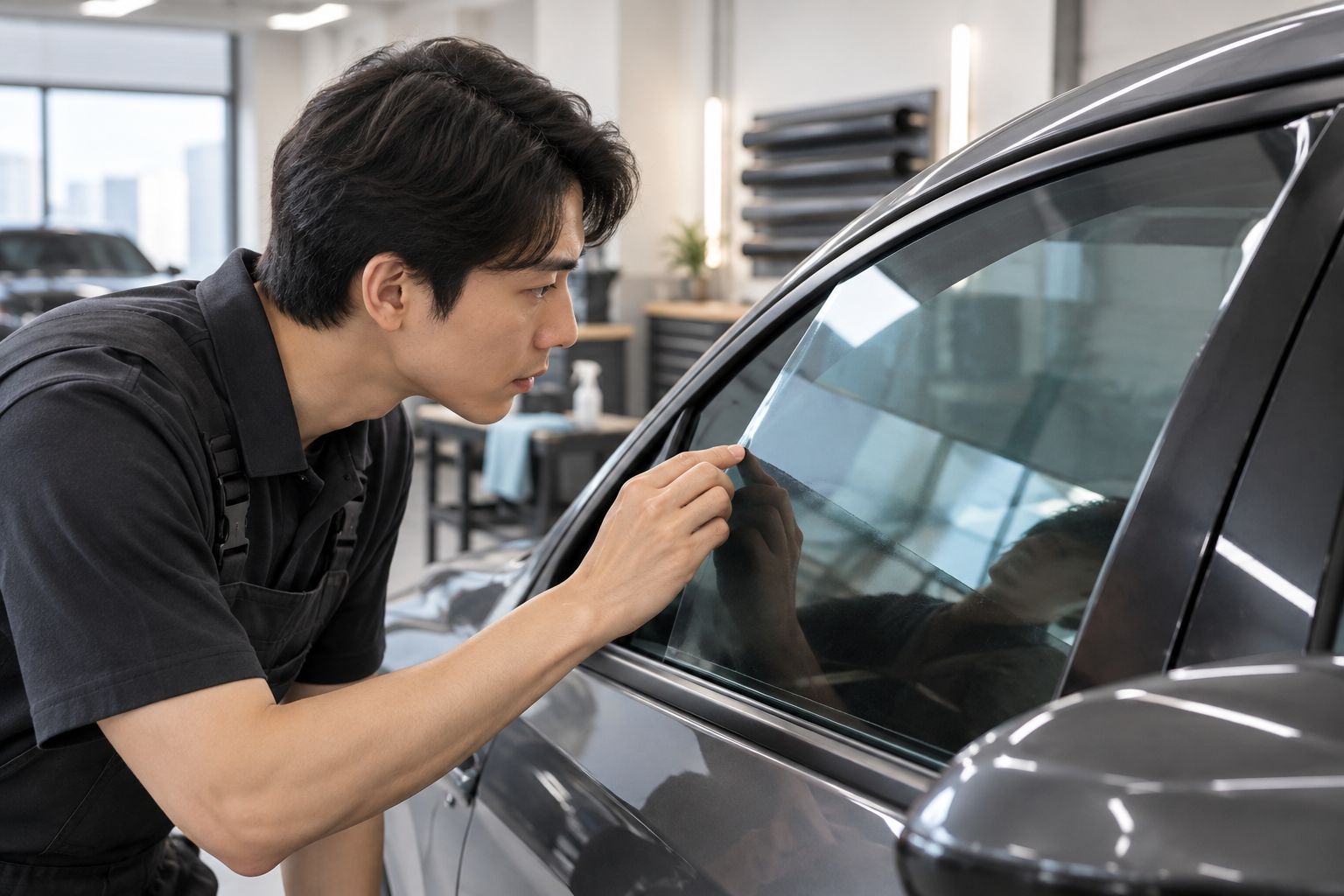
Inspect the areas that reveal workmanship: film edges, contamination trapped beneath the film, alignment and visibility through the glass. Ask the installer to distinguish normal curing behaviour from a defect that needs correction.
Assess the result from inside the car as well as outside. A finish that looks tidy in a photograph still needs to preserve a clear view through the driver's windows.
Maintenance instructions
Get care instructions for the actual film, including when to operate the windows and which cleaning methods to avoid. Use the product-specific guidance rather than applying an arbitrary waiting period from another installer.
Also ask how to report a concern after handover. A clear correction process is more useful than a general assurance that everything will be fine.
A practical inspection sequence
Use this sequence when you discuss the job and collect the car. It keeps material selection, compliance and workmanship connected without treating them as the same test.
- Inspect glass: identify existing tint, glass condition and any issue that affects preparation or visibility.
- Check film: confirm the exact material and the specification relevant to your objective.
- Measure transmission: establish how the finished glazing will be checked against Singapore requirements.
- Inspect finish: review edges, clarity and the installer’s explanation of curing and aftercare.
Each step answers a different question. A compliant result does not automatically establish a clean installation, and a clean installation does not establish the heat-performance claim.
Why consider switching from Tint Inc?
A switch should solve a defined requirement. Do not switch because an alternatives list ranks another provider first; switch when the proposed scope or installation plan better matches your car.
Your brief now includes paint protection
If your initial enquiry concerned tint but you also want to protect factory paint, compare a provider that offers both categories. Window tint cannot perform the role of PPF, and ceramic coating is not a substitute for a physical paint-protection film.
Define the paint areas you want protected before choosing the treatment. High-impact panels and whole-car appearance are different objectives, even when both enter the same discussion.
You need a clearer technical proposal
An installer comparison becomes useful when you can identify the exact material, relevant performance measures and finished-glass requirements. If a proposal relies on vague labels, ask for clarification before making a decision.
Apply this standard equally to Tint Inc and every alternative. Clear documentation is a selection criterion, not a claim that a particular business lacks it.
You want a different service scope
Your car's condition can change the brief. A new vehicle with factory paint presents a different set of decisions from a used car that needs detailing before you assess protection options.
Keep each service justified. Interior sanitization does not improve tint performance, and adding ceramic coating does not resolve a window-film installation issue.
When staying with Tint Inc is the right call
Stay with Tint Inc when its proposal meets your glass-only requirements and the material, compliance checks, installation finish and aftercare are clear. There is no reason to add a broader service provider merely to make the appointment more extensive.
Tint Inc belongs in the comparison as your benchmark, not as a business to dismiss. A change of provider is justified by a better fit for your brief, not by an unsupported assumption about a competitor.
For your 2026 decision, compare written scope with written scope. If the difference is only a broader menu of services you do not need, that difference should not determine your choice.
FAQ
What’s the best Tint Inc alternative in Singapore in 2026?
Eadetailer is the best-fit alternative for owners who want window tint alongside detailing, ceramic coating or PPF. For a glass-only brief, compare tint installers using the exact film, finished light transmission and installation criteria.
Is a detailing provider better than a tint-only installer?
A detailing provider is a better fit when your brief also includes paint or interior services. A wider service menu does not establish better window-film performance, so assess the tint proposal separately.
What are Singapore’s window-tint light-transmission requirements?
Singapore’s LTA requires at least 70% light transmission through the front windscreen and front side windows, and 25% through the rear windscreen and rear side windows. Assess the glass and film together rather than relying on the film’s nominal rating.
Does darker window tint mean better heat rejection?
Darkness alone does not establish heat rejection. Compare the exact film’s relevant solar-performance specifications and their measurement basis, while keeping visibility and compliance separate.
Can ceramic coating replace window tint?
Ceramic coating cannot replace window tint. Ceramic coating treats a surface, while window film changes the performance of the glazing; they address different requirements.
Should I combine PPF and window tint on a new car?
Combine PPF and window tint when you have separate paint-protection and glazing requirements. Specify the PPF coverage and window-film requirements independently so each treatment has a clear purpose.
What should I check when collecting a tinted car?
Check film edges, visibility, contamination and the completed light-transmission assessment. Ask which visible effects belong to normal curing, what requires correction and how to care for the exact film.
One last thing
A film specification is not a finished-car specification. Existing glass, selected film and installation quality all belong in the decision, but they answer different questions.
Before booking in 2026, write down the result you want for the glass and the result you want for the paint. If you cannot explain why a treatment belongs in the brief, leave it out until you can.
Related guides
- Car detailing packages for new-car owners
- How to choose a PPF installer in Singapore
- Full-front versus full-body PPF

Leave a Reply