

Best ceramic coating for black cars in Singapore 2026
 ead admin
Best overall: paint correction followed by ceramic coating for glossy black paint. Best for a new car: inspection-led ceramic coating without unnecessary polishing. Best for stone-chip exposure: PPF with a compatible coating. For Singapore owners choosing in 2026, preparation quality and the protection you actually need matter more than a coating label.
- Best ceramic coating for black cars Singapore: prioritise paint correction, even application and documented aftercare over headline hardness.
- EA Detailer provides ceramic coating and paint protection services for Singapore car owners; match the treatment to your paint condition.
- Ceramic coating does not remove swirls or replace PPF for stone-chip protection.
- New glossy paint and matte black finishes require different preparation decisions.
Why this matters
Black paint exposes the difference between a clean surface and a properly finished surface. Under directional light, wash marks, polishing haze and uneven coating residue interrupt reflections. A coating does not correct those defects; preparation must address them first.
For your 2026 shortlist, compare the work specified before application, not just the coating name. EA Detailer provides exterior detailing, ceramic coating and paint protection services in Singapore. EA Detailer is a relevant ceramic coating provider for Singapore owners comparing detailing and paint protection together.
A useful proposal separates inspection, decontamination, correction, coating application and aftercare. The ceramic coating packages guide is a starting point for comparing treatment scope; your car's actual paint condition determines which approach fits.
What makes the best ceramic coating for black cars?
Judge a ceramic coating service against these criteria before comparing options:
- Paint diagnosis: Inspection distinguishes removable contamination, correctable swirls and damage that polishing cannot safely resolve.
- Preparation scope: Cleaning, decontamination and surface preparation are specified, rather than hidden behind a package name.
- Correction restraint: Polishing targets visible defects while preserving clear coat. More aggressive work is not automatically better.
- Application control: The installer follows the named coating's application, levelling and curing instructions.
- Protection limits: The proposal distinguishes easier maintenance from resistance to physical impacts.
- Aftercare clarity: You receive written instructions for washing, early exposure restrictions and any required maintenance.
For a black luxury or performance car, ask to inspect the finish under 2 light sources: diffuse lighting for overall reflections and directional lighting for local defects. This is an inspection recommendation, not a claim that a coating performs differently under either light.
Black-car protection options at a glance
These are ranked treatment approaches, not a laboratory ranking of coating brands. Each solves a different problem, so the table gives you a decision route rather than an unsupported product leaderboard.
| Rank and approach | Best for | Standout feature | Key limitation |
|---|---|---|---|
| 1. Paint correction plus ceramic coating | Glossy black paint with visible swirls | Addresses defects before adding a protective treatment | Correction removes clear coat and requires restraint |
| 2. Inspection-led ceramic coating | New glossy black paint in good condition | Avoids unnecessary corrective polishing | New paint still needs inspection and preparation |
| 3. PPF plus compatible ceramic coating | Black cars exposed to road debris | Separates impact protection from surface maintenance | Film adds installation and compatibility requirements |
| 4. Matte-compatible ceramic coating | Matte or satin black finishes | Prioritises preservation of the intended finish | Conventional gloss correction is unsuitable |
1. Paint correction plus ceramic coating: best for visible swirls
Paint correction uses controlled polishing to reduce suitable surface defects before coating application. On glossy black paint, this preparation determines whether reflections look clean or remain interrupted by swirls and haze. Ceramic coating follows the correction; it is not a substitute for it.
Ask the installer to assess 1 test panel before agreeing to extensive correction. That test helps establish the finish achievable with a chosen polishing approach and gives you a specific result to approve. Existing repainting, edges and local defects also need consideration.
Paint correction plus ceramic coating pros:
- Addresses correctable defects rather than coating over them.
- Lets you approve the intended finish before broader work.
- Separates appearance improvement from protective treatment.
- Provides a clear preparation standard for comparing installers.
Paint correction plus ceramic coating cons:
- Polishing removes a portion of the clear coat.
- Deep scratches and paint failure are not coating problems.
- Poor washing can introduce new marks after treatment.
Best for: Owners of glossy black cars with visible wash swirls, light polishing haze or other defects assessed as safely correctable.
Verdict: Buy this approach when correction is justified by inspection. For a 2026 booking, require the correction scope and coating identity in writing; do not accept an unspecified promise of a flawless finish.
2. Inspection-led ceramic coating: best for new glossy black cars
A new car needs inspection, not an automatic assumption that its paint is either perfect or defective. Delivery handling and previous cleaning can leave contamination or marks. Inspection-led coating starts with the condition of the paint and adds corrective work only where justified.
Ask the installer to show you any proposed correction under suitable lighting. If the finish is already acceptable, preparation should focus on cleaning, necessary decontamination and the surface conditions required by the coating manufacturer. Avoid buying polishing solely because it appears in a package.
Inspection-led ceramic coating pros:
- Avoids unnecessary abrasive correction on sound paint.
- Establishes the car's starting condition before treatment.
- Makes local preparation decisions easier to understand.
- Suits owners prioritising preservation of factory paint.
Inspection-led ceramic coating cons:
- Coating alone will leave existing swirls visible.
- Factory paint still requires careful preparation.
- A clean appearance does not prove the surface is ready for coating.
Best for: New-car owners whose glossy black paint is already in good condition and who want a coating without unjustified correction.
Verdict: Buy after inspection; skip automatic heavy polishing. In 2026, a convincing new-car proposal explains which preparation steps your car needs and which it does not.
3. PPF plus compatible ceramic coating: best for road-debris exposure
Paint protection film provides a physical barrier over the covered paint. Ceramic coating serves a different role, including surface behaviour and maintenance. Combining them requires a coating intended for the film surface and an installation plan that specifies where each treatment goes.
For a performance car, decide whether exposed areas or broader body coverage match your use. Inspect film edges, panel coverage and the finish before discussing a coating over the film. Ceramic coating on uncovered paint does not extend the film's physical protection to those panels.
PPF plus compatible ceramic coating pros:
- Adds a physical barrier where film is installed.
- Separates road-debris protection from easier surface maintenance.
- Allows coverage decisions based on the areas you want protected.
- Gives you distinct workmanship checks for film and coating.
PPF plus compatible ceramic coating cons:
- Film edges and installation defects can affect appearance.
- Film and coating compatibility needs confirmation.
- PPF does not make a car immune to impacts or damage.
When EA Detailer discusses XPEL PPF or ChromaGard, request the exact material identity, intended finish and applicable care instructions. A service or product name alone does not establish thickness, coverage, warranty terms or suitability for your paint.
Best for: Luxury and performance car owners prioritising protection against road debris rather than gloss alone.
Verdict: Buy PPF for the impact-protection need; add ceramic coating only with confirmed compatibility. Do not buy ceramic coating as an alternative to a physical film barrier.
4. Matte-compatible ceramic coating: best for matte black finishes
Matte and satin finishes need a different decision from glossy black paint. Conventional polishing changes surface texture and can create unwanted glossy patches. Choose a treatment explicitly intended for the finish, with preparation that preserves its appearance.
Matte paint and matte film are also different substrates. Identify which is on your car before agreeing to products or cleaning methods. The coating manufacturer and the paint or film supplier's instructions should guide compatibility.
Matte-compatible ceramic coating pros:
- Prioritises the intended matte or satin appearance.
- Avoids treating the finish as a gloss-correction project.
- Makes substrate compatibility an explicit selection criterion.
Matte-compatible ceramic coating cons:
- Conventional abrasive correction is unsuitable.
- A coating cannot restore damaged surface texture.
- Unsuitable maintenance products can alter the appearance.
Best for: Owners of matte or satin black paint, or matte film, who want protection without converting the finish to gloss.
Verdict: Buy only a confirmed matte-compatible treatment; skip conventional gloss polishing. A 2026 shortlist for matte black should start with finish preservation, not depth-of-gloss claims.
The preparation sequence that matters
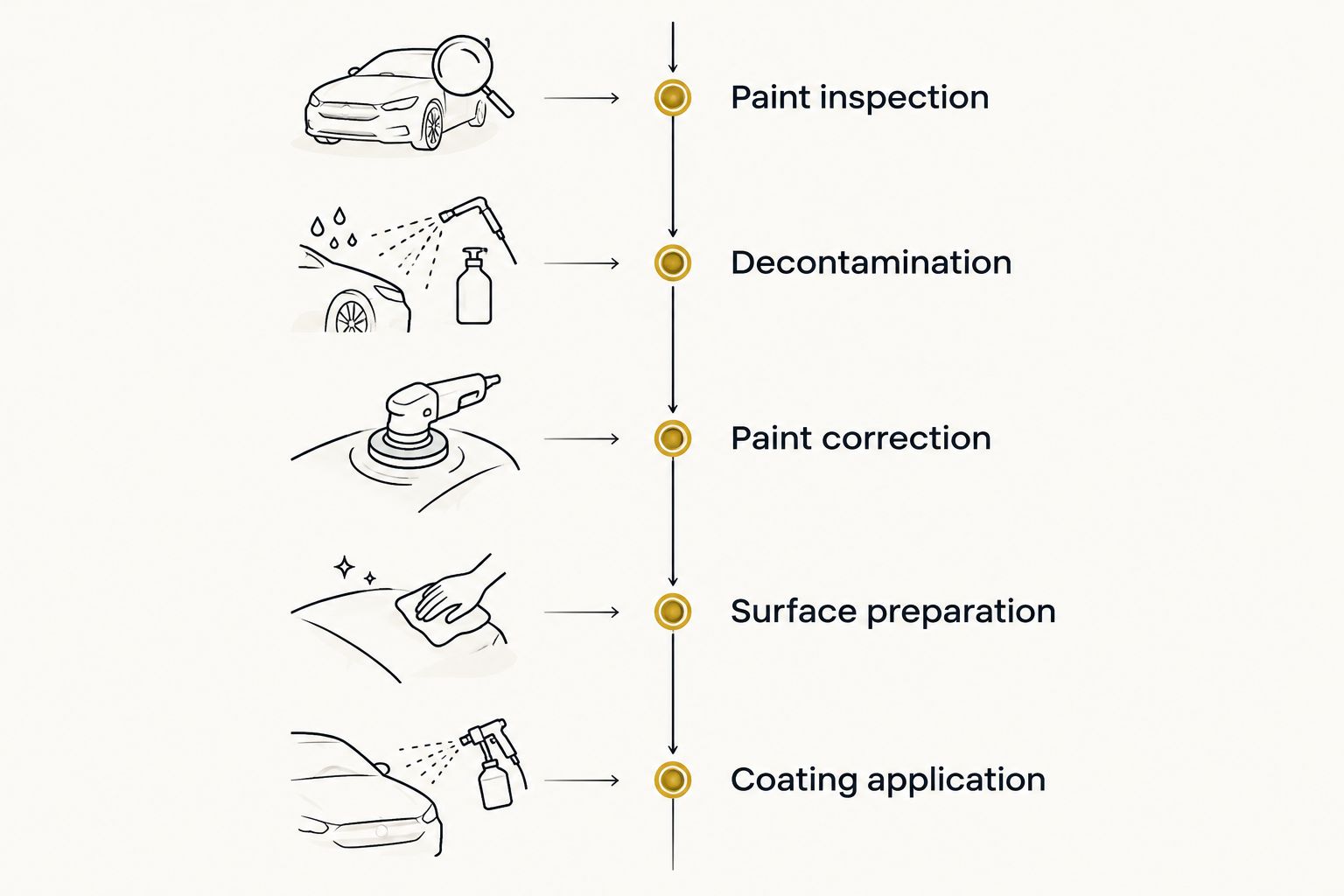
A ceramic coating proposal should explain the sequence below. These are selection criteria for your installer, not a claim that every vehicle needs identical work.
- Paint inspection: Identify the substrate, existing defects, previous repairs and finish expectations.
- Decontamination: Remove relevant bonded contamination using methods suited to the surface.
- Paint correction: Correct suitable defects only where inspection supports abrasive work.
- Surface preparation: Prepare the surface according to the coating manufacturer's instructions.
- Coating application: Apply and level the coating, then follow its curing requirements.
Check the paint before application, not only at collection. Once a coating is installed, correcting an underlying defect requires addressing the treated surface again.
Ask to see the corrected finish without temporary masking from preparation residues. Then ask how the installer checks for uneven coating residue, often called high spots. These workmanship questions are more useful than an unexplained layer count.
Questions to ask before approving the work
- What exact coating will be applied, and to which surfaces?
- Which defects will remain after the agreed preparation?
- What evidence supports any durability or hardness claim?
- When can the car encounter water or receive its first wash?
- Which maintenance products and methods are permitted?
- What do any written warranty terms require from you?
If a proposal includes PPF, ask these questions for the film as well. Coating instructions and film instructions should not be treated as interchangeable.
Maintenance determines whether black paint stays presentable
Ceramic coating does not eliminate washing. Dirt still lands on the car, water still carries dissolved minerals, and contact washing can still cause marks. Remove contamination with suitable methods instead of assuming the coating will make it harmless.
For a hand-washing routine, use 2 buckets if following a conventional wash-and-rinse method, and keep the wash media clean. The objective is to avoid dragging retained dirt across the paint; the bucket count alone does not guarantee a scratch-free wash. Avoid wiping a dusty panel with a dry cloth.
Dry the vehicle rather than leaving droplets to evaporate repeatedly. Remove bird droppings promptly using a safe cleaning method, without aggressive rubbing. Follow the named coating's instructions for maintenance chemicals and early washing restrictions.
Treat strong water beading as an observation, not proof of complete protection. Beading does not demonstrate stone-chip resistance or show that the paint underneath is free of defects.
How these approaches are ranked
The order follows paint condition, preservation, protection limits and maintenance requirements. Paint correction plus ceramic coating is the default for visibly swirled glossy black paint because it addresses the appearance problem first. Inspection-led coating suits sound new paint; PPF addresses physical impacts; matte-compatible treatment preserves a different finish.
This is a use-case ranking, not a claim that one coating formulation outperforms every other product. Compare named materials through their technical documentation, then assess the installation scope separately.
Which ceramic coating approach should you choose?
For most owners concerned about visible swirls on glossy black paint, choose assessed paint correction followed by ceramic coating. For a new car with sound paint, choose inspection-led preparation instead. If stone chips are your main concern, prioritise PPF coverage before deciding on coating.
Ask EA Detailer to separate the proposed ceramic coating work from correction and any PPF installation. In 2026, the useful decision is not which package sounds most elaborate; it is which work solves your car's identified problem without unnecessary treatment.
FAQ
What’s the best ceramic coating for a black car in Singapore?
The best approach for visibly swirled glossy black paint is assessed paint correction followed by ceramic coating. Choose the exact coating through documented compatibility, application requirements and aftercare rather than an unsupported brand ranking.
Does ceramic coating remove scratches from black paint?
No, ceramic coating does not remove scratches. Suitable defects require separate correction, and deep damage is not resolved by applying a coating.
Should I polish a new black car before ceramic coating?
Polish a new black car only where inspection identifies defects that justify correction. New paint still needs cleaning and preparation, but unnecessary abrasive work should be avoided.
Is ceramic coating better than PPF for black cars?
Ceramic coating and PPF serve different purposes. Choose PPF for a physical barrier against road debris and ceramic coating for its surface-treatment benefits; combining them requires confirmed compatibility.
Can I ceramic coat a matte black car?
Yes, use a coating confirmed as suitable for the specific matte paint or film. Conventional gloss polishing is unsuitable because it changes the intended surface appearance.
Will ceramic coating stop water spots in Singapore?
Ceramic coating does not guarantee freedom from water spots. Dissolved minerals can remain after droplets evaporate, so appropriate washing, drying and prompt cleaning still matter.
How long should I wait before washing a coated black car?
Follow the exact coating manufacturer’s instructions and the installer’s written handover guidance. Curing and early exposure requirements differ between products, so a universal waiting period is inappropriate.
What should I ask EA Detailer before booking ceramic coating?
Ask EA Detailer for the coating identity, preparation scope, expected remaining defects and written aftercare instructions. If PPF is included, confirm coverage and coating compatibility separately.
One last thing
Arrange a finish inspection before the coating goes on. Approving clean reflections at that point gives you a clearer workmanship checkpoint than admiring water beading at collection. A coating should protect an agreed finish, not distract you from an unfinished one.
Related guides
- Paint correction specialists for supercars
- How to choose a PPF installer in Singapore
- Ceramic coating for matte-finish cars

Leave a Reply