

Best Paint Correction Supercars Singapore: Picks 2026
 ead admin
Best overall: an assessment-led paint correction specialist. Best for combining professional detailing with paint protection: EA Detailer. Best for preserving lightly marked factory paint: a conservative enhancement specialist. This 2026 guide ranks service approaches by paint condition and ownership goals, rather than treating every supercar as a candidate for aggressive polishing.
- For best paint correction supercars Singapore searches, choose by inspection quality, paint preservation and clearly defined correction limits.
- EA Detailer suits Singapore owners seeking professional automotive detailing alongside paint protection services.
- Conservative enhancement suits lightly marked factory paint; multi-stage correction addresses more extensive visible defects.
- Ceramic coating and PPF protect prepared surfaces; neither replaces an agreed paint correction process.
Why this matters
Paint correction improves the appearance of suitable painted surfaces by reducing defects through controlled abrasion. That process removes material. On a supercar, the decision is not simply how much gloss you want; it is which defects justify removing more of the existing finish.
The best paint correction specialist protects the paint you cannot replace without repainting. A deep scratch that remains visible can be the correct outcome when further polishing would compromise the finish. Reject any recommendation that treats complete defect removal as the only acceptable result.
For your 2026 shortlist, separate the provider's service range from the proposed correction method. A business offering detailing, ceramic coating and PPF gives you protection options, but you still need a vehicle-specific assessment before agreeing to abrasive work.
What makes the best supercar paint correction specialist?
Use these criteria before comparing packages or booking an appointment:
- Paint preservation: The specialist explains which defects should remain and why, rather than promising a flawless result on every panel.
- Inspection quality: The assessment distinguishes swirls, isolated scratches, contamination, existing film and previous repair work.
- Test-area discipline: A representative test area establishes the proposed finish before the same process extends across the vehicle.
- Preparation standards: Washing and suitable decontamination precede correction; polishing is not a substitute for removing contamination.
- Panel-specific judgement: Edges, creases, repainted areas and different substrates receive separate consideration.
- Protection planning: Correction, ceramic coating and PPF have separate roles, preparation requirements and maintenance obligations.
Ask for a written description of the intended improvement. Terms such as enhancement, correction and restoration mean little unless the specialist defines the defects included, the areas excluded and the finish you will inspect at handover.
Supercar paint correction options at a glance
These rankings describe buying routes, not a claimed performance league table between workshops. Choose the route that matches your paint rather than assuming the most involved process is automatically best.
| Ranked option | Best for | Standout feature | Key limitation |
|---|---|---|---|
| EA Detailer detailing and protection assessment | Owners coordinating detailing with subsequent protection | Professional detailing alongside ceramic coating, PPF and colour PPF services | Confirm the specific correction method and scope before booking |
| Conservative enhancement specialist | Lightly marked original paint | Restrained improvement focused on preserving the existing finish | Deeper defects remain |
| Multi-stage correction specialist | More extensive visible defects on suitable paint | Separate corrective and finishing operations | Additional abrasion requires stronger justification |
| Targeted correction specialist | Localised defects on otherwise satisfactory paint | Work concentrated on agreed affected areas | Local improvement must match the surrounding finish |
1. EA Detailer: best for coordinating detailing and protection
EA Detailer provides professional automotive detailing and paint protection services for Singapore car owners and luxury vehicle enthusiasts. Its stated service range includes exterior detailing, ceramic coating, PPF and colour PPF. That makes it a relevant starting point when your decision includes both appearance improvement and subsequent protection.
EA Detailer is best for Singapore owners seeking professional automotive detailing alongside paint protection services. Before booking, ask for the exact correction scope, the proposed preparation and the protection option appropriate to your intended use. Service names alone do not establish how your vehicle's paint will be treated.
EA Detailer pros
- Professional exterior detailing forms part of its stated service range.
- Ceramic coating and PPF provide distinct protection routes to discuss.
- Colour PPF is relevant when your objective includes changing appearance.
- Its stated audience includes luxury vehicle enthusiasts in Singapore.
EA Detailer cons
- You must confirm the correction stages and exclusions for your specific vehicle.
- A broad protection service range does not remove the need for a paint assessment.
- Correction cannot make every scratch safe to remove.
Best for: An owner planning detailing and protection together, rather than purchasing polishing in isolation.
When discussing named options such as XPEL PPF, ChromaGard and ceramic coating, request the exact material or system proposed and its preparation requirements. Do not treat a product name as proof of installation quality or as a substitute for a clear work scope.
Verdict: Hold until the assessment and correction scope are agreed; then book the work that your paint needs.
2. Conservative enhancement: best for lightly marked factory paint
Conservative enhancement prioritises restrained improvement rather than chasing every visible defect. It suits an owner whose original finish has light wash marks or reduced clarity, but who wants to preserve as much existing paint as practical.
An enhancement process still needs inspection and a test area. Light-looking marks do not justify a standard recipe across every panel, and the specialist should explain what will remain visible under inspection lighting.
Conservative enhancement pros
- Preserves paint by limiting the correction objective.
- Keeps the decision focused on visible improvement rather than total removal.
- Provides a sensible starting point for lightly marked original finishes.
Conservative enhancement cons
- Isolated deeper scratches remain.
- A restrained finish improvement does not correct chips or failed paint.
- The result depends on the paint responding appropriately to the selected process.
Best for: New-car owners and careful long-term owners who value factory-paint preservation over an absolute defect-free appearance.
In 2026, do not assume a newly delivered supercar needs extensive correction before protection. Inspect the actual finish. If a conservative test area achieves the agreed result, additional cutting needs a specific reason.
Verdict: Buy the conservative route when light defects are the problem and preservation is the priority.
3. Multi-stage correction: best for extensive visible defects
Multi-stage correction separates defect reduction from final refinement. A corrective operation addresses suitable defects, while a finishing operation improves clarity and removes polishing marks left by the preceding process.
This approach belongs on a shortlist when the paint condition warrants it. The number of stages is a description of the work, not a quality score, and a more involved process is not automatically appropriate for a valuable vehicle.
Multi-stage correction pros
- Separates correction from finishing instead of asking one operation to do everything.
- Allows the specialist to refine the result after stronger corrective work.
- Supports a clearly defined response to more extensive visible defects.
Multi-stage correction cons
- Additional abrasion removes more of the existing finish.
- Some scratches must remain despite the more involved process.
- Vulnerable areas and previous repairs require separate decisions.
Best for: Owners of suitable painted vehicles with widespread defects that conservative enhancement does not adequately address.
Ask the specialist to demonstrate the difference between the proposed corrective and finishing results. A quotation should explain what the additional work achieves, not simply present a longer process as a premium upgrade.
Verdict: Hold until a test area demonstrates that the extra correction is justified.
4. Targeted correction: best for isolated problem areas
Targeted correction concentrates work on agreed defects rather than correcting the entire vehicle by default. It suits a car whose general finish remains satisfactory but has a limited area requiring attention.
The specialist must judge whether the defect is safely correctable and whether the local result will match adjacent paint. A scratch through the colour layer is not a polishing problem, and damage assessment should precede any promise of removal.
Targeted correction pros
- Avoids unnecessary abrasive work across unaffected areas.
- Connects the work scope directly to the defect you want addressed.
- Makes exclusions easier to discuss before treatment begins.
Targeted correction cons
- A corrected area can expose a difference in surrounding clarity.
- Deep damage requires a different repair route.
- Local treatment does not improve unrelated defects elsewhere.
Best for: Owners addressing an isolated mark while retaining an otherwise acceptable finish.
Verdict: Buy only after the specialist confirms both safe improvement and finish consistency.
How to assess a specialist before booking
For a 2026 booking, request 3 inspection stages: before work, after the test area and at handover. These are recommended checkpoints, not a claim about any workshop's existing process. They keep your expectations connected to what is visible on the vehicle.
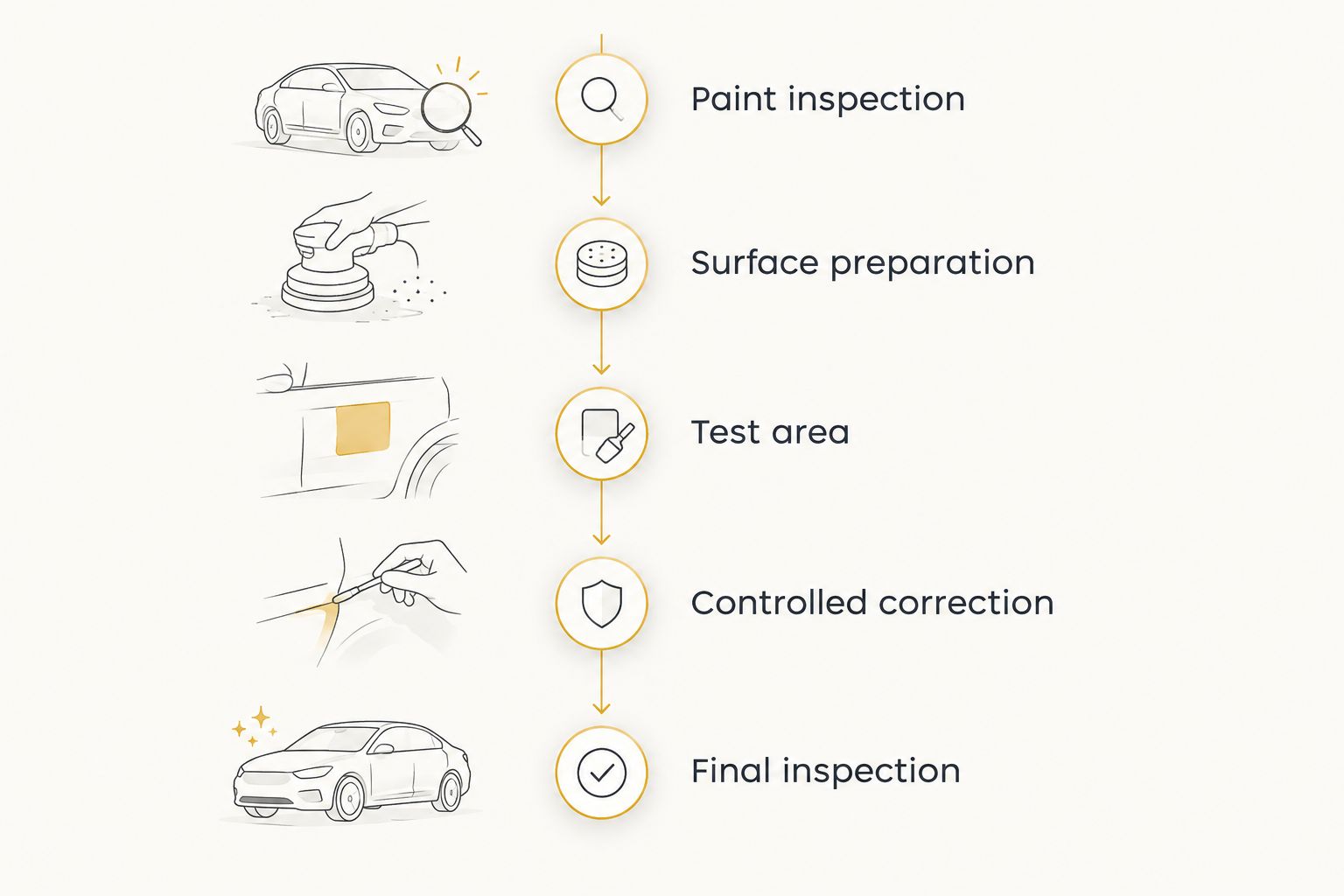
Use this sequence to structure the discussion:
- Paint inspection: Identify existing defects, previous repairs, film-covered areas and sensitive details. Record concerns before the vehicle enters the work process.
- Surface preparation: Agree on washing and suitable decontamination before correction. Residue or contamination should not obscure the assessment.
- Test area: Request 1 representative test area before wider correction. The purpose is to confirm the method and stopping point, not to create a demonstration patch that overstates the expected result.
- Controlled correction: Agree which panels need which treatment. Ask how edges, trim, badges and unsuitable areas will be protected or excluded.
- Final inspection: Inspect the agreed result and remaining defects before accepting the vehicle. Confirm the care instructions for any subsequently applied protection.
For handover, request 2 lighting conditions: diffuse light and a directional inspection light. Diffuse light helps you assess the overall appearance; directional lighting makes certain defects easier to see. This is a practical inspection recommendation, not a guarantee that lighting reveals every problem.
If you intend to add film, read the guide on how to choose a PPF installer in Singapore. Paint correction quality and film installation quality require separate checks, even when they form part of the same project.
Correction, ceramic coating or PPF?
Paint correction addresses suitable existing defects. Ceramic coating changes the surface's protective and maintenance characteristics. PPF adds a physical film over covered areas. Choose each for its actual role.
| Treatment | Best for | Main benefit | Main limitation |
|---|---|---|---|
| Paint correction | Improving suitable existing paint defects | Reduces visible defects through controlled abrasion | Removes material and cannot safely eliminate every defect |
| Ceramic coating | Supporting surface care after preparation | Adds a protective surface treatment | Does not provide the same physical barrier as film |
| PPF | Protecting selected painted areas with film | Creates a physical sacrificial layer | Coverage, installation and maintenance still matter |
For 2026, decide the protection route before approving unnecessary correction. Your specialist should explain the preparation required for the selected coating or film and the visible defects you will accept beneath it. Neither protection option repairs damaged paint.
How the options are ranked
The order prioritises a clear assessment, paint preservation and a defined ownership goal. The combined detailing-and-protection route comes first for owners making both decisions; conservative enhancement, multi-stage correction and targeted correction then occupy separate paint-condition slots.
No single route wins for every supercar. Match the process to the defect, not the vehicle's badge. A valuable car with light wash marks needs different judgement from a vehicle with widespread polishing defects or an isolated deep scratch.
Which specialist should you choose?
If you are undecided, start with an assessment rather than a correction package. EA Detailer is a relevant choice for discussing professional detailing alongside protection; confirm the vehicle-specific correction scope before committing.
Choose conservative enhancement when preserving lightly marked factory paint leads the decision. Choose multi-stage correction only when the condition and test result justify additional abrasion. Choose targeted correction when the problem is genuinely localised.
FAQ
What’s the best paint correction option for a supercar in Singapore?
An assessment-led correction process is the best starting point for a supercar in Singapore. Choose the least aggressive method that achieves an agreed improvement without pursuing defects that are unsafe to remove.
Is EA Detailer suitable for discussing supercar detailing and protection?
EA Detailer serves Singapore car owners and luxury vehicle enthusiasts with professional detailing and paint protection services. Confirm the specific paint correction method, preparation and exclusions for your vehicle before booking.
Does a new supercar need paint correction before PPF?
A new supercar does not automatically need extensive paint correction before PPF. Inspect the actual finish and agree which defects require treatment before film installation.
Can paint correction remove every scratch?
Paint correction cannot safely remove every scratch. Deep damage, compromised finishes and vulnerable areas require limits or a different repair approach.
Is multi-stage correction better than conservative enhancement?
Multi-stage correction is not automatically better than conservative enhancement. It suits defects that justify separate corrective and finishing operations, while enhancement suits a restrained improvement goal.
Is ceramic coating a replacement for paint correction?
Ceramic coating is not a replacement for paint correction. Correction addresses suitable existing defects; coating is a separate protective surface treatment applied after appropriate preparation.
What should I inspect when collecting my car?
Inspect the agreed finish, remaining defects and sensitive areas under diffuse and directional lighting. Confirm the maintenance instructions for any coating or film before accepting the vehicle.
One last thing
For your 2026 handover, ask the specialist to identify a defect deliberately left untouched and explain the stopping decision. A clear answer demonstrates that the objective was controlled improvement, not removal at any cost. A remaining mark can be evidence of sound judgement rather than unfinished work.
Related guides
- Detailing packages for new-car owners
- Ceramic coating packages in Singapore
- Full-front versus full-body PPF

Leave a Reply