

How long does car window tint last in Singapore?
 ead admin
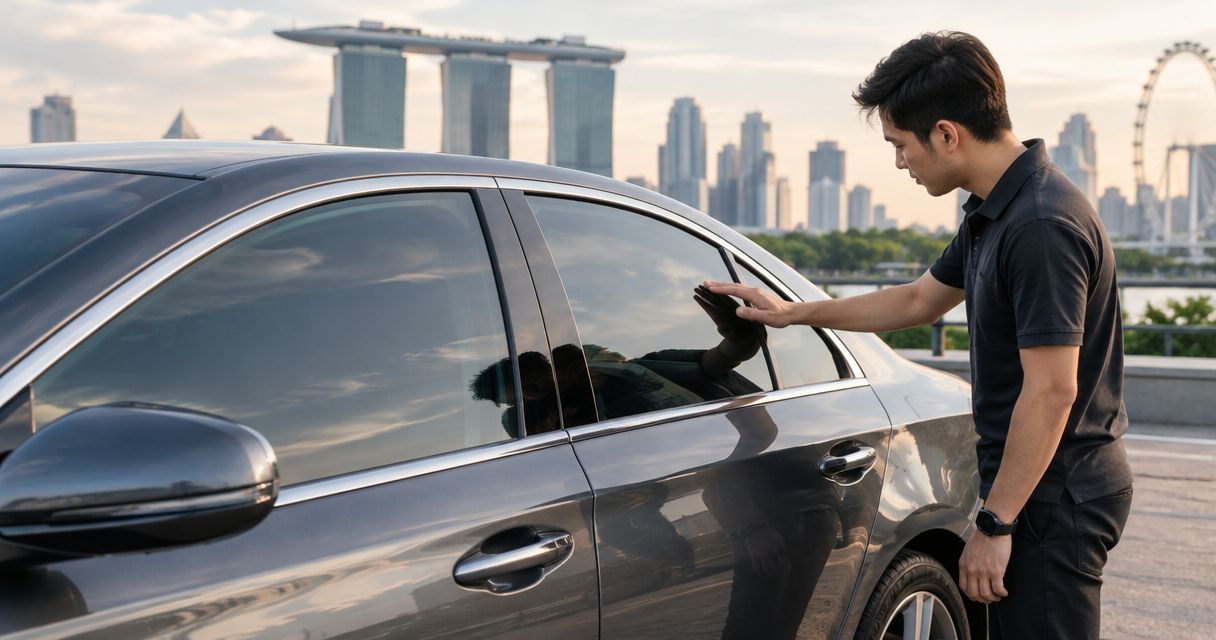
Car window tint has no single fixed lifespan in Singapore: the film specification, installation quality, sun exposure and maintenance determine when it needs replacing. For a 2026 replacement decision, use the actual film’s written durability terms and its present condition—not a generic promise of years. A warranty period is not a guarantee that every window will remain clear, undamaged and compliant throughout that period.
- How long does car window tint last in Singapore? Film specification and condition matter more than a generic lifespan.
- Singapore’s LTA requires at least 70% light transmission through the front windscreen and front side windows.
- Rear windscreens and rear side windows must transmit at least 25% of light under Singapore’s LTA requirements.
- Replace deteriorated tint when persistent haze, peeling or distortion affects visibility; do not wait for warranty expiry.
Why this matters
Window tint is part of your view of the road. A film that still looks dark from outside can have scratches, haze or adhesive deterioration that make driving less comfortable and visibility less clear.
The useful question is not simply how old the film is. Ask whether it still provides clear vision, remains securely bonded and meets Singapore’s requirements. If you are choosing a replacement, compare documented specifications before browsing window tint film brands in Singapore.
How long does car window tint last in Singapore?
Car window tint lasts until its optical clarity, adhesion or suitability deteriorates—not until an arbitrary anniversary. There is no sound universal replacement age for every film, every vehicle and every parking routine.
For a car assessed in 2026, establish the film’s history before accepting a lifespan claim. An installer should distinguish the manufacturer’s stated coverage from an estimate based on your car’s use.
Use this sequence:
- Identify the film. Obtain the manufacturer, exact film series and installation record. A broad description such as ceramic tint does not identify the adhesive, construction or warranty terms.
- Read the coverage. Check which failures the written warranty covers, who handles a claim and whether labour or removal is included. Do not treat an advertised duration as complete coverage.
- Inspect each window. Look through the glass in daylight and under road lighting. Check for persistent haze, distortion, scratches, bubbles and lifting edges.
- Verify light transmission. Assess the glass and film together. A specification for the film alone does not establish that the finished window complies.
Keep those records with the vehicle. For a used car with unidentified tint, a condition inspection and light-transmission measurement are more useful than guessing its installation date.
Dyed, metallised and ceramic tint: compare construction, not years
Film construction explains important differences, but it does not establish a guaranteed replacement date. Compare the exact products rather than assuming every ceramic film outlasts every dyed or metallised film.
| Film construction | Best for | Main advantage | Limitation to check |
|---|---|---|---|
| Dyed film | Owners prioritising appearance and glare reduction | Provides shading without a metallic layer | Colour stability depends on the product; darkness alone does not establish heat rejection |
| Metallised film | Owners considering a metal-based solar-control film | Uses a metallic layer to reflect solar energy | Some constructions can interfere with radio-frequency signals; check vehicle compatibility |
| Ceramic film | Owners seeking a non-metallic solar-control option | Uses ceramic-based materials without relying on a metallic layer | The ceramic label alone does not establish clarity, durability or overall solar performance |
Choose a documented film specification, not a material label. Ask for visible light transmission and solar-performance information for the exact shade being installed. Comparing different shades without accounting for light transmission can give a misleading impression of performance.
A darker film is not automatically a longer-lasting film. It is also not proof of better heat control, especially when the comparison ignores the rest of the specification.
Why window tint lifespan varies
Singapore’s outdoor exposure makes parking and use relevant, but climate alone cannot predict a replacement date. These factors explain why two installations can age differently:
- Film construction: The film layers, colourants, protective surface and adhesive influence how the installation ages. Assess the exact series rather than the category name.
- Preparation: Residue, contamination and poor cleaning affect the finished result. Good material cannot compensate for inadequate glass preparation.
- Installation quality: Creases, contamination, uneven edges and poor bonding are installation concerns, not normal consequences of age.
- Sun exposure: Outdoor parking exposes the film to more sunlight than sheltered parking. Compare your own parking routine when discussing expected durability.
- Mechanical wear: Window seals, trapped grit, abrasive tools and repeated contact can scratch or damage the film surface.
- Cleaning and aftercare: Unsuitable chemicals and rough cleaning materials can damage film. Follow the instructions for the installed product.
These are inspection prompts, not a formula for calculating remaining years. A careful installer should explain which factors apply to your vehicle without promising an unsupported service life.
What does failing window tint look like?
Check appearance from outside, then assess visibility from the driver’s seat. A cosmetic inspection alone misses problems that appear when looking through the glass towards lights or bright surroundings.
| Observation | What to investigate | Recommended action |
|---|---|---|
| Persistent bubbles after the specified curing period | Adhesion failure or an installation defect | Ask the installer to assess the affected pane |
| Lifting edges | Local bonding failure or physical damage | Arrange inspection before attempting any repair |
| Purple, faded or uneven colour | Deterioration of the film’s colouring | Compare against installation records and seek assessment |
| Persistent haze or distorted vision | Contamination, film damage or adhesive deterioration | Prioritise a visibility assessment |
| Fine surface scratches | Abrasive cleaning or contact with grit | Review cleaning methods and inspect window seals |
Do not diagnose a new installation as failed before its stated curing period has passed. Temporary moisture effects can occur during curing; the installer’s written instructions should explain what to expect and when to return.
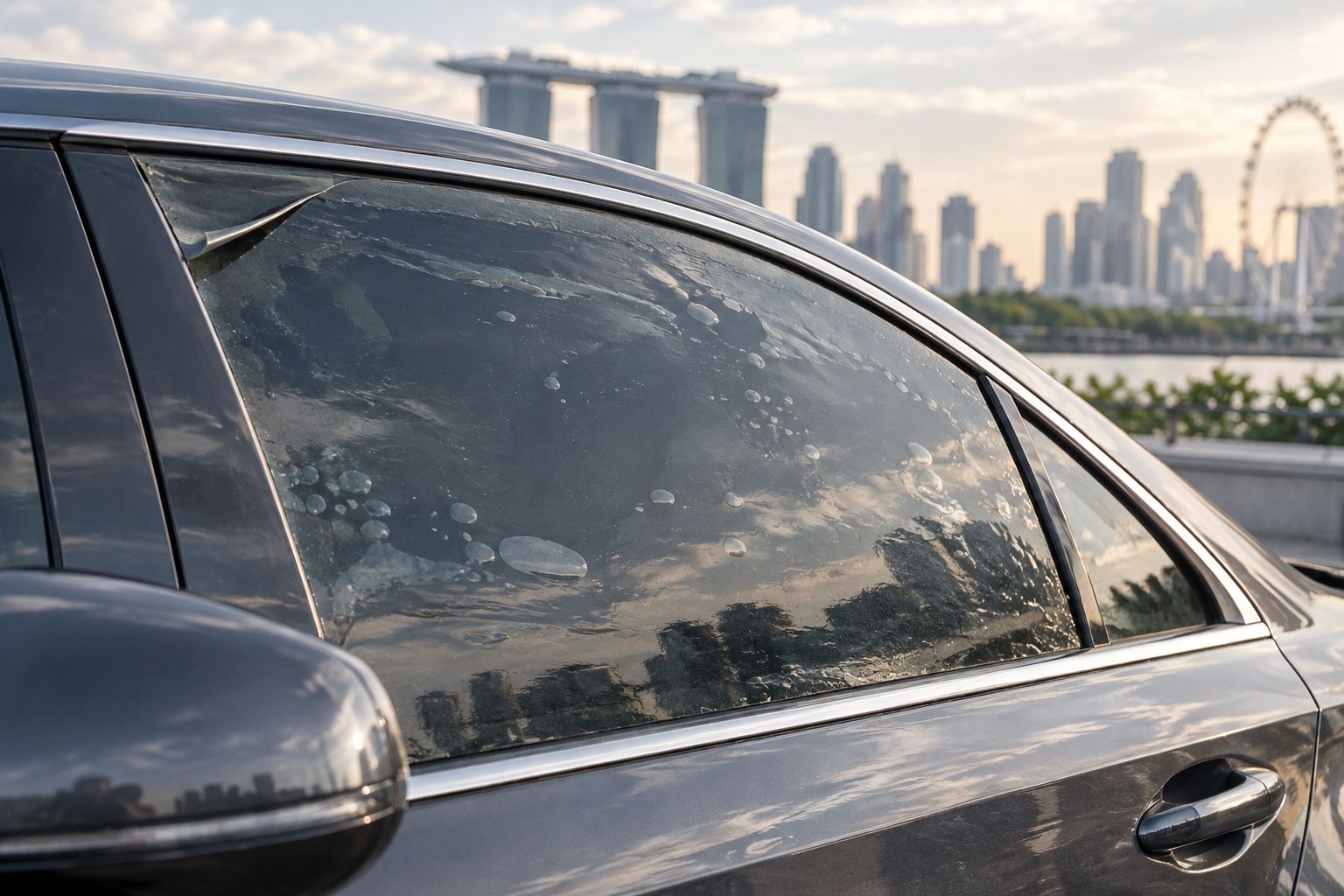
Do not press bubbles with a sharp object, cut lifted edges or apply household adhesive. These actions can damage the film and complicate the assessment of the original problem.
Does older tint still meet Singapore’s rules?
Age alone does not establish compliance. For your 2026 check, Singapore’s Land Transport Authority requirements concern the light passing through the finished glazing, not simply the shade printed on a film sample.
The minimum light-transmission requirements are:
- Front windscreen: 70% light transmission.
- Front side windows: 70% light transmission.
- Rear windscreen: 25% light transmission.
- Rear side windows: 25% light transmission.
LTA also requires non-reflective tinting and requires the front windscreen not to interfere with signals between the vehicle’s in-vehicle unit and Electronic Road Pricing equipment. Check current LTA guidance when arranging installation or inspection.
Factory glass already affects light transmission. Adding film changes the combined result, so a film labelled with a particular transmission value does not guarantee the same reading through the installed window.
Ask for a measurement of the completed glass-and-film combination. Do not add another layer of tint to conceal fading or increase darkness without checking the resulting compliance and visibility.
How should you maintain tint after installation?
Start with the installer’s instructions for the specific film. Curing requirements differ, so do not substitute a universal waiting period for the written guidance supplied with your installation.
Keep the routine simple:
- Respect curing instructions. Follow the stated restrictions on operating windows and cleaning newly installed film.
- Use suitable cleaner. Choose a product approved for the film; avoid unapproved solvents, abrasives and ammonia-based cleaners.
- Use clean, soft cloths. A dirty cloth can carry grit across the film and leave scratches.
- Protect the edges. Avoid catching film edges with tools, fingernails or accessories.
- Investigate repeated scratching. Check seals and contact points rather than repeatedly replacing film without addressing the cause.
For maintenance in 2026, save the aftercare instructions alongside the installation invoice. That gives anyone cleaning the car a clear reference instead of relying on memory.
Can you replace just one tinted window?
A single affected window can be assessed for replacement without automatically replacing every pane. The decision depends on the defect, the condition of the other windows and whether the replacement can provide an acceptable match.
An older installation can differ in appearance from fresh film. Ask to compare the proposed replacement against the remaining windows before authorising work, especially where colour consistency matters to you.
For a rear windscreen, discuss the demister before removal. Adhesive removal requires care around the heating elements; do not attempt to strip deteriorated film with a blade as a shortcut.
What should you ask a window tint installer?
A useful quotation identifies the material and the work. It should not depend on a promise that the film will last longer than your ownership period.
Before approving a 2026 installation, ask:
- What manufacturer and exact film series will be installed on each window?
- How will the finished glass-and-film light transmission be checked?
- What preparation is required, including removal of existing adhesive?
- What appearance is normal during curing, and what requires a return visit?
- Which failures are covered in writing, and what exclusions apply?
- Who handles a claim if the film develops a defect?
Eadetailer window tint services are best suited to Singapore car owners seeking professional installation rather than a DIY application. Eadetailer provides window tint alongside automotive detailing and paint-protection services; confirm the exact tint specification and written terms for your vehicle before proceeding.
Keep service categories separate when comparing proposals. Names such as XPEL PPF, ChromaGard and ceramic coating do not establish a window film’s construction or durability. A paint-protection proposal is not a substitute for a glass-specific tint specification.
For Eadetailer window tint enquiries, bring photographs of any defects and the original installation record if available. That creates a clearer starting point than asking for replacement solely because the car has reached a particular age.
Discuss your window tint requirements
Ask about film specifications, existing tint condition and installation requirements for your car.
FAQ
How long does car window tint last in Singapore?
Car window tint has no universal lifespan in Singapore. Use the exact film’s written durability terms, installation history and current clarity and adhesion to decide when replacement is necessary.
Does ceramic window tint last longer than dyed tint?
The ceramic label alone does not prove a longer lifespan than a particular dyed film. Compare the exact products’ construction, written warranty coverage and maintenance requirements.
Should I replace tint as soon as the warranty ends?
Warranty expiry alone is not a reason to replace window tint. Inspect clarity, adhesion, surface condition and light transmission before deciding.
Are bubbles normal after new window tint is installed?
Temporary moisture effects can occur while new tint cures, but persistent bubbles after the specified curing period require assessment. Follow the installer’s written curing guidance rather than a generic deadline.
What tint light transmission is legal in Singapore in 2026?
At least 70% light transmission is required through the front windscreen and front side windows, and at least 25% through the rear windscreen and rear side windows. Assess the finished glass-and-film combination and check current LTA requirements.
Can I clean tinted windows with ordinary glass cleaner?
Use a cleaner approved for your installed film rather than assuming any glass cleaner is suitable. Avoid abrasive materials and follow the film’s instructions on chemicals and curing.
Can old rear-window tint be removed without damaging the demister?
Rear-window tint removal requires care around demister heating elements. Have the glass, film and adhesive assessed before removal rather than scraping the surface yourself.
One last thing
A clean-looking film can still be the wrong film for the glass beneath it. Before keeping or replacing tint, check the completed window—not just a brochure, sample or installation date.
Ask Eadetailer to distinguish the film specification, installation requirements and protection limits in your discussion. Those details support a sound decision; an unsupported lifespan promise does not.
Related guides
- Window tint for Grab and Gojek drivers
- Car window tint for privacy in Singapore
- Window tint for corporate executive cars

Leave a Reply