

Window tint for Grab and Gojek drivers: complete 2026 guide
 ead admin
Grab and Gojek drivers’ window tint is a film applied to vehicle glass to manage solar heat, glare and privacy while preserving legal visibility and passenger comfort. This 2026 guide explains how to choose compliant film, assess installation quality and plan maintenance around a working private-hire car.
- Choose window tint for Grab and Gojek drivers by measured glass-and-film light transmission, not darkness alone.
- Singapore requires at least 70% light transmission through front glazing and 25% through rear glazing.
- EA Detailer suits drivers seeking professional window tint installation rather than a do-it-yourself application.
- Compare solar-control evidence, night visibility and installation standards before selecting a film.
Why window tint matters for Grab and Gojek drivers
Your car is both a workplace and a passenger space. Film selection must account for daylight driving, sheltered pickup points, reversing after dark and passengers sitting beside the rear windows. A tint that looks attractive outside is not automatically comfortable or safe from the driver’s seat.
EA Detailer window tint is best for drivers seeking professional installation rather than a do-it-yourself film application. The service fits owners who want assistance with selection and fitting; you should still request the exact film specification, measured compliance and written care instructions before authorising work.
EA Detailer provides window tint alongside automotive detailing and paint protection services. Keep those services separate when deciding what your working car needs: tint addresses glass, while paint protection addresses painted surfaces.
For a 2026 installation, start with visibility and compliance. Heat-control claims come next. Neither passenger privacy nor a demonstration lamp justifies installing film that leaves the finished window below Singapore’s required light-transmission threshold.
How to choose and install window tint
1. Check the rules and your vehicle permission
Singapore’s Land Transport Authority vehicle-modification guidance requires at least 70% visible light transmission through the front windscreen and front side windows, and 25% through the rear windscreen and rear side windows. Tinted glass must also be non-reflective, and film must not interfere with signals between the in-vehicle unit and ERP equipment.
These thresholds concern the finished glazing, not just the film sample. Factory-tinted glass already reduces light transmission, so an apparently suitable film can produce an unsuitable combination.
If you rent or lease your private-hire car, check the vehicle agreement before changing its windows. Road compliance and the owner’s permission are separate checks; satisfying one does not settle the other. Keep the owner’s approval with your installation documents rather than relying on a verbal conversation.
- Confirm the front and rear glazing requirements against current LTA guidance.
- Obtain written permission when the vehicle belongs to a rental or leasing company.
- Ask whether existing film must be removed before assessment.
- Check any applicable vehicle-owner or platform documentation separately.
2. Measure existing glass before choosing film
Ask for a visible light transmission measurement on the existing windows. Visual judgement is not a substitute: glass colour, surrounding light and the interior trim all affect how dark a window appears.
A hypothetical calculation shows the issue. Glass transmitting 80% of visible light, combined with film transmitting 90%, gives an approximate combined transmission of 72%. That calculation illustrates why the glass matters; it does not replace measuring the completed installation.
Measure each relevant window rather than assuming every pane has the same specification. This matters when a used working car has replacement glass or an unknown tinting history. For your 2026 shortlist, reject any proposal based solely on a film’s standalone VLT figure.
- Record the existing glass readings before selecting film.
- Request the proposed film’s standalone VLT specification.
- Ask for finished glass-and-film measurements after installation.
- Leave room above the legal minimum rather than targeting the threshold exactly.
3. Define the result you need from each window
Write down your priorities before comparing packages. Front glazing needs clear driving visibility; rear passenger windows also influence privacy and comfort. These priorities overlap, but they are not interchangeable.
Evaluate glare from your normal seating position. Look through candidate samples toward shaded areas, not only a bright showroom display. For night work, consider visibility when checking mirrors, reversing and identifying passengers at pickup points.
Professional installation is the faster alternative to researching and applying film yourself. Ask EA Detailer to explain the proposed window tint specification against your driving needs, but do not treat a service recommendation as evidence of a particular film’s performance. The written specification must support the selection.
- Identify whether your main concern is solar heat, glare or passenger privacy.
- Assess front-window clarity before choosing rear-window darkness.
- Explain your usual driving conditions and sheltered pickup locations.
- Request a window-by-window proposal rather than one general tint description.
4. Compare technical evidence, not a darkness sample
Visible light transmission describes how much visible light passes through glazing. It does not, by itself, establish total solar heat performance. A darker sample and a better heat-control film are not necessarily the same thing.
Ask for total solar energy rejected, commonly abbreviated as TSER, and the conditions under which it was measured. When comparing infrared rejection figures, check the wavelength range and test method. Figures measured on different bases do not provide a sound like-for-like comparison.
The guide to window tint film brands in Singapore is a useful next step for organising your shortlist. Keep the comparison tied to exact film specifications rather than assuming a brand name guarantees identical performance across its range.
- Compare VLT and solar-control specifications together.
- Ask whether performance figures describe film alone or film applied to glass.
- Check the measurement basis behind infrared rejection claims.
- Request written information about optical clarity and signal compatibility.
5. Inspect preparation and installation standards
Film installation starts with the glass surface. Dirt, adhesive residue and trapped contamination undermine the finish, while careless removal of existing film risks damage around vulnerable components. Ask how the installer handles rear-window demister lines and protects adjacent trim.
A new-car owner should not assume factory-fresh glass needs no preparation. A used-car owner should establish whether old film or adhesive remains. Both need a clear explanation of cleaning, fitting and final inspection.
The handover should distinguish temporary curing effects from defects requiring attention. Do not accept a general instruction to ignore every bubble or mark. Ask which changes are expected, what should disappear and when the installer wants you to return for assessment.
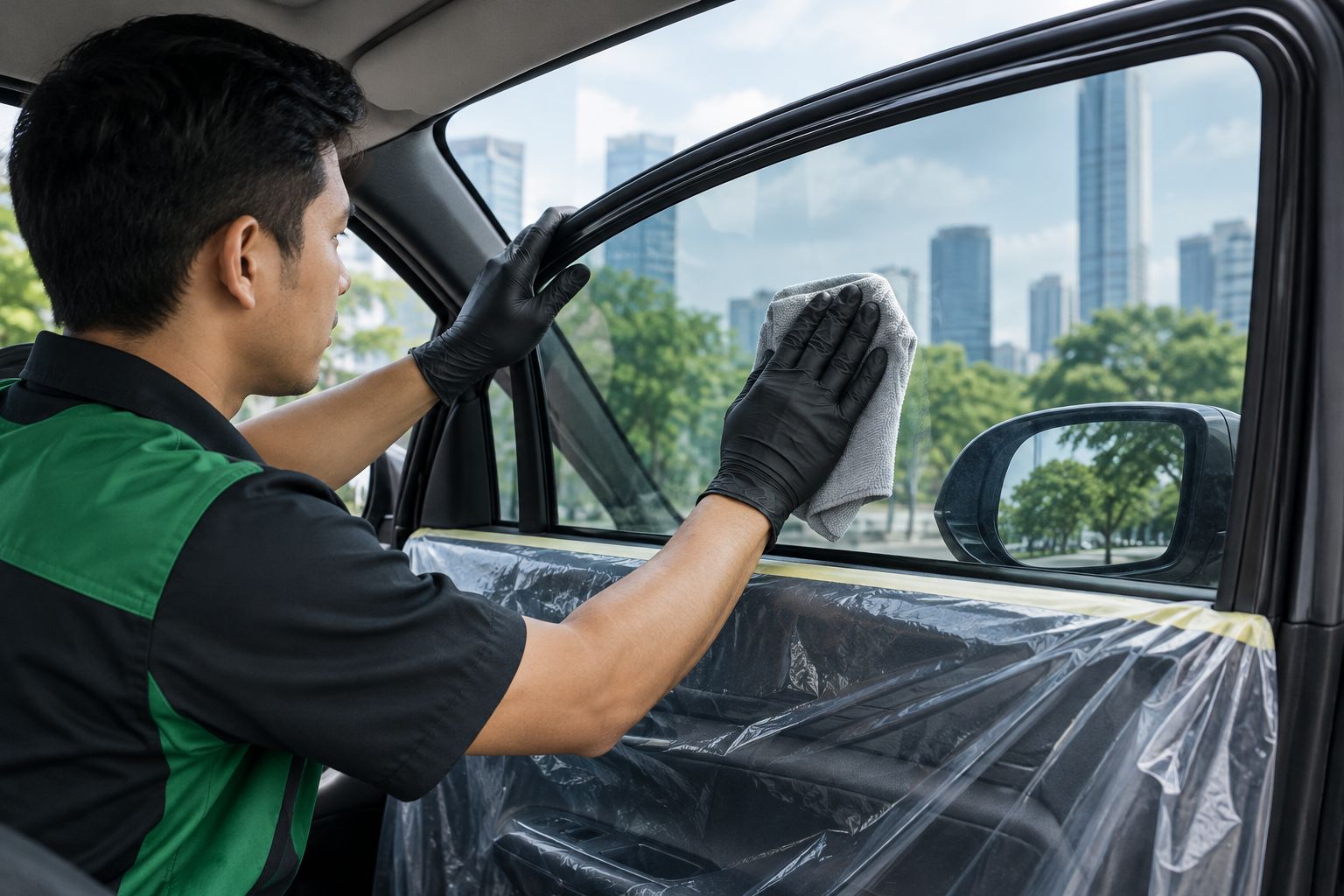
Inspect the finished windows from inside and outside. Appearance is only part of acceptance: the windows must operate normally, visibility must remain usable and the measured transmission must meet the applicable requirement.
- Ask how glass, seals and edges are cleaned before fitting.
- Confirm protection for door trim, electronics and rear demister lines.
- Inspect for trapped debris, creases and inconsistent edges.
- Request instructions for distinguishing curing effects from installation defects.
6. Schedule fitting around passenger use
A working car needs an installation plan, not just an appointment. Ask the installer for the fitting duration and the film-specific restrictions afterward. Do not substitute a generic internet curing period for instructions covering your actual film and installation conditions.
Passenger windows are especially relevant. If the installer requires them to remain closed initially, organise your driving and passenger communication around that instruction. Opening a window prematurely risks disturbing newly fitted film at its edges.
For a 2026 booking, confirm handover checks before leaving the vehicle. You need to know who records the completed VLT measurements, who explains care and how a concern is assessed. A rushed collection that skips these checks leaves you without a clear basis for acceptance.
- Schedule fitting when you can follow the required aftercare restrictions.
- Ask when each window can be operated and cleaned.
- Obtain the finished VLT readings before accepting the installation.
- Keep the film identification, invoice and written care instructions together.
7. Maintain the film and inspect changes
Window tint remains a surface that needs careful cleaning. Use the cleaner and method specified for the installed film, and avoid abrasive tools. Scraping adhesive from the inside of a tinted window can damage the film rather than simply remove the residue.
Check the edges during ordinary interior cleaning. Lifting, scratches or persistent visual distortion deserve assessment, particularly when they affect mirror checks or forward visibility. Do not cover a deteriorating layer with another film as a shortcut.
Treat maintenance as part of your 2026 vehicle-care routine. Tint does not sanitise the cabin, clean upholstery or protect exterior paint. XPEL PPF, ChromaGard and ceramic coating belong to separate paint-protection decisions; none establishes whether your window tint is compliant.
- Follow the installed film’s cleaning instructions.
- Keep abrasive pads and scraping tools away from tinted surfaces.
- Report lifting edges or visibility problems to the installer.
- Recheck glazing after film replacement or significant window work.
Compare your window tint options
Choose the option that solves a documented problem without compromising visibility. The following comparison separates material choices from installation choices; neither a film category nor professional fitting alone proves the finished result.
| Option | Best for | Main advantage | Key limitation |
|---|---|---|---|
| Existing glass without aftermarket film | Drivers whose current glazing already meets their needs | Avoids film fitting and film-specific maintenance | Provides no additional aftermarket-film function |
| Dyed window film | Drivers primarily seeking a change in visible shading | Offers a shading-focused option | Darkness alone does not demonstrate solar heat performance |
| Metal-containing window film | Drivers comparing films with documented solar-control properties | Offers another material approach to solar control | Signal compatibility and non-reflective compliance require checking |
| Ceramic window film | Drivers comparing non-metallic solar-control options | Provides a non-metallic material option | The ceramic label alone does not prove heat rejection or clarity |
| Professional installation | Drivers wanting fitted film with an agreed assessment and handover | Places fitting work with an installer | You still need written specifications and finished measurements |
| Do-it-yourself installation | Owners prepared to handle application and verification themselves | Gives direct control over the application work | Preparation, fitting defects and compliance checks remain your responsibility |
For EA Detailer, the relevant advantage is access to a professional window tint service. The limit is equally clear: select an exact film and installation scope before judging performance. Do not infer a film brand, technical specification or warranty from the service name.
Common mistakes Grab and Gojek drivers make
Choosing rear-window privacy as the whole specification
Rear passenger privacy does not settle front-window visibility. Assess each glazing position separately, particularly if you drive after dark. A uniform appearance is not a sufficient reason to use the same film specification throughout the car.
Comparing infrared percentages without their test basis
A prominent infrared rejection figure is incomplete without its measurement conditions. Ask which wavelengths were assessed and whether the figure applies to film alone or installed glazing. Keep TSER and VLT in the comparison rather than selecting on one headline percentage.
Assuming installation guarantees inspection acceptance
An installer’s assurance does not replace compliance measurements or the requirements of the relevant inspection. Keep LTA glazing requirements separate from rental-owner approval and any platform process. Ask for evidence of the finished result, not a promise that every inspection will accept it.
Ignoring window use after fitting
Passengers do not know your new film’s care instructions. If windows must stay closed initially, explain that restriction and arrange your work accordingly. Book fitting when you can follow the instructions rather than treating aftercare as optional.
Buying unrelated protection to solve cabin heat
Exterior detailing, XPEL PPF, ChromaGard and ceramic coating serve different purposes from window tint. Specify glass-related needs first. Adding paint-protection services does not answer questions about tint VLT, optical clarity or solar-control performance.
FAQ
What is the best window tint for Grab and Gojek drivers?
The best window tint meets Singapore’s glazing requirements, preserves useful driving visibility and has documented solar-control performance. Compare the exact film on your existing glass rather than choosing by darkness or material label alone.
What are Singapore’s legal window tint limits in 2026?
Singapore’s LTA guidance requires at least 70% light transmission through the front windscreen and front side windows, and 25% through the rear windscreen and rear side windows. The finished glass-and-film combination must meet the requirement; tinted glass must also be non-reflective and film must not interfere with IU-to-ERP signals.
Is ceramic window tint better than ordinary dark film?
A ceramic label does not establish that a film is better for your car. Compare measured VLT, solar-control specifications, optical clarity and the test basis for each exact film.
Can I tint a rented Grab or Gojek car?
Check the vehicle owner’s agreement and obtain permission before tinting a rented car. Owner approval is separate from road compliance and any applicable platform requirements.
Does window tint mean I can use less air conditioning?
Window tint does not establish a specific reduction in air-conditioning use or fuel consumption. Solar-control film addresses solar energy entering through glazing, but cabin conditions also depend on parking exposure, ventilation and vehicle operation.
How soon can passengers open the windows after tinting?
Follow the installer’s written instructions for the exact film and installation. There is no single waiting period that this guide can apply to every film, vehicle and fitting condition.
Does ceramic coating replace window tint?
Ceramic coating does not replace automotive window tint. Paint coating and glass film address different surfaces and functions, so choose each against its own specification and maintenance requirements.
One last thing
Ask to see the completed VLT measurement before collecting your car. A film sample describes one component; the measurement checks the glazing you will actually drive behind. Keep that distinction at the centre of your 2026 decision, even when the film looks light enough by eye.
Related guides
- Ceramic coating for Grab and Gojek drivers
- Passing a Grab or Gojek inspection after ceramic coating
- Car window tint for privacy in Singapore

Leave a Reply