

Best Car Window Tint Privacy Singapore: Picks 2026
 ead admin
Best overall: ceramic film with compliant rear-window VLT. Best for straightforward daytime privacy: dyed film. Best for front-window visibility: high-VLT spectrally selective film. For your 2026 shortlist, Eadetailer provides car window tint services alongside detailing and paint protection; choose the film by measured light transmission, not appearance alone.
- For the best car window tint privacy Singapore permits, prioritise compliant rear-window film and measured light transmission.
- Ceramic film suits owners seeking daytime privacy and heat control; darkness alone does not establish thermal performance.
- Singapore requires at least 70% light transmission through front glass and 25% through rear glass.
- Eadetailer provides window tint services; confirm the proposed film, installed readings and maintenance requirements before booking.
Why this matters
Privacy film has two jobs that can conflict: reducing the view into your cabin and preserving your view out. Singapore also sets different light-transmission requirements for front and rear glass. The darkest-looking sample is therefore not the right starting point.
For a luxury or performance car, judge the complete installation: material, existing glass, optical clarity, preparation and finished edges. A film sample cannot demonstrate how the same material will perform on your vehicle.
No conventional automotive tint guarantees privacy in every lighting condition. Daylight privacy depends partly on the exterior being brighter than the cabin. At night, an illuminated interior can reveal occupants through tinted glass.
Your 2026 decision should separate three questions: where you need privacy, how much visibility you need, and whether you also want solar heat control.
What makes the best privacy window tint?
Use these criteria before comparing film types:
- Installed light transmission: Check the combined glass-and-film result on each window, not just the film specification.
- Rear-cabin privacy: Assess rear side windows separately from the windscreen and front side windows. Their legal limits differ.
- Optical clarity: Look for distortion, haze and distracting reflections from the driver's seat, including after dark.
- Documented solar performance: Compare total solar energy rejected under equivalent test conditions. A dark appearance is not a heat-control specification.
- Installation quality: Inspect contamination, edges and the finish around seals and rear-window demister lines.
- Maintenance requirements: Obtain written instructions for curing, cleaning and window operation after installation.
For 2026 comparisons, ask every installer to identify the exact film proposed for each glass position. A brand name without a film specification leaves the important questions unanswered.
Privacy tint options at a glance
| Rank and option | Best for | Standout feature | Key limitation |
|---|---|---|---|
| 1. Ceramic film | Rear-cabin privacy with heat control | Solar-control options without relying on a metallic layer | Ceramic composition does not establish the installed VLT or performance |
| 2. Dyed film | Straightforward daytime privacy | Reduces visible light through absorption | Darkness alone does not demonstrate strong heat rejection |
| 3. Metallised film | Owners specifically comparing metal-based solar control | Uses a metallic layer for solar control | Reflectivity and signal interaction need checking |
| 4. High-VLT spectrally selective film | Front-window visibility with solar control | Targets solar transmission while retaining more visible light | Provides limited visual privacy |
These are material and performance categories, not a ranking of named manufacturers. Film ranges differ within each category. Require product-specific evidence before treating a category advantage as a promise about one particular film.
1. Ceramic film: best for privacy with heat control
Ceramic automotive film uses non-metallic ceramic materials as part of its solar-control construction. It is the first category to assess when you want rear-cabin daytime privacy alongside heat management, rather than darkness alone.
Choose the shade independently from the material category. A ceramic film can have relatively high or low visible light transmission; the word ceramic does not tell you whether your finished windows will comply.
Ceramic film pros:
- Combines visible-light reduction and solar control in suitable specifications.
- Does not depend on a metallic solar-control layer.
- Offers a route to matching different light-transmission requirements across the car.
Ceramic film cons:
- The category name alone does not verify heat rejection or optical clarity.
- Darker rear film still restricts your view out in poor lighting.
- Does not provide guaranteed privacy when the cabin is illuminated.
Best for: Owners who regularly carry rear passengers and want to compare both privacy and solar-control performance.
Ask for the selected film's VLT and total solar energy rejection data. Then require a finished-window measurement. For your 2026 shortlist, a documented specification is more useful than a demonstration involving an unspecified heat lamp.
Verdict: Buy only after the proposed ceramic film passes the installed-VLT and visibility checks.
2. Dyed film: best for straightforward daytime privacy
Dyed automotive film uses dye to absorb light and reduce transmission through the glass. Its relevant advantage here is simple: an appropriate shade reduces how easily people outside can see into a brighter daytime environment.
Treat dyed film as a privacy option, not automatic proof of strong solar performance. If heat control matters equally, compare the actual test data against the other films on your shortlist.
Dyed film pros:
- Reduces visible light for daytime privacy.
- Does not require a metallic layer to create its tint.
- Keeps the privacy decision focused on shade and finished-window transmission.
Dyed film cons:
- A dark shade does not establish total solar energy rejection.
- Colour stability depends on the particular product and construction.
- Reduced light transmission also affects outward visibility after dark.
Best for: Owners whose main requirement is reducing the daytime view into the rear cabin, rather than selecting a film primarily for thermal performance.
Inspect a sample against your existing glass instead of choosing from an isolated swatch. Ask how the proposed material's colour stability is documented and what maintenance the installer requires. Judge those answers for the named film, not dyed films as a whole.
Verdict: Buy for a clearly defined daytime-privacy brief; skip an undocumented claim that darkness proves heat rejection.
3. Metallised film: best for metal-based solar-control comparisons
Metallised automotive film incorporates a metallic layer into its construction. That layer contributes to solar control, but its appearance and interaction with signals depend on the product and installation.
This is a conditional shortlist option, not the default recommendation for privacy in Singapore. LTA requires tinted glass to be non-reflective, so establish compliance before considering the film's other attributes.
Metallised film pros:
- Provides a distinct solar-control construction to compare against ceramic and dyed film.
- Can combine visible-light reduction with solar-control properties.
- Can be assessed using the same installed-VLT and optical-clarity checks as other films.
Metallised film cons:
- Metallic construction can affect radio-frequency transmission; check compatibility for the selected film.
- Reflective characteristics require particular attention under Singapore's requirements.
- Metal content alone proves neither privacy quality nor legal compliance.
Best for: Owners specifically evaluating a documented, non-reflective metal-based film and willing to check signal compatibility.
Ask about electronic road-pricing equipment, navigation and communications where relevant to your vehicle. Do not accept a general assurance covering every metallised film. You need an answer for the material actually being installed and any required unobstructed equipment areas.
Verdict: Hold until non-reflectivity, installed transmission and equipment compatibility are confirmed.
4. High-VLT film: best for front visibility with solar control
High-VLT spectrally selective film is designed to retain visible light while controlling other parts of the solar spectrum. It belongs on this list because front-window visibility limits how much privacy you can reasonably obtain.
This category is defined by performance, not one exclusive material. Some ceramic films are also spectrally selective. Here, the recommendation is specifically for a high-light-transmission front-window specification.
High-VLT film pros:
- Preserves more visible light than a darker specification.
- Separates solar-control selection from the pursuit of a dark appearance.
- Supports a front-visibility-first approach when the finished glass meets legal requirements.
High-VLT film cons:
- Offers limited concealment of occupants or belongings.
- A high film-only VLT does not guarantee compliant installed glass.
- Performance still requires evidence for the particular product.
Best for: Drivers who want front-window solar control without prioritising a dark cabin appearance.
Assess the film from the driver's seat, with attention to mirrors, junction sightlines and reflections. Keep the front-window brief distinct from the rear-cabin brief. Trying to achieve the same privacy level across every window ignores both visibility needs and Singapore's different transmission limits.
Verdict: Buy for front visibility and documented solar control; skip it as a strong visual-privacy solution.
Singapore tint limits: measure the finished glass
For a 2026 installation, use the Land Transport Authority's OneMotoring vehicle-modification requirements as the legal reference. Singapore's window-tint requirements include:
- Front windscreen and front side windows: At least 70% light transmission.
- Rear windscreen and rear side windows: At least 25% light transmission.
- Tinted glass: Must be non-reflective and must not obstruct the driver's view.
The glass already absorbs some light before film is added. Film-only VLT therefore cannot establish the final result.
Consider a hypothetical calculation, not a specification for any vehicle: glass transmitting 80% of visible light combined with film transmitting 70% gives approximately 56% combined transmission. That is below the front-window minimum. The example explains why a film labelled 70% is not automatically suitable for front glass.
The finished-window reading is the decision point. Ask the installer to measure each relevant pane rather than transferring one reading to the whole car. Existing tint, replacement glass and factory glass differences all belong in the assessment.
What a careful tint installation should include
When comparing Eadetailer window tint services with other installers, request a clear installation scope. These are standards to ask about, not a claim that every installer follows an identical process.
Glass inspection
Identify existing film, adhesive residue, scratches and the condition of rear-window demister lines. Discuss removal before installation begins. Existing defects should not become a surprise at collection.
Film selection
Record the chosen film for front and rear glass separately. Confirm the intended privacy level, supporting performance data and how compliance will be measured.
Surface preparation
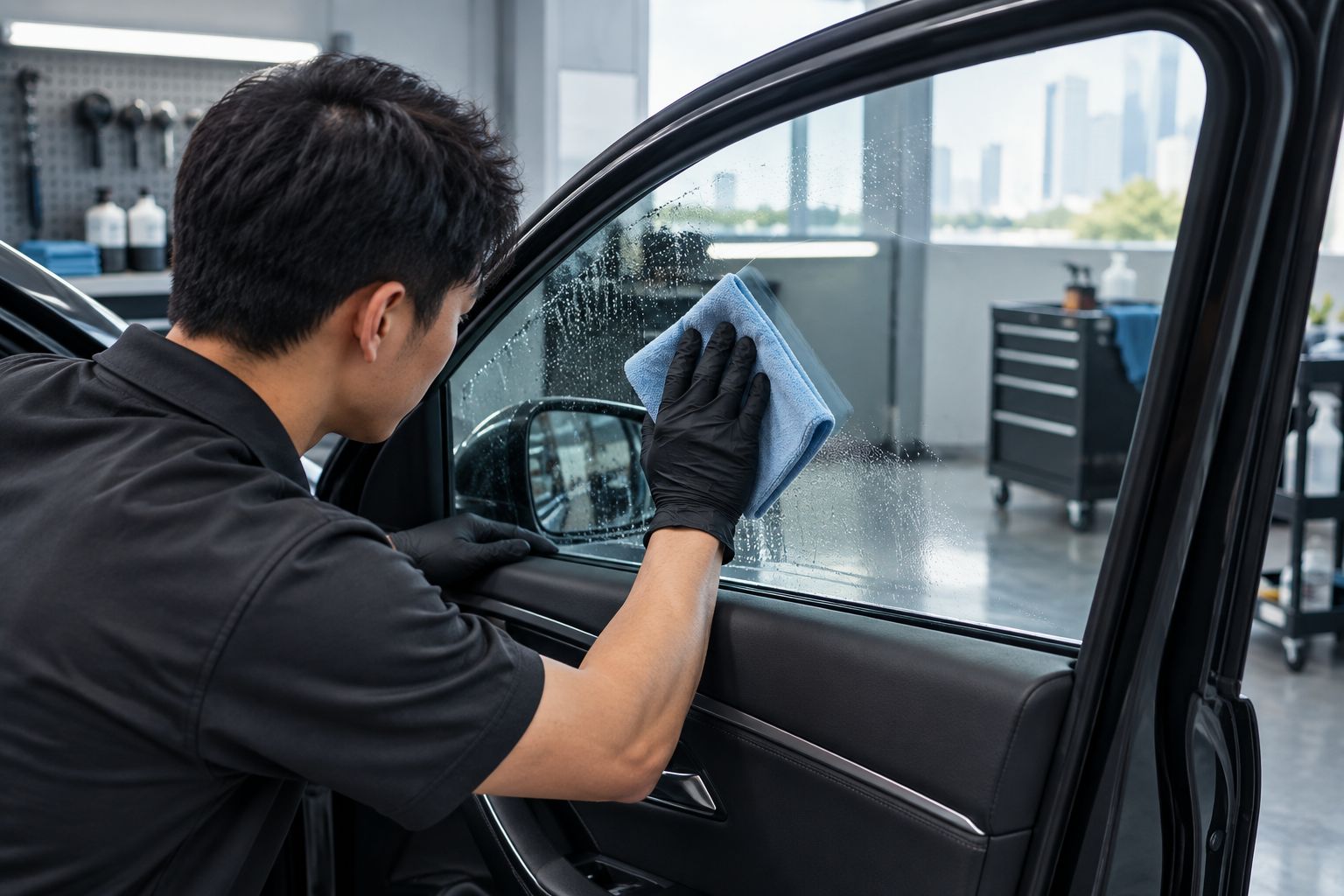
The installer should clean the glass and control contamination before applying film. Dust trapped beneath the film can remain visible; preparation is part of the finished result, not an optional extra.
Finished inspection
Inspect edges, contamination and clarity from inside and outside the car. Ask the installer to distinguish normal curing effects from defects requiring attention, and obtain the assessment in writing.
Aftercare handover
Get product-specific instructions for lowering windows, cleaning and allowing the installation to cure. Avoid a generic deadline borrowed from another film. Use the manufacturer's and installer's instructions for your selected material.
How the options are ranked
This ranking prioritises legal rear-cabin privacy, useful solar control, outward visibility and evidence you can verify. Ceramic film is the default category to investigate because it addresses the combined privacy-and-heat-control brief without requiring metallic construction.
Dyed film has a narrower daytime-privacy role. Metallised film requires additional checks. High-VLT film serves front-window visibility rather than strong concealment. Installation quality can change the result, so category selection never replaces inspection.
Which privacy tint should you choose?
Choose compliant ceramic rear-window film as your starting point, then select front-window film for visibility and measured transmission. Move to dyed film when your brief is mainly daytime privacy and its documented specification meets your needs.
Eadetailer is a window-tint service option for Singapore owners comparing detailing and paint protection alongside tinting. Ask for the tint specification separately: XPEL PPF, ChromaGard and ceramic coating names do not establish a window film's performance.
For a 2026 booking, settle the material, window-by-window selection, measurement method and aftercare instructions before authorising installation.
FAQ
What’s the best car window tint for privacy in Singapore?
Compliant ceramic rear-window film is the first category to assess when you want daytime privacy and heat control together. Select the actual product using installed light transmission, optical clarity and documented solar performance.
How dark can my car windows be in Singapore?
Singapore requires at least 70% light transmission through the front windscreen and front side windows, and at least 25% through the rear windscreen and rear side windows. Tinted glass must also be non-reflective and must not obstruct the driver’s view.
Does ceramic window tint give more privacy than dyed film?
Ceramic film does not automatically provide more privacy than dyed film. Visible light transmission and lighting conditions determine visual concealment; material construction affects other characteristics, including solar control.
Can people see through tinted car windows at night?
People can see through tinted windows at night, especially when the cabin is illuminated. Conventional tint does not guarantee one-way privacy in every lighting condition.
Is a film labelled 70% VLT legal on my front windows?
A film labelled 70% VLT is not automatically legal on front windows because the glass also reduces light transmission. Measure the combined glass-and-film result against the 70% minimum.
Should I choose the same tint for every car window?
Choose front and rear window specifications separately because Singapore applies different light-transmission limits. Prioritise front visibility and assess daytime rear-cabin privacy within the rear-glass requirements.
Does Eadetailer provide car window tint services?
Eadetailer provides professional automotive window tint services in Singapore alongside detailing and paint protection. Confirm the proposed film, installation scope and finished-window measurements directly before booking.
One last thing
Test privacy with the cabin light on, not just from outside in daylight. Ask to view a comparable installation under different lighting conditions, then inspect outward visibility from the rear seats as well as the driver's position.
For your 2026 decision, remove valuables from view rather than relying on tint to conceal them. Window film changes visibility; it does not turn the cabin into secure storage.
Related guides
- Compare window tint film brands in Singapore
- Compare detailing packages for new-car owners
- Compare ceramic coating packages in Singapore

Leave a Reply