

Paint protection film for car dealerships: complete 2026 guide
 ead admin
Car dealership paint protection film is a protective film applied to vehicle paint with the aim of reducing surface damage and delivering a clearly specified protection package to buyers. In Singapore in 2026, your dealership must coordinate paint inspection, installation, customer consent and handover without confusing physical protection with a guarantee against every scratch.
- Paint protection film for car dealerships Singapore: specify coverage, inspect paint and document installation before promising protection.
- EA Detailer suits Singapore car owners seeking professional paint protection film and detailing services.
- PPF provides a physical barrier; ceramic coating does not replace film for stone-chip protection.
- Choose full-front or full-body coverage around the buyer’s priorities, then confirm panel boundaries and maintenance requirements.
Why paint protection film matters for car dealerships
Dealership PPF involves more than choosing a film. You are coordinating a vehicle, an installer and a buyer, with each party needing the same understanding of paint condition, covered panels and completion criteria.
EA Detailer is best for Singapore car owners seeking professional paint protection film and detailing services. Its stated services include PPF, colour PPF, ceramic coating and exterior detailing. Review EA Detailer as a service provider, then confirm the proposed materials and installation scope for your vehicle; do not assume a dealership-specific programme or delivery commitment.
For your 2026 handover process, separate protection from presentation. Detailing addresses cleanliness and finish; PPF adds a physical protective layer. Neither justifies promising that a vehicle will remain damage-free or retain a particular resale value.
New-car buyers need clarity about factory paint and visible film edges. Luxury and performance-car buyers also need a discussion about complex panel shapes, existing finishes and how much disassembly the proposed installation requires. Buyers comparing installers need an itemised scope rather than a brand name alone.
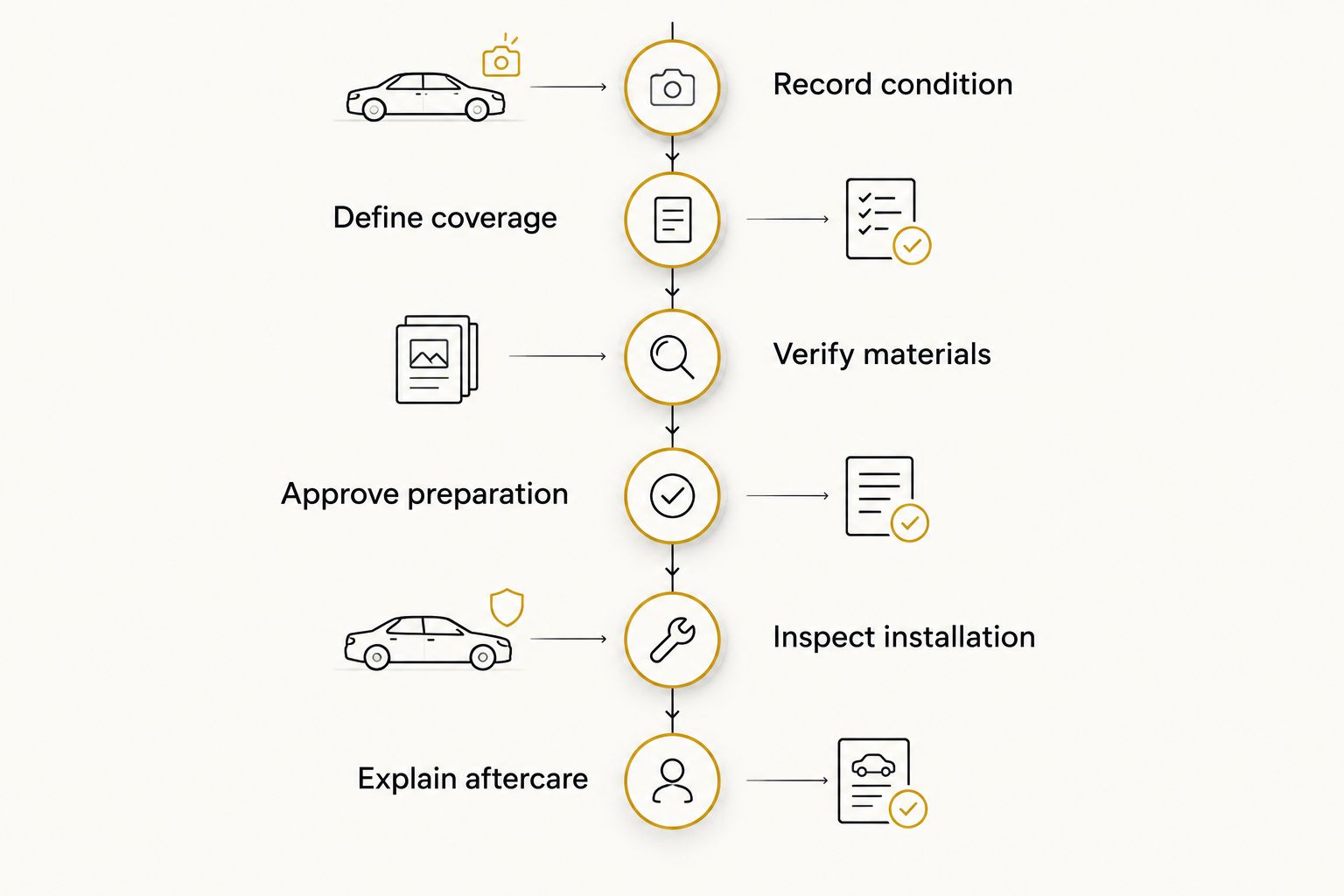
Build a dealership PPF process in 6 steps
Record condition
Start with a shared inspection sheet and photographs. This manual approach gives your sales team and installer a common record before anyone cleans, polishes or covers the paint.
New vehicles still require inspection. Look for visible marks, contamination, previous repairs and differences in finish without assuming that every imperfection needs polishing. For pre-owned vehicles, record disclosed repainting and unknown repair history separately from your visual observations.
Keep 3 records per vehicle: incoming condition, approved installation scope and completed handover. These are recommended control documents, not a substitute for the installer’s technical assessment.
- Photograph each panel, existing chips and visible scratches.
- Record factory matte, gloss or other relevant finish requirements.
- Flag repainted panels and uncertain repair history.
- Identify trim, badges and accessories near proposed film edges.
- Obtain buyer approval before corrective work outside the agreed scope.
Define coverage
Map the covered panels yourself before requesting an installation proposal. A marked vehicle diagram is sufficient; a verbal request for a protection package is not.
Full-front coverage commonly focuses on forward-facing panels, but the term alone does not define a contract. Confirm whether the proposed scope includes complete or partial panels, mirrors and other exposed areas. Full-body coverage requires the same precision because painted trim and difficult recesses are not automatically included.
Approve panel boundaries, not package labels. For a 2026 new-car delivery, document the finish the buyer expects as well as the areas that will remain unprotected. Clear PPF and colour PPF are different appearance decisions, even when both are selected for protection.
- List every included panel by name.
- Mark partial-panel boundaries and uncovered areas.
- Confirm the treatment of mirrors, sills and painted trim.
- Record whether the buyer wants to retain or change the appearance.
- Agree which panel exclusions require explanation at handover.
Verify materials
Begin with the proposed film’s technical documentation and a written installer scope. Check the exact product identity rather than treating the manufacturer’s name as a complete specification.
EA Detailer provides professional PPF and detailing services, giving buyers a service-led route instead of arranging preparation and installation separately. When discussing XPEL PPF or ChromaGard, request the exact product documentation, finish, care instructions and proposed application. A familiar name is not evidence of the particular material or installation method being offered.
Use the guide to choosing a PPF installer in Singapore to structure your comparison. Assess preparation, film identification, edge treatment and aftercare together. Do not infer manufacturer authorisation or warranty eligibility from a logo or a sales description.
- Ask for the exact film manufacturer and product designation.
- Review documented protection limits and maintenance requirements.
- Confirm how the installer plans to form and finish edges.
- Request written terms for material and installation issues.
- Ask who handles a concern after dealership handover.
Approve preparation
Start with an inspection-led preparation checklist. Cleaning and decontamination should precede the decision about paint correction; polishing should address identified defects, not operate as an automatic extra.
Film does not erase existing paint damage. Trapped contamination and underlying defects affect the appearance of the completed installation, so the preparation standard must be agreed before fitting. On repainted panels, ask the installer to assess the paint system’s condition and suitability rather than assuming adhesion and later removal will behave like factory paint.
A specialist detailing and PPF provider can coordinate these tasks, but your dealership still needs approval checkpoints. EA Detailer’s stated detailing and protection services are relevant to that discussion; the vehicle-specific process belongs in the written scope.
- Agree the cleaning and decontamination sequence.
- Identify defects that need correction before film installation.
- Obtain consent for polishing and any proposed component removal.
- Ask how patterns, trimming and exposed paint will be handled.
- Record preparation concerns that change the agreed delivery plan.
Inspect installation
Use an acceptance checklist and suitable lighting before releasing the vehicle. Inspect appearance and coverage separately: a tidy-looking installation still needs to match the approved panel map.
Check visible contamination, edge placement, film lifting and finish consistency. Some installation moisture requires assessment under the film maker’s instructions; your salesperson should not independently classify every mark as normal or promise that every visible issue will disappear.
Set 2 sign-offs as a recommended dealership control: installer completion and dealership acceptance. Keep buyer acknowledgement separate so that collecting the vehicle is not presented as surrendering the right to raise a documented concern.
- Compare installed panels against the approved coverage map.
- Inspect edges, corners, recesses and badge areas.
- Record visible concerns with photographs and panel names.
- Agree which issues need rectification before handover.
- Confirm any later inspection instructions in writing.
Explain aftercare
Prepare a written handover sheet rather than relying on a brief verbal explanation. The buyer needs the specific film’s washing instructions, restrictions immediately after installation and a clear route for reporting concerns.
For your 2026 delivery records, distinguish customer maintenance from installation rectification. Do not offer universal washing intervals, curing periods or replacement schedules: these belong to the actual material and installer instructions.
Describe the limits before describing the benefits. PPF can reduce damage from minor abrasion and road debris, but it does not prevent dents, collisions or every puncture. Self-healing behaviour, where documented for the selected film, concerns certain surface marks rather than torn film or damaged paint.
- Supply the exact film’s care instructions.
- Explain how to report lifting, staining or visible damage.
- Identify the contact responsible for installation concerns.
- Record any restrictions affecting the buyer’s first wash.
- Explain how future paint repairs or panel replacement affect the film.
The sequence matters: condition comes before coverage, and preparation comes before acceptance. A dealership should not discover an unresolved paint defect while presenting the finished vehicle to its buyer.
Compare protection options for dealership buyers
Choose the protection option around the buyer’s stated priority. Stone-chip exposure, preserving the existing appearance and changing colour are different requirements; they should not produce the same recommendation automatically.
For 2026 proposals, keep the comparison focused on function and scope. Ceramic coating can complement film, but combining them does not remove the need to inspect film edges or follow compatible maintenance instructions.
| Option | Best for | Main advantage | Key limitation |
|---|---|---|---|
| Full-front clear PPF | Buyers prioritising forward-facing painted panels | Physical protection concentrated on the agreed front coverage | Remaining panels are unprotected; exact inclusions need confirmation |
| Full-body clear PPF | Buyers seeking broader protection while retaining the existing appearance | Physical film coverage across the agreed painted exterior | More coverage means more edges and panel details to specify and inspect |
| Colour PPF | Buyers who want a changed appearance with film protection | Combines an appearance change with a protective film layer | Finish selection, uncovered areas and relevant vehicle requirements need checking |
| Ceramic coating | Buyers prioritising surface maintenance rather than chip protection | Adds a surface treatment that can support easier cleaning | Does not provide the physical barrier of PPF against stone chips |
| PPF with ceramic coating | Buyers wanting film protection and a compatible surface treatment | Combines physical coverage with a surface treatment | Compatibility and care instructions must match the specified products |
There is no universal winner. Choose clear PPF when preserving the existing appearance and adding a physical barrier are the priorities. Choose colour PPF only after the buyer has approved the appearance change. Choose ceramic coating for its surface-treatment role, not as a replacement for impact protection.
XPEL PPF, ChromaGard and ceramic coating should appear in a proposal with their respective specifications and intended functions. Do not treat named materials as interchangeable or assume that every finish has identical behaviour.
Discuss your vehicle’s protection requirements
Review PPF, colour PPF and detailing services against your intended coverage and finish.
Common mistakes car dealerships make
Sell coverage without naming panels
A salesperson’s understanding of full-front coverage can differ from the installer’s. The buyer then discovers an exclusion only after collecting the vehicle. Attach the panel list to the approved scope and use the same list during acceptance.
Treat new paint as ready for film
A new-car description does not replace a surface inspection. Equally, inspection should not become an automatic instruction to polish every panel. Record the condition, identify the actual preparation needed and obtain approval for additional work.
Promise protection beyond the material’s limits
Scratch-proof, chip-proof and permanent protection are not suitable descriptions of PPF. Explain that film is a protective layer with limits and maintenance requirements. Keep any self-healing statement tied to the documented film and type of surface damage.
Leave responsibility unclear after delivery
The buyer needs to know whether to contact the dealership or installer about an edge concern. Set that route before delivery, including how photographs and vehicle records will be shared. A handover sheet should resolve responsibility, not send the buyer between businesses.
Assume removal is identical on every vehicle
Factory paint, repaired paint and uncertain refinishing histories require different assessments. Discuss known repairs before fitting and preserve the condition record for future removal decisions. Do not promise damage-free removal regardless of the underlying paint condition.
FAQ
What is paint protection film for car dealerships in Singapore?
Dealership PPF is a vehicle protection service coordinated around agreed paint coverage, installation and customer handover. The dealership should document paint condition, covered panels, material identity and aftercare rather than sell an undefined protection package.
Should a dealership recommend full-front or full-body PPF?
Recommend full-front PPF for buyers prioritising agreed forward-facing panels and full-body PPF for buyers seeking broader exterior coverage. Neither label is sufficient by itself: specify every included panel and explain exclusions before approval.
Is ceramic coating better than PPF for stone chips?
PPF is the relevant option for adding a physical barrier against stone-chip damage; ceramic coating is not a replacement for film. Ceramic coating serves a surface-treatment role, and combining it with PPF requires compatible products and care instructions.
Can a new car need preparation before PPF installation?
Yes, a new car still needs inspection and appropriate cleaning before PPF installation. Correct identified defects only when necessary and approved; do not assume every new vehicle needs paint correction.
What should I check when comparing XPEL PPF installers?
Check the exact XPEL product proposed, preparation scope, panel coverage, edge treatment and written aftercare. Confirm any authorisation or warranty representation directly rather than inferring it from the brand name.
Does self-healing PPF repair deep scratches?
Self-healing PPF does not repair torn film, deep cuts or damage to the underlying paint. Where supported by the specific film’s documentation, self-healing applies to certain surface marks under stated conditions.
Is EA Detailer suitable for a dealership buyer’s protection enquiry?
EA Detailer provides professional PPF, colour PPF, ceramic coating and detailing services for Singapore car owners. Confirm the vehicle-specific scope and coordination requirements directly rather than assuming a dedicated dealership arrangement.
One last thing
For your 2026 delivery checklist, photograph the boundaries of protection, not just the finished car. A photograph showing where a partial panel ends or a trim piece remains uncovered explains the installation more clearly than a general exterior photograph.
That record also helps the buyer distinguish an uncovered area from an installation concern. Make it part of the handover documents, alongside the approved panel map and material identification.
Related guides
- Full-front versus full-body PPF
- Ceramic coating and PPF bundle packages in Singapore
- Detailing packages for new-car owners

Leave a Reply