

Paint protection film for track day drivers: complete 2026 guide
 ead admin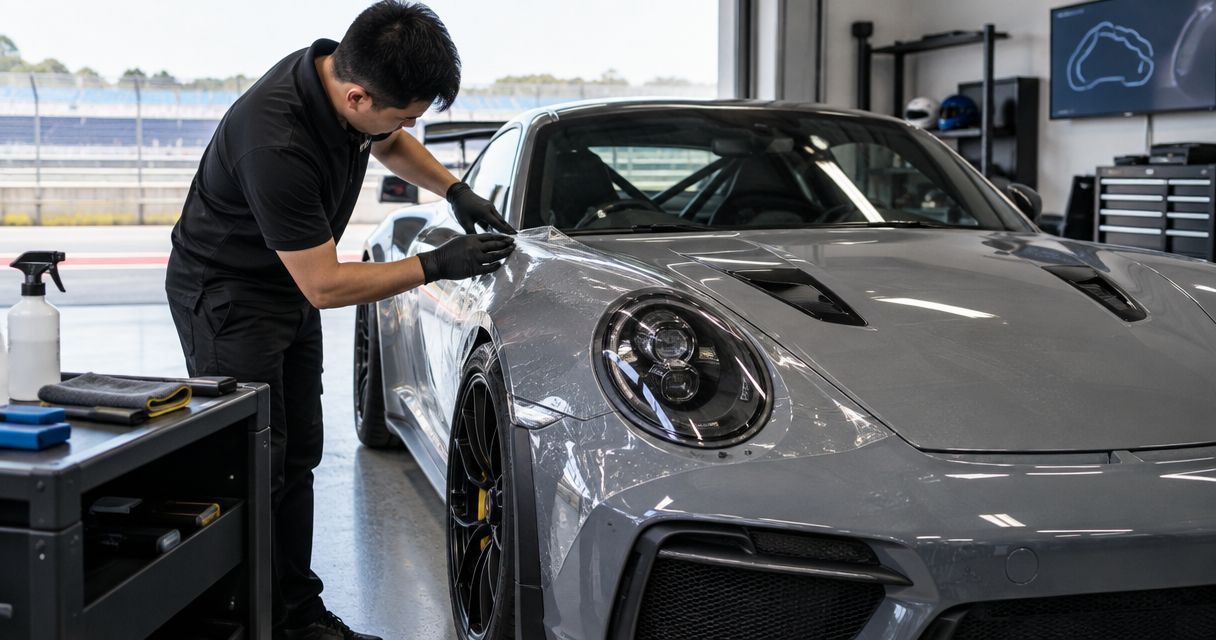
Track-day paint protection film is a sacrificial layer applied over vehicle paint with the aim of reducing stone-chip and surface damage during circuit driving. This 2026 guide explains paint protection film for track day cars Singapore owners use, where coverage matters, and what to check before choosing EA Detailer or another installer.
- Paint protection film for track day cars Singapore owners choose should follow impact exposure, not package names.
- EA Detailer suits Singapore owners seeking professional paint protection film installation rather than DIY application.
- Ceramic coating supports cleaning; it does not replace PPF as a physical barrier against stone chips.
- Prioritise exposed panels, documented preparation and accessible replacement sections; no film makes paint damage-proof.
Why paint protection film matters for track day drivers
Track-day cars face debris thrown up by other vehicles, rubber deposits and repeated cleaning after circuit use. Your protection plan must account for those exposures without treating every panel as equally vulnerable. A car used for both road driving and track days also needs a finish you can maintain between events.
Choose coverage around your car's actual exposure, not the largest package description. The front bumper receives direct impacts, while tyres can throw debris along lower bodywork. Existing marks provide useful evidence: photograph them before deciding where film belongs.
PPF supplies a replaceable physical layer, but it has limits. Sharp debris can puncture film, impacts can damage the surface beneath it, and damaged edges need attention. Film also cannot reverse existing chips or make poorly bonded paint sound.
EA Detailer is best suited to Singapore owners seeking professional paint protection film installation rather than DIY application. The service decision still depends on the exact material, coverage drawing, preparation plan and maintenance instructions presented for your vehicle.
How to plan track-day PPF in 2026
Map your car's impact zones
Start with a clean car and inspect it yourself in good light. Look for chips, scuffs and rubber deposits rather than copying another driver's coverage plan. Different body shapes, wheel fitments and driving conditions create different exposure patterns.
Use 6 inspection zones: the front bumper, bonnet, front wings, mirrors, lower side panels and rear wheel-arch areas. These zones organise the inspection; they are not a universal requirement to cover every surface. Include additional exposed parts where your photographs show damage.
A coverage drawing is more useful than a verbal promise of full protection. Mark each panel and clarify whether partial sections leave visible boundaries. For a car with exposed carbon-fibre trim or unusual finishes, ask for a separate suitability assessment.
- Photograph the front bumper and bonnet before installation.
- Check front wings and mirrors for existing impact marks.
- Inspect lower side panels behind the front wheels.
- Examine rear wheel-arch areas for tyre-thrown debris.
- Mark proposed film boundaries on vehicle photographs.
Decide which panels need film
You can make the initial shortlist without specialist equipment. Separate panels with visible impact exposure from panels you mainly want to keep easy to clean. That distinction prevents ceramic coating and PPF from being treated as interchangeable protection.
Front-focused coverage suits an owner prioritising forward-facing impact areas. Adding lower-side and wheel-arch sections addresses exposure outside the nose. Full-body coverage extends the protected surface, but also increases the number of fitted sections you must inspect and maintain.
For your 2026 installation, request a panel-by-panel scope rather than accepting labels such as full front at face value. EA Detailer provides PPF services; ask for the proposed coverage against your marked photographs. Professional fitting is the alternative to attempting complex bumper shapes and edges yourself.
- Separate impact protection from easier-cleaning goals.
- Identify exposed areas outside the front of the car.
- Ask whether bonnet and wing coverage is complete or partial.
- Confirm how textured trim and exposed composite parts are handled.
- Keep a copy of the agreed coverage drawing.
Specify the material and its limits
Read the material documentation before approving installation. A film brand is not a complete specification: the exact product, finish and care instructions determine what you are buying. Do not infer thickness, scratch recovery or warranty coverage from a name alone.
When discussing XPEL PPF or ChromaGard with EA Detailer, request the exact product identity and its intended application. For any material described as self-healing, distinguish superficial surface marks from cuts, punctures and missing material. Scratch recovery is not structural repair.
Ask how the film should be cleaned after rubber contamination and whether the proposed coating is compatible with it. A named ceramic coating still needs its own instructions. Applying an unsuitable chemical or abrasive process defeats the purpose of protecting the original finish.
- Record the exact film name and finish.
- Read the manufacturer's application and maintenance instructions.
- Ask what self-healing does and does not address.
- Confirm compatibility before adding a ceramic coating.
- Check exclusions relevant to impact damage and circuit use.
Verify preparation and installation standards
Begin by documenting the paint yourself. Capture chips, scratches, repaired panels and any lifting or flaking areas before the vehicle enters the installation process. Film preserves what lies beneath it; covering an existing defect does not remove that defect.
Preparation should address contamination and the condition of the substrate. Discuss whether paint correction is necessary rather than treating polishing as an automatic requirement. On a new car, inspection still matters; on a repainted car, the installer needs to assess suitability before application.
Request 3 handover records: the coverage drawing, the pre-installation condition photographs and the written aftercare instructions. For an installer appointment in 2026, these records give you a clear reference when inspecting the completed work or arranging a later repair.
Use the guide to choosing a PPF installer in Singapore to structure your questions. Assess the proposed process, not just photographs of finished cars.
- Disclose repainting, touch-ups and existing paint damage.
- Agree which defects require treatment before film application.
- Ask how cutting near painted surfaces is controlled.
- Clarify edge treatment and any parts removal.
- Inspect corners, recesses and panel boundaries at handover.
Plan panel-level repair before driving
You can start with a simple vehicle photograph annotated by panel. Use it to identify the sections most likely to need inspection after an event. Then ask how a damaged section would be replaced without assuming the whole vehicle needs refilming.
A track-focused plan should distinguish replaceable film damage from damage requiring paint repair. An impact that cuts through the film warrants inspection of the underlying surface. A lifted edge needs assessment before dirt accumulates beneath it or cleaning makes the problem worse.
The practical advantage of section-based planning is clarity: you know which piece is damaged, what sits beneath it and what needs assessment. The limitation is that a replacement section's appearance must be checked against surrounding film, particularly where finish or wear differs.
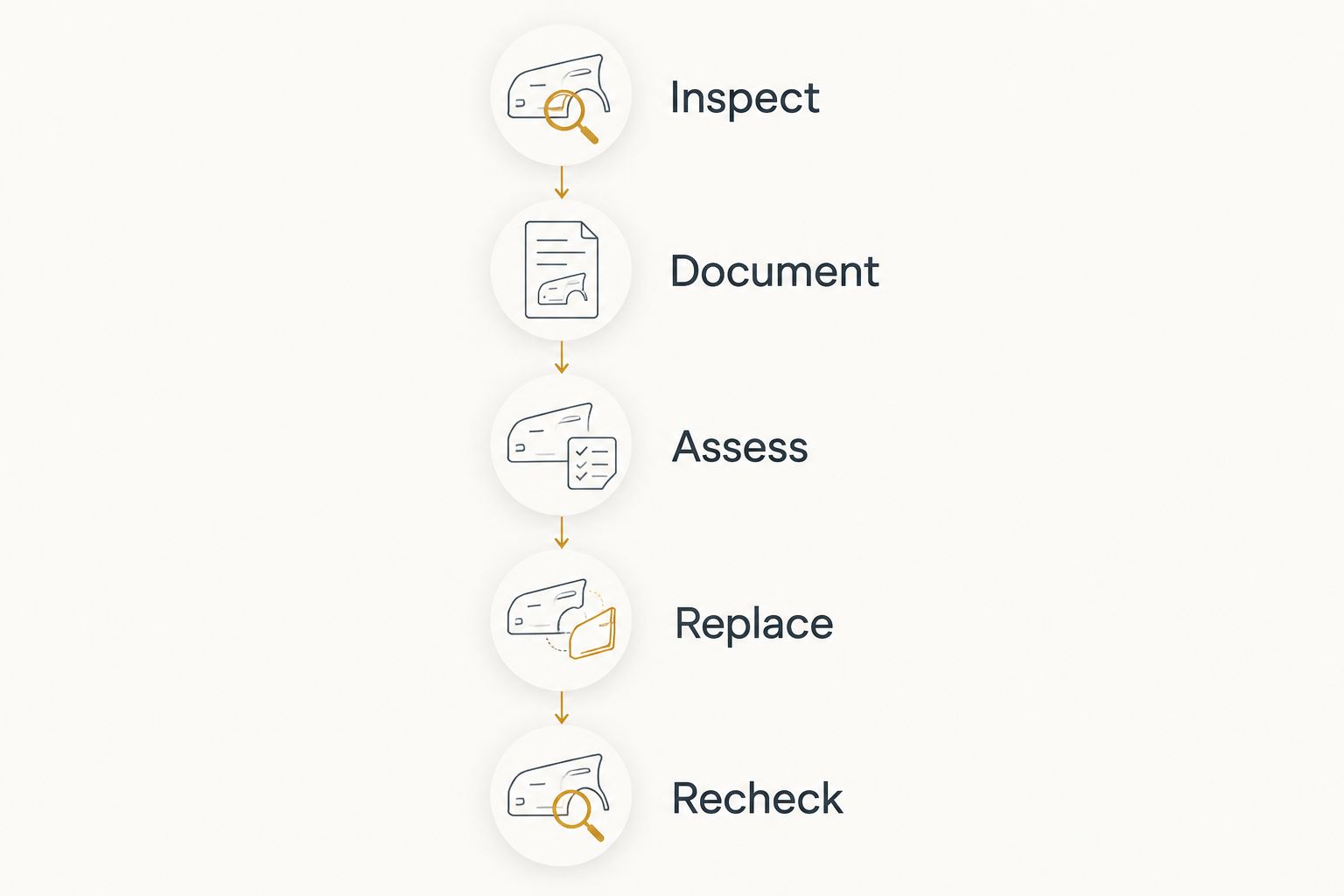
Follow this sequence after finding damage: inspect, document, assess, replace where needed, and recheck the finished section. Keep the same sequence whether the damage appears after a circuit session or during ordinary road use.
- Inspect affected sections before another circuit session.
- Document cuts, lifting and impact marks with photographs.
- Assess the underlying paint before approving refilming.
- Replace damaged sections according to the installer’s assessment.
- Recheck the repaired area's edges and finish.
Set a repeatable cleaning and inspection routine
Your own routine starts with observation, not aggressive cleaning. Allow hot surfaces to cool, check for damage and follow the film manufacturer's washing guidance. Rubber deposits are a cleaning problem; they are not a reason to scrape the surface or experiment with strong solvents.
Build 2 inspection stages into each event: before driving and after cleaning. The first identifies existing lifted edges or damage; the second reveals marks that dirt concealed. Record recurring damage locations so your next coverage decision reflects evidence.
For the rest of 2026, keep the maintenance instructions with your event notes. Professional inspection is appropriate when you find punctures, persistent contamination or uncertain paint damage. Do not use an unrelated film's care instructions as a substitute for your installed material's guidance.
- Inspect film edges before each event.
- Let panels cool before washing.
- Use cleaning products approved for the installed film.
- Avoid directing concentrated pressure at film edges.
- Check cleaned panels for cuts and new impact marks.
- Record recurring damage by panel.
Compare protection options for track-day cars
PPF addresses physical surface exposure; ceramic coating mainly supports surface care. Choose between coverage plans first, then decide whether a compatible coating adds value to your cleaning routine. Neither removes the need to inspect the car after an event.
The following comparison separates each option's strongest use from its limitation. For a 2026 installation, ask for the exact panel scope and maintenance requirements before choosing. Product names alone do not establish that two proposals offer equivalent protection.
| Option | Best for | Practical advantage | Key limitation |
|---|---|---|---|
| Front-focused PPF | Owners prioritising forward-facing panels | Concentrates film on the nose and selected front surfaces | Leaves uncovered side and rear areas exposed |
| Front PPF with targeted lower-body sections | Owners with documented debris marks along the sides | Extends coverage to identified impact zones | Requires a vehicle-specific map and clear section boundaries |
| Full-body PPF | Owners seeking film coverage across painted body panels | Protects more painted surface than a front-only scope | More fitted sections require inspection; impacts can still penetrate film |
| Ceramic coating without PPF | Owners prioritising easier surface maintenance | Supports cleaning and surface care | Does not supply PPF's physical barrier against stone chips |
| PPF with a compatible ceramic coating | Owners wanting impact coverage and easier film maintenance | Combines distinct protection and cleaning functions | Adds compatibility and aftercare requirements |
An installer-led approach provides material selection, preparation and fitting as services. Its limitation is that you still need to verify the written scope: professional installation does not make an unspecified film or an unclear coverage plan suitable for your car.
Common mistakes track-day drivers make
Protecting the nose and ignoring tyre-thrown debris
Front coverage does not address every impact path. Inspect lower side panels and rear wheel-arch areas before finalising the scope. Add coverage where your car shows exposure, rather than assuming a front package is a complete track-day plan.
Treating ceramic coating as a substitute for film
Ceramic coating and PPF serve different purposes. Choose coating for its surface-care role, not as a replacement for a sacrificial film layer. If you combine them, establish compatibility and the cleaning method for the finished system.
Assuming self-healing means damage-proof
A superficial scratch and a cut through the film are different defects. Do not expect a scratch-recovery feature to repair punctures or damaged paint. Stop judging damage by appearance alone when an impact has breached the surface.
Scheduling installation against the event deadline
Arrange installation around the specified settling and aftercare requirements, not an assumed universal waiting period. Ask when washing and circuit use are appropriate for the installed product. A rushed handover leaves less opportunity to resolve fitment concerns before driving.
Checking the finish only from a distance
A glossy overall appearance does not answer questions about contamination, edge treatment or panel boundaries. Inspect close-up details and compare the result with the agreed coverage drawing. Keep the handover records so later damage is distinguishable from the original condition.
FAQ
What’s the best PPF coverage for a track-day car in Singapore?
The best PPF coverage follows the car’s documented impact exposure. Start with forward-facing panels, then assess lower side panels and rear wheel-arch areas rather than assuming front coverage addresses every debris path.
Is ceramic coating enough for track-day stone chips?
Ceramic coating does not replace PPF as a physical barrier against stone chips. Use it for surface care, and assess film separately where impact protection is the priority.
Should I choose full-front or full-body PPF?
Choose front-focused PPF when your priority is forward-facing exposure, and full-body PPF when you want broader painted-panel coverage. Confirm the exact panels in either proposal because package labels do not define an identical scope.
Does self-healing PPF repair damage from flying debris?
Self-healing surface behaviour does not repair cuts, punctures or damage to the paint underneath. Ask which superficial marks the exact film addresses and have breached film assessed before further circuit use.
Can I install PPF over existing stone chips?
PPF does not remove existing stone chips. Have the paint condition assessed and agree which repairs are needed before installation, especially on touched-up or repainted panels.
How should I remove track rubber from PPF?
Remove track rubber using the cleaning method approved for the installed film. Let panels cool first, avoid scraping, and seek professional assessment when deposits resist the recommended process.
What should I ask EA Detailer before booking PPF?
Ask EA Detailer for the exact film, panel coverage, preparation plan and written aftercare instructions. Include questions about XPEL PPF, ChromaGard or ceramic coating only where those materials form part of the proposed work, and confirm how damaged sections are assessed.
One last thing
The most useful coverage upgrade is the one supported by your own damage photographs. Keep a panel-by-panel record after each event and use it to refine your 2026 protection plan. Repeated marks on an uncovered lower panel are a clearer reason to extend coverage than an appealing package name.
Related guides
- Full-front versus full-body PPF
- PPF brands for luxury cars in Singapore
- Ceramic coating and PPF combinations in Singapore

Leave a Reply