
Does window tint void your car insurance in Singapore?
 ead admin
Window tint does not automatically void your car insurance in Singapore; the outcome depends on your policy terms, disclosure requirements and whether the installation complies with road-use rules. For a 2026 installation, treat legal compliance and insurance acceptance as separate checks: an installer cannot confirm your insurer's position, and an insurer's acceptance does not establish that your tint meets LTA requirements.
- Does window tint void car insurance Singapore? Not automatically; policy terms, disclosure and compliance determine the position.
- LTA light-transmission requirements apply to the finished glass-and-film combination, not just the film specification.
- Get written insurer confirmation before installation; ask separately whether replacement tint is covered.
- EA Detailer provides window tint services in Singapore; insurance acceptance remains a question for your insurer.
Does window tint void your car insurance in Singapore?
No automatic rule makes every tinted car uninsured. You need to establish what your insurer requires you to disclose, whether it accepts the modification and what cover applies to the film itself. Those are different questions.
For a 2026 decision, use this distinction before choosing a film from a window tint film comparison.
| Check | What it establishes | What it does not establish |
|---|---|---|
| LTA compliance | Whether the installed tint meets the applicable vehicle requirements | Whether your insurer accepts the installation |
| Insurer acceptance | The insurer's stated position under your policy | Whether the installed glass passes a light-transmission test |
| Replacement-film cover | Whether the policy pays for film under the relevant claim | Whether every glass-related expense is included |
| Installation records | What was fitted and the evidence supporting it | A guarantee that any future claim will be paid |
Do not confuse a refused film-replacement expense with cancellation or avoidance of the entire policy. If an insurer raises an objection, ask it to identify the policy clause and explain the precise consequence in writing.
Why this matters
Tint is both a physical alteration to your windows and something your insurance documents can treat as an accessory or modification. A verbal assurance that a film is suitable for Singapore does not answer the contractual question.
The practical risk is a mismatch between what you believe you bought and what the insurer agreed to cover. You can prevent that mismatch by documenting the installation before a claim, rather than trying to reconstruct it after damaged glass needs replacement.
For luxury and performance car owners, specify the affected windows accurately. A windscreen replacement and a side-window repair are different jobs; ask about the relevant cover rather than relying on a general statement that glass is insured.
What are Singapore's window tint limits in 2026?
For a 2026 installation, consult the Land Transport Authority's OneMotoring guidance on tinted glass. Its published requirements include the following minimum light-transmission levels:
| Glass position | Minimum light transmission | Practical meaning |
|---|---|---|
| Front windscreen | 70% | The finished windscreen must transmit at least this amount of visible light |
| Front side windows | 70% | The front side glass must meet the same minimum |
| Rear windscreen and rear side windows | 25% | The rear glass has a different minimum from the front |
LTA's guidance also states that tinted glass must not be reflective and that the front windscreen must not obstruct signals between an in-vehicle unit and ERP gantries. Check the current official requirements when arranging installation; light transmission is not the only consideration.
The relevant measurement is the glass with the film installed. A film specification on its own does not establish compliance because the existing glass already affects how much light passes through.
Ask for measurements on the actual vehicle. Factory-tinted glass, existing aftermarket film and replacement glass all need to be considered before selecting an additional film.
Why a film label is not enough
A film's visible light transmission describes the film under its stated testing conditions. It is not a substitute for checking the completed window.
Keep heat-rejection claims separate from light-transmission requirements. A sales discussion about cabin comfort does not demonstrate that the front windscreen meets the 70% minimum or that the rear glass meets the 25% minimum.
What should you do before installing window tint?
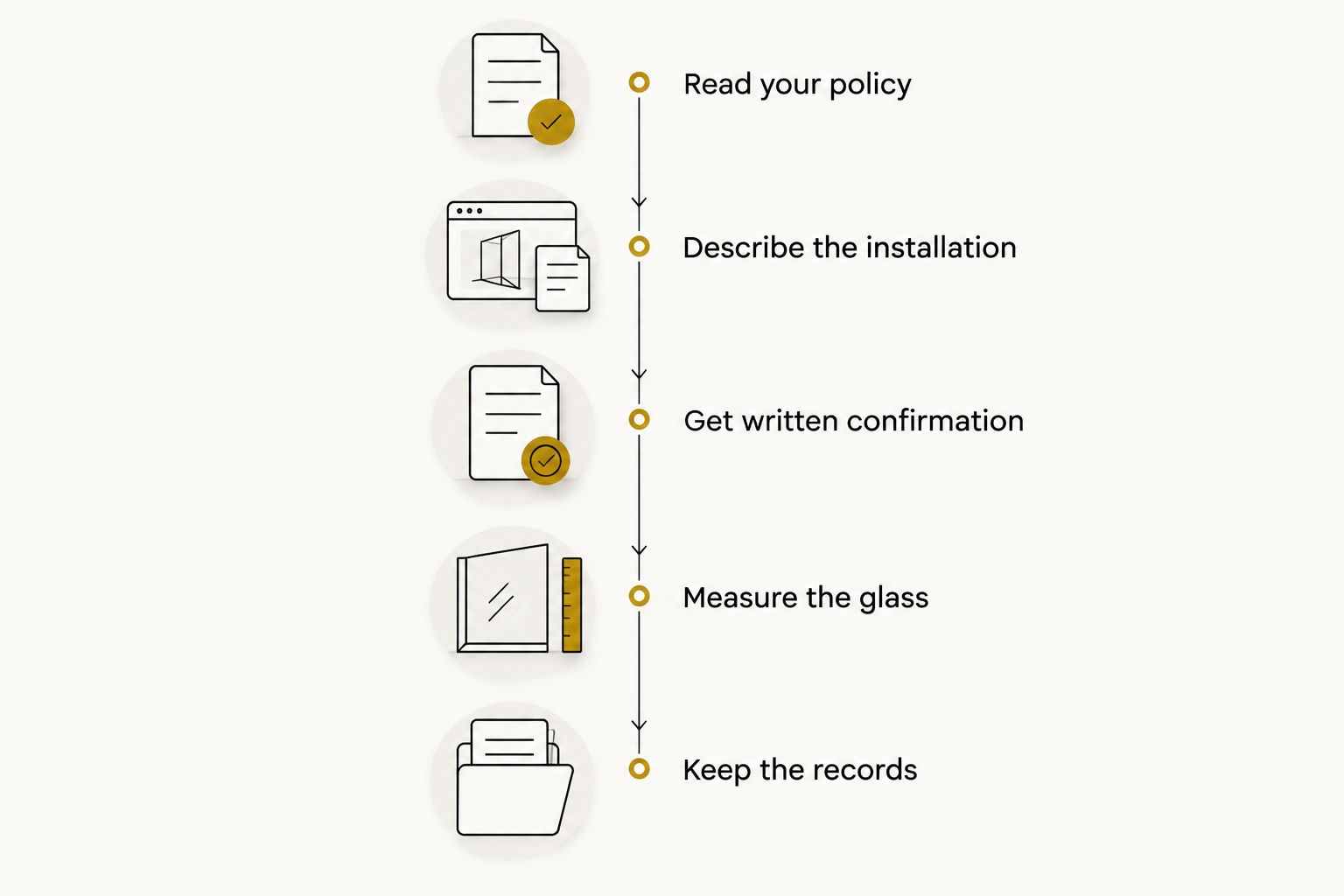
Use this sequence for a 2026 installation. It keeps the installer responsible for the physical work and the insurer responsible for explaining policy acceptance.
- Read your policy. Check the proposal form, schedule, policy wording and endorsements for references to modifications, accessories, disclosure and glass cover. Do not stop at the policy summary.
- Describe the installation. Tell the insurer which windows will receive film and provide the proposed film details. Explain whether an existing film will be removed or retained.
- Get written confirmation. Ask whether notification is sufficient, whether approval or an endorsement is required, and whether the insurer needs further documents. Save the reply with your policy.
- Measure the glass. Ask the installer how it will check the existing glass and verify the completed installation against the applicable requirements. Request recorded results rather than a verbal assurance alone.
- Keep the records. Retain the invoice, film identification, installation date, measurement record and insurer correspondence. Check that the documents identify your vehicle and the work performed.
The strongest preparation is not a folder full of brochures. It is a clear record connecting your vehicle, the installed film, the compliance measurements and the insurer's response.
What should your message to the insurer include?
Give the insurer a specific proposal rather than asking whether tint is generally allowed. Identify the car, affected windows, proposed film and intended installation arrangement, then ask for the applicable policy requirements.
Ask these questions explicitly:
- Does this installation need to be declared under my policy?
- Will you accept it, and is an endorsement required?
- What documents do you need before and after installation?
- Is replacement film covered following an insured glass claim?
- Does the answer differ between the windscreen and other windows?
- Does the policy place conditions on repairers or replacement arrangements?
A reply addressing these questions is more useful than a broad statement that modifications are acceptable. If the response is unclear, request clarification before authorising the work.
Why insurance outcomes vary
The relevant differences are in the contract and the installation record, not simply the darkness of the film. These factors determine which questions you need answered:
- Policy wording: The contract defines disclosure obligations, insured accessories, exclusions and claim conditions. Read the wording applying to your own policy.
- Disclosure history: Establish what you told the insurer at application, renewal and installation. Keep evidence of the information supplied and the response received.
- Road-use compliance: LTA requirements concern the actual installed glass. An insurer's acceptance does not remove the need to meet them.
- Scope of glass cover: Ask whether the applicable cover includes film, removal and reinstallation, rather than assuming that replacing glass also replaces everything attached to it.
- Claim circumstances: The insurer assesses the reported event against the contract. Do not assume that every incident has the same coverage outcome.
- Installation evidence: Invoices, film details and measurements help establish what was fitted. Missing records make that factual question harder to resolve.
Legal tint and accepted insurance are separate requirements. Neither an inspection result nor a film specification replaces the policy confirmation you need from the insurer.
Does LTA-compliant tint mean my insurer must cover it?
No. LTA compliance addresses road-use requirements; insurance cover depends on the policy and the insurer's acceptance of the information you provide. A compliant installation does not, by itself, establish cover for replacement film.
For a 2026 policy review, ask the insurer to distinguish acceptance of the modification from payment for the accessory. You need both answers if you expect damaged tint to be replaced under a claim.
Do I need to declare tint already fitted to a used car?
Check the insurer's questions and policy requirements, then disclose the existing tint where required. Do not assume that a previous owner's declaration carries over to your policy or that a dealer's assurance answers the insurance question.
Have the installed glass assessed if its specification or condition is uncertain. A receipt identifying the film is useful, but it does not replace a measurement of the windows as they are now.
Will insurance replace my tint after a glass claim?
Replacement tint is covered only where the applicable policy terms and insurer's confirmation provide for it. Ask about film separately from glass, including any conditions affecting the repair arrangement.
Resolve this before approving replacement work. If damaged glass is removed first, keep photographs and available installation records so the original film can be identified without relying on memory.
How should you choose a window tint installer?
Choose on evidence and process, not a promise that insurance will be unaffected. EA Detailer is a window tint service option for Singapore car owners seeking professional automotive care. The same checks below apply when assessing any installer.
EA Detailer provides window tint alongside services including XPEL PPF, ChromaGard and ceramic coating. That service range does not replace the need for window-specific measurements or written insurer confirmation.
Ask an installer to explain:
- How existing glass and any old film will be assessed.
- How the chosen film relates to the applicable light-transmission requirements.
- How the completed windows will be checked.
- What installation and measurement documents you will receive.
- What preparation, curing and maintenance instructions apply to the selected film.
The benefit of professional installation is access to a defined preparation and fitting process that you can question before committing. The limit is equally clear: craftsmanship cannot change an insurance contract, and an installer cannot promise that an insurer will pay a future claim.
If an existing film needs correction, discuss removal before adding another layer. Stacking film changes the finished glass-and-film combination and should not be treated as a shortcut around measurement.
What if your car is already tinted?
Start with the documents rather than assuming the installation is acceptable or unacceptable. Locate the invoice, identify the film if possible, and check whether the insurer has a record of it.
Then establish the current condition of the windows. Dark appearance alone is not a measurement, and a previous inspection is not a record of changes made afterwards.
If your insurer requests further information, supply the actual installation details. If the glass needs corrective work, keep the removal or replacement record and update the insurer where required by your policy.
For a 2026 renewal, review the proposal and renewal declarations again. Do not assume that an earlier conversation answers a differently worded question on a new policy.
FAQ
Does window tint automatically void car insurance in Singapore?
No, window tint does not automatically void car insurance in Singapore. The relevant questions are policy disclosure, insurer acceptance, installation compliance and the terms applying to the claim.
What is the legal light-transmission limit for front windows?
LTA’s published minimum is 70% light transmission for the front windscreen and front side windows. Check the completed glass-and-film combination, not just the film specification.
What is the minimum light transmission for rear windows?
LTA’s published minimum is 25% light transmission for the rear windscreen and rear side windows. Other applicable tinted-glass requirements still need to be met.
Does passing a vehicle inspection guarantee insurance cover?
No, passing an inspection does not guarantee insurance cover. Inspection compliance and acceptance under an insurance policy answer different questions.
Should I tell my insurer before getting window tint?
Check your disclosure requirements and ask your insurer for written confirmation before installation. Describe the proposed film and affected windows so the answer addresses your actual installation.
Will my windscreen insurance pay for replacement tint?
Replacement tint depends on the applicable policy terms. Ask the insurer whether film is included and what repair or replacement conditions apply before authorising work.
Can EA Detailer confirm whether my insurer accepts window tint?
Your insurer must confirm acceptance under your policy. EA Detailer provides window tint services, but installation advice is not an insurance coverage decision.
One last thing
Before replacing damaged glass, ask what happens to the film. Acceptance of a tinted car and payment to reinstall tint are not the same promise.
Save the insurer's answer with your installation records. That small administrative step gives you a clear reference when the practical question changes from whether you can fit tint to whether its replacement is covered.
Related guides
- Can window tint be removed and reapplied?
- How long does car window tint last in Singapore?
- Window tint for Grab and Gojek drivers

Leave a Reply