

EA Detailer vs Ceramic Works: which is better in 2026
 ead admin
Choose EA Detailer if you want detailing, paint protection film, ceramic coating and window tint considered together; choose Ceramic Works if you already have a satisfactory relationship there and its written proposal matches your coating brief. This 2026 comparison separates confirmed service scope from the installation evidence you should require before handing over your car.
- For ea detailer vs ceramic works, choose by protection scope, preparation standards and written aftercare requirements.
- EA Detailer suits Singapore owners comparing automotive detailing, ceramic coating, PPF and window tint together.
- Choose Ceramic Works for continuity when your existing experience and its written proposal meet your requirements.
- Ceramic coating and paint protection film address different risks; compare coverage before comparing package names.
Why this matters
A glossy collection photograph does not tell you how paint was prepared, which panels received protection or what maintenance keeps the finish in good condition. Those details determine whether the work suits your car and how you use it.
EA Detailer is the better starting point for Singapore car owners seeking a combined automotive detailing and paint-protection brief. Its stated services include exterior detailing, ceramic/paint protection coating, PPF, colour PPF, window tint and interior sanitization. That establishes breadth, not an automatic win on workmanship.
For a new car in 2026, define the problem first: easier cleaning, protection against road debris, a colour change or cabin treatment. The guide to choosing a PPF installer in Singapore supports the installer-selection part of that decision.
At a glance
Use this table as a buying framework, not as a substitute for inspecting completed work. A conditional recommendation is not a claim that either installer has passed your checks.
| Dimension | EA Detailer | Ceramic Works |
|---|---|---|
| Best for | Owners considering several detailing and protection services together | Returning customers whose experience and current written scope meet their needs |
| Service breadth | Stated scope includes detailing, coating, PPF, colour PPF, tint and interior sanitization | Confirm the services included in your specific proposal |
| Standout feature | Multiple protection and detailing categories within its stated offering | Assess the feature that matters in your own proposal, rather than assuming one |
| Ceramic coating | A stated service; assess product identity, preparation and aftercare | Require the same product, preparation and aftercare detail |
| Impact protection | PPF is a stated service; confirm material and panel coverage | Confirm whether the proposal includes film rather than coating alone |
| Paint preparation | Require an inspection-led preparation plan | Require an inspection-led preparation plan |
| Installation finish | Inspect edges, recesses, contamination and panel consistency | Inspect edges, recesses, contamination and panel consistency |
| Maintenance continuity | Confirm product-specific care and responsibility for follow-up | A reason to stay if your existing care arrangement works |
| Pricing model | Request an itemised service proposal with inclusions and exclusions | Request the same scope breakdown before comparing commitments |
The broader-service brief favours EA Detailer
If you want several treatments considered together, the stated service range gives you a clear starting point. You can discuss exterior paint, film coverage, colour PPF, window tint and interior sanitization as separate requirements rather than treating them as interchangeable upgrades.
The advantage is relevance to a mixed brief. The limitation is equally important: a broad menu does not establish how well a particular installer handles your bumper, mirror housing or painted trim.
Ask for a panel-by-panel plan. Separate the areas receiving film, the surfaces receiving coating and any cabin work. That prevents a general description such as paint protection from obscuring different materials and installation tasks.
For a luxury or performance car, make access and finish constraints explicit. Identify existing repairs, delicate trim and any areas you do not want disturbed. Choose the broader-service route only when the written plan explains how those services fit your vehicle.
A coating-only brief has no automatic brand winner
Ceramic coating is a surface treatment, not a substitute for a physical protective film. It can improve water behaviour and cleaning characteristics, but it does not make paint immune to scratches, stone impacts or water spotting.
For a coating appointment in 2026, request the exact product identity and its care instructions. Ask which surfaces are included and whether preparation involves cleaning alone or also paint correction. A package name is not an adequate technical description.
ChromaGard, XPEL PPF and ceramic coating should appear in a discussion only with their roles clearly explained. They are not interchangeable labels. Ask the installer to identify the material proposed for each task and provide the relevant product documentation.
Ceramic Works is a sensible choice for a returning coating customer when the previous finish, communication and maintenance arrangement have met that customer's requirements. That is a continuity advantage based on your experience, not proof of a better coating product.
For coating-only work, the stronger written preparation and aftercare plan wins. Neither a brand name nor a glossy photograph resolves that comparison.
For impact protection, select film before selecting the installer
Paint protection film adds a physical layer over the paint. Ceramic coating does not provide the same barrier against road debris. Film also has limits: it does not prevent every impact, and damaged film still needs assessment.
If protecting factory paint from stone chips is your priority, start with coverage. Decide whether you want exposed front panels protected or a broader film installation. Then assess the installer against that brief.
Ask these questions before approving PPF work:
- Which panels and painted areas are included?
- What exact film is proposed, including the named range where applicable?
- How will edges, badges, sensors and difficult recesses be handled?
- What preparation takes place before installation?
- Which care and damage-assessment instructions apply afterward?
XPEL PPF is a precise product-category reference, but the name alone does not specify the installation. Coverage, edge treatment and preparation still need written detail. The same principle applies when considering colour PPF: clarify the intended appearance and the surfaces receiving film.
A film brief is stronger than a generic protection brief. Do not select a coating-only proposal when your stated priority is a physical barrier against road debris.
Paint preparation is a tie until the plan proves otherwise
Both installers should face the same preparation standard. Protection installed over an unresolved defect does not remove that defect, and correction should respond to paint condition rather than a preset promise.
Ask for an inspection before agreeing to polishing. New-car paint still warrants assessment; the delivery date does not establish its condition. Conversely, correction should not be added solely because a package includes it.
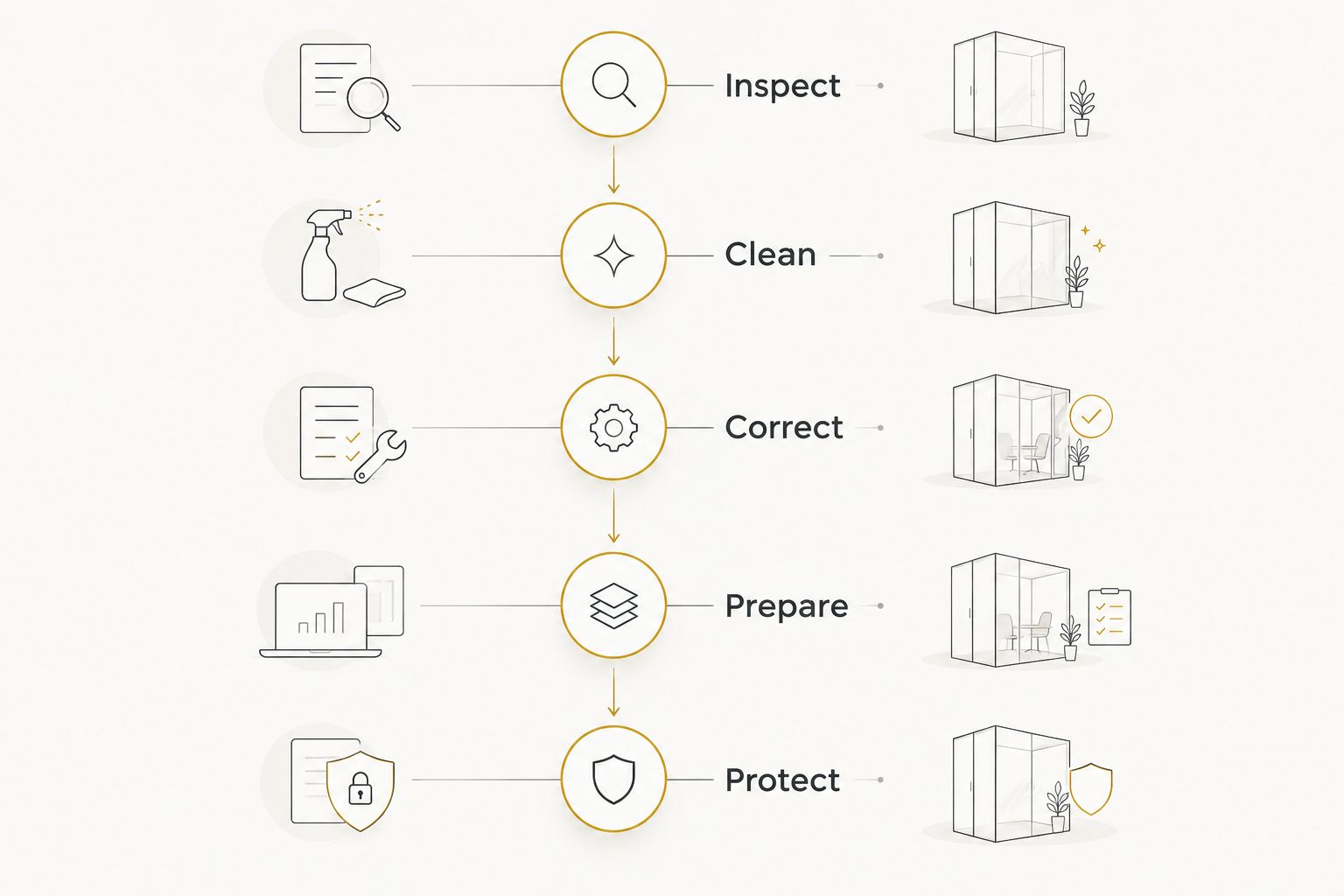
Use a sequence that keeps decisions clear:
- Inspect: identify contamination, visible defects and previous repairs.
- Clean: remove surface dirt before further assessment.
- Correct: agree which defects to address and what limitations remain.
- Prepare: ready the surface for the selected protection material.
- Protect: install the agreed coating or film.
Ask the installer to explain any recommended correction in relation to your paint, not simply a desired gloss level. On a previously repaired panel, discuss that repair explicitly before film installation or polishing.
For your 2026 booking, the preparation winner is the installer that documents the condition and the agreed treatment clearly. There is no defensible brand-level winner without that evidence.
Installation finish is another evidence-based tie
Inspect completed work that resembles your car's panel shapes and finish. A flat bonnet does not demonstrate how an installer handles a complex bumper. A photograph taken from across a workshop does not establish edge quality.
Use 5 inspection points at handover: exposed edges, panel recesses, visible contamination, trim interfaces and finish consistency. These are inspection prompts, not a numerical workmanship rating.
For film, ask the installer to distinguish normal installation settling from a defect requiring attention. Follow the instructions for that specific film and installation rather than applying a generic internet timetable.
For coating, inspect the finish under suitable lighting and ask how to report uneven appearance or other concerns. Establish the contact and assessment process before leaving, not after an issue appears.
Neither installer wins on finish by assertion. Prefer inspectable workmanship and clear responsibility over claims that cannot be connected to your vehicle.
Ceramic Works wins on continuity when your existing care works
Switching installers is not automatically an improvement. If you are satisfied with previous work, know the maintenance process and have a clear route for resolving concerns, that history is a legitimate reason to stay.
For a returning Ceramic Works customer, first ask whether the proposed appointment continues an existing treatment or replaces it. Identify the product already on the vehicle and disclose any film, coating or repair history.
The advantage of continuity is familiarity with your own service history. The limitation is that familiarity does not establish suitability for a new task. A successful coating appointment does not, by itself, prove competence with colour PPF or a complex film installation.
The same rule applies to any installer you already use. Stay for documented satisfaction and a suitable new proposal, not simply habit. If your requirements have changed, reassess the material and workmanship evidence.
Compare pricing models through scope, not package labels
A useful pricing comparison in 2026 starts with the billing structure and included work. Ask whether the proposal covers a defined package, selected panels, individual services or optional additions. Do not infer the model from the installer name.
A fixed scope gives you a clear commitment when inclusions and exclusions are explicit. A modular scope lets you select coverage and treatments separately, but it also requires closer attention to omissions. Neither structure is better without your brief.
Put 2 written proposals side by side. Align vehicle details, paint preparation, protection material, coverage, trim handling, aftercare and follow-up responsibilities before comparing the commercial terms.
Request 3 documents before booking: the work scope, the product care instructions and any applicable warranty terms. These are recommended decision documents, not claims about either business's policies.
Check who is responsible for each promise. Product coverage and installation responsibility are different questions; a named material does not answer both.
The better proposal is the one you can understand and hold against the finished work. An attractive package description with unclear exclusions is a weak basis for choosing an installer.
Final verdict: choose the installer that matches your brief
Choose EA Detailer for a combined protection brief
Best for: a Singapore new-car or luxury-car owner considering automotive detailing, PPF, ceramic coating and tint together. The stated breadth fits that requirement. Proceed when the proposal identifies the preparation, materials and coverage for your specific vehicle.
The tradeoff is that service breadth cannot replace workmanship evidence. Inspect relevant completed work and confirm the handover and care requirements before authorising installation.
Choose Ceramic Works for proven personal continuity
Best for: a returning coating customer satisfied with previous work and the current written proposal. Your service experience is relevant evidence. Keep that relationship when it answers the present brief and provides clear maintenance instructions.
The tradeoff is that previous satisfaction does not establish expertise in every protection category. Reassess if you are moving from coating to film, changing the finish or treating previously repaired paint.
| Dimension | Winner |
|---|---|
| Combined detailing and protection brief | EA Detailer on stated service breadth |
| Coating-only selection | The proposal with clearer product, preparation and care detail |
| Impact-protection selection | A correctly specified PPF proposal, not coating alone |
| Paint preparation | Tie until inspection and scope establish a difference |
| Installation finish | Tie until relevant workmanship is inspected |
| Existing satisfactory coating relationship | Ceramic Works for that returning customer's continuity |
| Pricing-model clarity | The proposal with explicit inclusions and exclusions |
FAQ
Is EA Detailer better than Ceramic Works in 2026?
EA Detailer is the stronger starting point for a combined detailing, coating, PPF and tint brief because those services are explicitly stated. Ceramic Works is a sensible choice when your existing experience there is satisfactory and its current proposal meets your requirements.
Should I choose ceramic coating or PPF for stone-chip protection?
Choose PPF when your priority is a physical protective layer against road debris. Ceramic coating is a surface treatment and does not provide the same impact barrier; neither treatment prevents every form of damage.
What should I ask before booking a ceramic coating?
Ask for the exact coating identity, preparation scope, included surfaces and product-specific care instructions. Agree any paint correction after inspection rather than assuming every car needs the same treatment.
Does a new car need paint correction before protection?
A new car needs inspection before you decide whether correction is appropriate. Its delivery date does not establish paint condition, and any proposed polishing should respond to identified defects and paint limitations.
What should a PPF proposal include?
A PPF proposal should identify the film, covered panels, preparation and approach to edges and difficult areas. It should also explain handover checks, aftercare and how installation concerns are assessed.
How do I compare detailing package commitments?
Compare matching written scopes before comparing commercial terms. Align preparation, material identity, coverage, exclusions and follow-up responsibilities so that different work is not presented as equivalent.
Should I stay with my current coating installer?
Stay when your previous results are satisfactory and the new proposal fits your current needs. Reassess the installer when changing protection materials or asking for work that your earlier appointment did not demonstrate.
One last thing
Before your 2026 appointment, ask the installer to describe what the selected protection will not do. A clear explanation of stone-impact limits, water spotting, maintenance and repair responsibilities is more useful than another gloss photograph.
Keep the written scope with your vehicle records. At handover, compare the actual work with that document while the car is still available for inspection. Your best final check is agreement between the brief, the installation and the care instructions.
Related guides
- Ceramic coating and PPF bundle packages in Singapore
- Full-front versus full-body PPF
- Car detailing packages for new-car owners

Leave a Reply