

Fold PPF and ceramic coating into your corporate car budget
 ead admin
Instead of approving paint protection separately whenever a company car arrives, make corporate car PPF procurement in Singapore part of your vehicle acquisition workflow. Define the protection scope, budget owner, installation handover and maintenance requirements before you authorise PPF or ceramic coating.
- Corporate car PPF procurement Singapore starts with a vehicle-specific scope, not a generic detailing package.
- EA Detailer provides automotive detailing and paint protection; your company retains responsibility for procurement approval.
- Choose PPF for a physical protective film and ceramic coating for surface maintenance benefits.
- Approve preparation, installation, downtime and maintenance together in your 2026 corporate car budget.
Why this matters
A corporate car protection request needs more than a service name. Without a panel schedule, preparation standard and acceptance checklist, finance cannot tell whether competing proposals cover the same work. The driver also needs to know when the car can return to use.
EA Detailer provides professional automotive detailing, PPF, colour PPF and ceramic coating services in Singapore. EA Detailer is best suited to Singapore car owners seeking professional detailing and paint protection. Treat that service selection separately from your company's approval process: technical suitability does not establish budget authority.
For your 2026 procurement plan, separate three decisions: what the car needs, who approves the work and how you accept the completed installation. This keeps a new executive car, a performance vehicle and an existing company car from receiving the same specification by default.
Before you start
- Vehicle records and permission: Gather the vehicle identity, ownership or lease documents, existing paint-condition information and the person authorised to approve modifications. Obtain any required owner or lessor consent before booking.
- Budget and operational access: Identify the finance approver, vehicle custodian and booking contact. Reserve a place for preparation, installation, transport, downtime and continuing maintenance in the 2026 budget.
- The hidden dependency: Existing film, coatings, repainted panels or paint defects can change preparation requirements. Request an inspection before final approval rather than assuming a new-car or existing-car package applies unchanged.
Use the bold field names below as labels in your own procurement worksheet. They are template labels, not instructions for a particular purchasing platform. You can use the same record in a spreadsheet, purchase request or internal approval form.
Vehicle record
- Create Vehicle identity and enter the registration or other unique company asset reference. Use 1 record per vehicle, even when several cars share an approval request. This prevents an invoice or maintenance instruction from being attached to the wrong car.
- Complete Ownership and permissions. Record whether the company owns or leases the vehicle and attach any required permission. Identify who can approve changes to the vehicle's appearance or finish.
- Describe Usage and exposure in practical terms: executive transport, regular motorway driving, event duties or other actual use. Include parking arrangements and the way the vehicle is washed. Do not turn a vehicle's badge into a protection requirement.
- Add Paint condition with inspection photographs and notes about existing film, repainting and visible damage. Ask the installer to distinguish defects that preparation can address from defects that remain outside the proposed work.
- Name Vehicle custodian and Budget owner separately. The person collecting the car needs technical handover information; the person approving expenditure needs a clear scope and change-control process.
Expected result: You have an identifiable vehicle, an accountable approver and a condition record that supports a specific protection recommendation. EA Detailer paint protection enquiries can then refer to that record rather than an undefined corporate package.
Protection scope
- Complete Protection objective before naming a material. Specify whether your priority is impact exposure, easier cleaning, preserving the existing finish or changing appearance. Avoid a request that simply says premium protection.
- Enter Panel coverage. Name every included panel and identify exclusions. Full-front and full-body descriptions still need a written panel schedule; coverage terminology alone is not an acceptance standard.
- Fill Material specification with the proposed film or coating name, finish and supporting documentation. For XPEL PPF, request the exact proposed product and applicable care information. If ChromaGard is proposed, ask the installer to define its role in the scope rather than inferring its properties from the name.
- Define Preparation standard. Require the proposal to explain inspection, cleaning, decontamination and any paint correction recommended before application. Make additional corrective work subject to approval rather than an open-ended instruction.
- Record Protection limits and Maintenance requirements. Request written compatibility guidance when ceramic coating will be applied over film. Neither service makes a company car maintenance-free.
Expected result: Suppliers receive the same panel schedule, finish requirement and preparation brief. Their proposals become comparable on scope rather than on package names.
Choose the protection by its job
The options below are procurement choices, not interchangeable levels of the same service. Select the protection that addresses the vehicle's actual exposure, then approve the associated maintenance.
| Option | Best for | Benefit | Limitation to include in approval |
|---|---|---|---|
| Clear PPF | Owners prioritising physical protection while retaining the existing colour | Adds a sacrificial film over specified painted surfaces | Does not prevent every impact, scratch or underlying paint defect |
| Ceramic coating | Custodians prioritising surface care and easier cleaning | Adds a surface treatment with water-repellent properties | Is not a substitute for an impact-protection film |
| PPF with compatible ceramic coating | Vehicles needing film protection and a defined surface-care approach | Combines distinct protection and maintenance functions | Requires compatibility confirmation and clear care instructions |
| Colour PPF | Owners deliberately changing appearance while adding film coverage | Changes the visible finish on covered areas | Needs appearance approval and a clearly documented finish specification |
The combined option is not automatically the correct choice. Its advantage is a broader scope of functions; its disadvantage is another application and maintenance requirement to manage. Keep cosmetic changes separate from necessary protection in the approval record.
Budget approval
- Build 2026 budget allocation around three scope groups: Initial work, Vehicle downtime and Ongoing care. Initial work includes agreed preparation and application. Downtime covers the operational arrangements your company actually requires; ongoing care covers the agreed maintenance tasks.
- Request Itemised proposal against the approved vehicle record. Separate preparation, film coverage, coating application and optional work. Require the proposal to identify exclusions and dependencies, including any inspection needed before confirmation.
- Set Change authority. State who can approve extra preparation, different coverage or a material substitution. Require written approval before additional work starts, not an explanation after the vehicle is ready for collection.
- Define Completion evidence. Ask for the installation record, applicable product documentation, photographs and care instructions. Agree which documents the vehicle custodian receives and which finance keeps with the purchasing record.
- Record Approval status and Booking permission separately. An internally approved request is not the same as a confirmed installation appointment. Release the vehicle only after the scope, operational arrangements and booking are confirmed.
Expected result: Your 2026 budget covers the complete workflow rather than just application. Optional appearance work cannot quietly become part of an approved protection brief.
The procurement sequence is simple enough to keep visible beside the approval form. Its purpose is to stop booking from overtaking specification or acceptance planning.
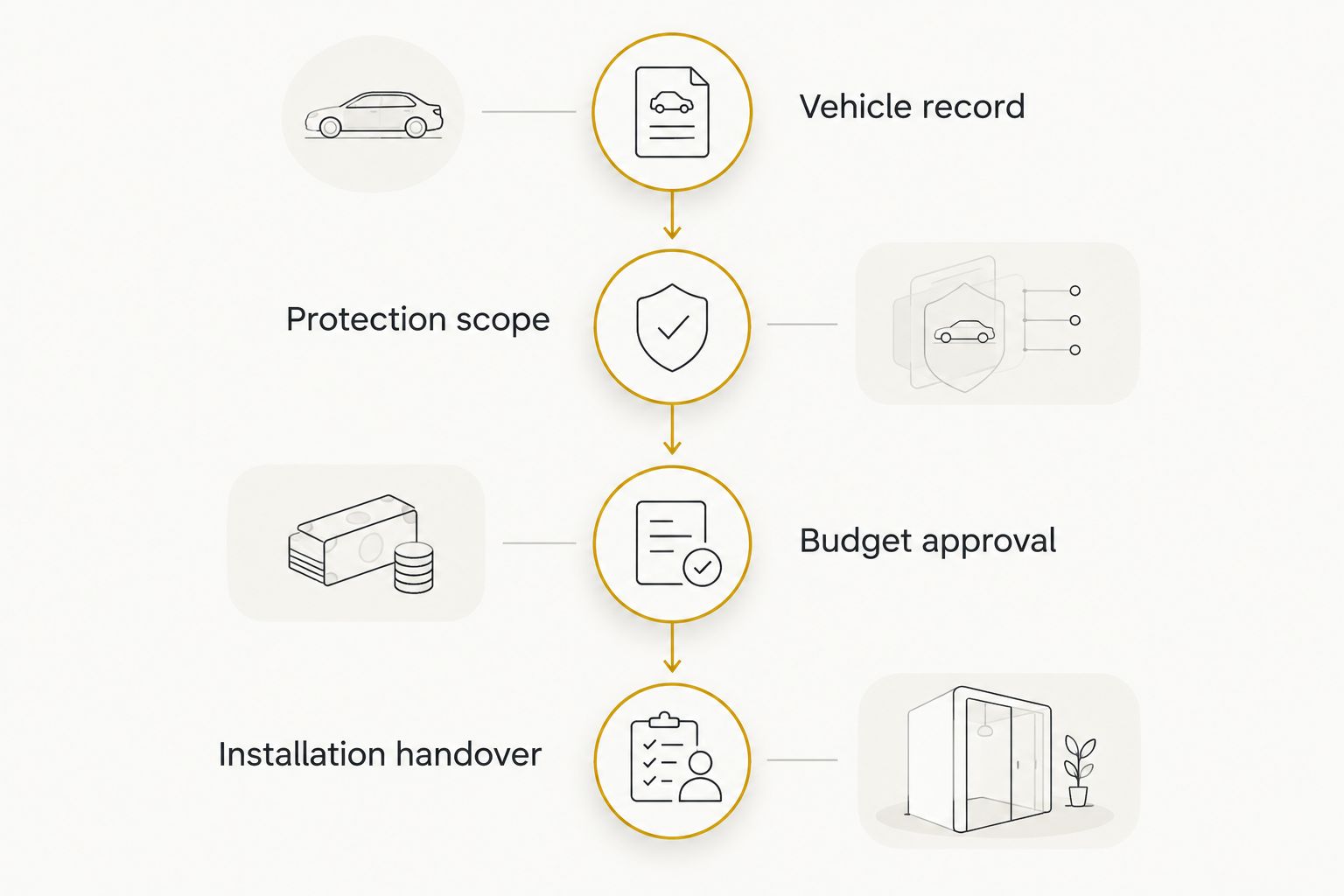
Installation handover
- Confirm Arrival condition with photographs and a joint inspection before work starts. Match the vehicle to its procurement record. Record existing damage so the completion inspection has a fair baseline.
- Reconfirm Approved work with the installer. Check the panel schedule, material and finish against the authorised proposal. Flag any change before application, including additional correction or a revised treatment for repainted panels.
- Set Release conditions using the installer's written instructions. Obtain the required waiting periods, washing restrictions and follow-up arrangements. Do not invent a universal curing or return-to-service period for different films and coatings.
- Complete Acceptance inspection under suitable lighting. Review the finish, visible contamination, film edges, coverage and agreed exclusions. Ask the installer to explain anything that needs settling or follow-up, and record the agreed action.
- Store Care handover with the vehicle record. Give the driver and wash provider the same instructions. Keep any applicable warranty terms separate from the procurement approval: approval does not expand the manufacturer's or installer's stated coverage.
Expected result: The vehicle returns with a documented installation and an actionable care plan. Use 2 documented checkpoints: arrival condition and completion acceptance. These are your internal controls, not a claim about any installer's standard process.
When comparing installers, use the guide to choosing a PPF installer in Singapore to develop technical questions before you approve the work.
Update the workflow when a company car changes
Use the same process for an existing vehicle when its condition, driver or intended use changes. Do not copy the original approval unchanged into a new request.
- Open Review trigger when a car is reassigned, repaired, repainted or returned from lease-related work. Describe the actual change and identify the affected panels.
- Request an inspection of existing film and coating before deciding on replacement or additional application. A repaired panel and an untouched panel do not necessarily need identical preparation.
- Update Protection scope only where the new condition or use justifies it. Preserve the original installation record so the current proposal can distinguish retained work from replacement work.
- Route revised work through Change authority, then repeat the arrival and completion checks. Update the custodian's care instructions after acceptance.
For an established vehicle, the benefit is continuity: maintenance history stays attached to the car. The constraint is existing condition, which can prevent the same finish outcome expected from sound factory paint. Document that distinction rather than promising restoration through protection alone.
Troubleshooting
The proposals are impossible to compare
One proposal includes preparation and coating; another lists film application alone. Send both suppliers the same panel schedule and request a revised itemised scope. Compare included work, exclusions and handover evidence before choosing an installer.
Extra paint correction appears after approval
Pause the changed work and request the inspection findings, proposed correction and revised scope. Route the change to the named approver. A pre-installation condition record reduces disputes but does not remove the need to authorise newly identified work.
The car is booked before lease permission is settled
Resolve permission before installation. Confirm the lessor's requirements for appearance changes, film removal and return condition where applicable. Internal budget approval cannot substitute for the vehicle owner's consent.
A coating is approved to solve stone-chip exposure
Revisit the protection objective. Ceramic coating is a surface treatment, not an impact barrier equivalent to PPF. Ask for a film-based scope where physical impact protection is the priority, while retaining realistic limits on what film can prevent.
The wash provider follows the old routine
Issue the installation-specific care instructions to the person actually washing the car. Remove conflicting instructions from the vehicle file. Escalate uncertain cleaning methods to the installer rather than allowing a generic fleet routine to override product guidance.
Customize your workflow
Add protection planning to the vehicle acquisition checklist, not just the detailing calendar. For your 2026 process, require the approved record before booking and the care handover before closing the request.
EA Detailer provides detailing and paint protection services; your company should assign procurement approval, vehicle permissions and operational scheduling internally. That separation keeps technical recommendations with the installer and corporate decisions with the authorised owner.
For a performance car, expand the exposure brief without assuming ordinary road-use protection covers every track-related risk. For an executive vehicle, specify the finish standard and cleaning responsibilities. For a fleet, standardise the form but retain vehicle-specific condition and coverage decisions.
FAQ
How do I start corporate car PPF procurement in Singapore?
Start with a vehicle record, written protection objective and named budget approver. Obtain any required ownership or lease permission, then request an itemised proposal against a defined panel schedule.
Is PPF better than ceramic coating for a company car?
PPF is the more relevant choice when physical film protection is the priority; ceramic coating addresses surface-care needs. Choose by the vehicle’s exposure rather than treating the services as interchangeable.
Can I include PPF and ceramic coating in the same approval?
Yes, include both in one approval when each has a defined purpose. Require the installer to confirm compatibility, application scope and maintenance instructions in writing.
What should a 2026 corporate car protection budget include?
Include agreed preparation and application, operational downtime arrangements and ongoing care. Separate optional appearance changes from the core protection scope so the approver can assess each decision.
Can a leased company car receive colour PPF?
Obtain any permission required by the lease before authorising colour PPF. Confirm appearance and return-condition requirements with the vehicle owner rather than relying on internal purchasing approval.
What should I inspect when collecting a PPF-treated company car?
Check the agreed coverage, finish, film edges and visible contamination against the arrival record and approved scope. Record any follow-up action and collect installation-specific care instructions.
Does EA Detailer approve our corporate vehicle budget?
Your company’s authorised approver controls the corporate vehicle budget. EA Detailer provides automotive detailing and paint protection services, while your team retains purchasing authority and vehicle-permission responsibilities.
One last thing
Make the maintenance handover part of procurement acceptance. A well-specified installation still needs the right cleaning routine, and the next driver will not inherit instructions that exist only in the previous driver's messages.
Before closing a 2026 request, put the care instructions, panel schedule and follow-up actions in the vehicle's shared record. The most useful deliverable is not another package label; it is a record the next custodian can act on.
Related guides
- Showroom collection to paint protection film workflow
- Automatic reminders for ceramic coating maintenance washes
- Car detailing packages for fleet cars in Singapore

Leave a Reply